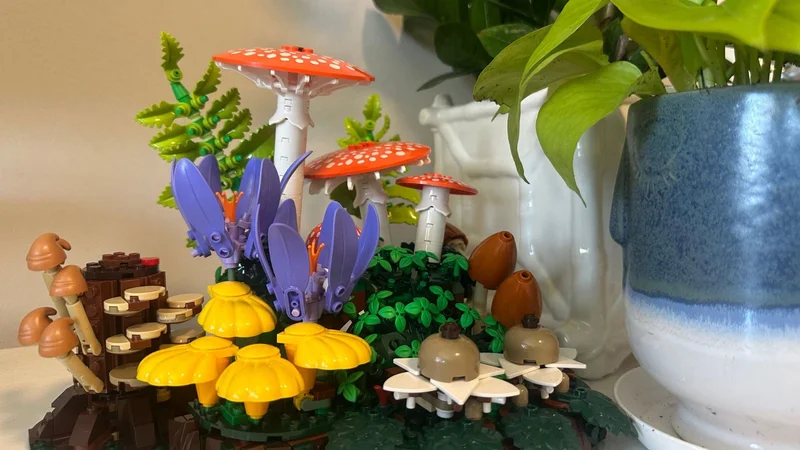
The LEGO Woodlands Mushrooms set is the first time the wildly popular Botanical collection has gone all in on a fungal theme. In my mind, it does the vibe justice, making for one of the most aesthetically pleasing sets I’ve ever built. It’s also got plenty of variety throughout the building process, so long as you have some patience and delicate fingers.
The set comes with 806 pieces and currently retails for $79.99, putting it slightly under 10 cents per brick, which is roughly the standard price for non-licensed sets in LEGO world.
Those pieces come in seven bags, with the exception of a single, particularly large flat piece. I almost thought this one ‘raw’ piece was an accident, but the instruction booklet quickly acknowledges it.
As per LEGO tradition, the instruction booklet includes some entertaining information about the build. In this case, it outlines the specific flowers and fungi you’ll be building: the autumn crocus, bracken, common bonnet, oyster mushroom, golden chanterelle, fly agaric, marzipan fibrecap, and collared earthstar. I recognized at least some of those names from Stardew Valley.
The building process starts with your good ol’ foundation. The foundation is thin enough that you don’t get to deal with any colorful layers hidden away. Instead, you start with brown blocks before moving to a layer of green on top, building your own section of the forest floor. It also isn’t completely flat – you quickly build up several elevated platforms.
The first true fungi you build are known as fly agaric mushrooms, featuring the classic red and white-spotted caps. I personally associated this section of the build with the huge mushrooms you can find in Minecraft's dark forest biomes.
The mushrooms themselves are relatively simple to build and have been seen in other LEGO sets (I recently built smaller versions as part of LEGO Willy Wonka), but instead of standing upright, they get slotted into small tube pieces at various angles. I couldn’t get any of those angles to look quite right, but the point is likely to embrace the whimsy.
From there, you build each section of mushrooms and flowers in sequence from right to left, slowly filling in your foundation with small sections of each individual mushroom and flower. You also place tiny little green leaves along the foundation, which is one of the more tedious stages of the building process, but ultimately creates a moss-like look to the forest floor.
I’ll give plenty of credit to the color choices across the set; they make each type of fungi recognizable while staying cohesive. It’s a very pleasing mix of vibrant purple, yellow, and red alongside more neutral shades of brown and green.
I also enjoyed that very few elements are symmetrical. You can’t necessarily expect what comes next, creating a more dynamic process compared to other builds that essentially just have you following the same steps twice.
The downside? You need a delicate hand for some of the smaller details. The foundation quickly gets very, very cramped, making it finicky to lock in new pieces or sections.
In exchange, however, you get beautifully developed layers, and the sense that the build is truly ‘full.’ The lack of symmetry makes it all look quite organic, too, as if you’d truly picked up a section of a forest floor.
The final step of the build actually has you return to that first section of red mushrooms, placing one final particularly big mushroom above the pack, which offers a pleasant sense of ‘bookending’ the building process. The full thing took me a couple of hours to build, making it a great activity for an evening after work or school.
Now, I will let you know that despite how layered and dynamic the build is, it doesn’t hold up from the back. It’s definitely intended to be displayed at specific angles, which means you kind of need a display plan. If you find a good spot, this set stacks up as one of the best-looking LEGO sets I've ever built.
All in all, LEGO has achieved a fantastic level of detail with the Woodland Mushrooms set, even compared to the rest of the Botanical collection. I have to admit I'm excited to see what other flora and fungi they adapt into plastic brick form next.
*Blythe (she/her) is an Audience Development Coordinator at IGN who spends way too much time in character customization screens and tracking down collectibles. *