Commentary: Fast-tracking of former public servants into Cabinet shows PM Wong has limited cards to play
Diversity is important and the Cabinet will benefit from members drawn from different backgrounds, but the prime minister’s hands were in effect tied, says veteran newspaper editor Han Fook Kwang.
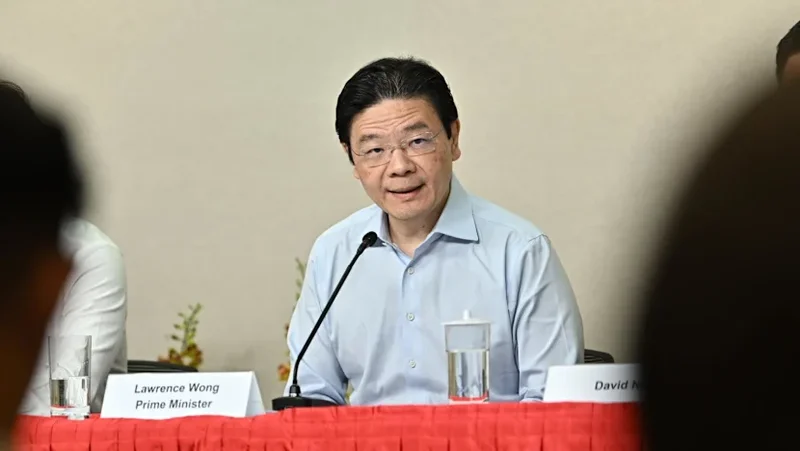
SINGAPORE: The Cabinet changes that Prime Minister Lawrence Wong announced last week revealed a stark reality facing Singapore: The choices were limited from the numbers available to him.
He had too few cards to play and it showed in the way first-term Members of Parliament have been fast-tracked into political office.
The new line-up featured the promotions of six parliamentarians who had spent most of their careers in the civil service or the miliary and who were elected for the first time in the General Election (GE) last year. Among these, Mr Jeffrey Siow and Mr David Neo were made full ministers while Ms Jasmin Lau was appointed acting minister.
Mr Wong inherited the problem which stemmed from the last two GEs, in 2015 and 2020, when the pipeline for minister-calibre material slowed down considerably leading to the situation today.
WHAT HAPPENED THEN?
Of the 22 new candidates fielded by the People’s Action Party (PAP) in GE 2015, only three are now serving as ministers: Mr Ong Ye Kung, Mr Chee Hong Tat and Mr Ng Chee Meng.
It was more barren in GE 2020 when out of 27 new PAP candidates, only Dr Tan See Leng is now minister.
If we combine the two most recent cohorts from GE 2020 and GE 2025, we have four who have become ministers so far.
Contrast this with the list of former ministers who left politics over these two GEs: Mr Goh Chok Tong, Mr Khaw Boon Wan, Mr Lim Hng Kiang, Mr Lim Swee Say, Assoc Prof Yaacob Ibrahim, Mr Teo Chee Hean, Mr Heng Swee Keat, Dr Ng Eng Hen and Mr Maliki Osman.
Nine veterans who collectively had more than 100 years of experience in government, replaced by four new ministers whose combined years in office can be counted on two hands, more or less.
It is a major problem that requires urgent action. Without a sufficient number of top quality people to fill leadership positions, the exceptional performance that has made Singapore what it is today will be at risk.
These are the pertinent numbers: Assuming a typical minister serves four terms in office or 20 years, and with 21 in the Cabinet today, it will require five minister-level candidates at every GE for self-renewal of the Cabinet to take place, or 10 every two GEs.
The actual number over the last two GEs is fewer than half the number required.
Hence, the limited options for Mr Wong to choose from this round. It will be the same the next time, and the next, if nothing is done to address the issue.
WHAT NEEDS TO HAPPEN?
It isn’t a new problem and the reasons are by now well known: Politics is not for everyone and can often be a thankless job.
You are under constant public scrutiny in social media and a 24-hour news cycle and need a thick skin to not allow all of this to affect your personal and family life. It is an uncertain vocation, even in Singapore where elections are now more competitive and the public mood can shift unpredictably.
None of this is unique to Singapore. In fact, politicians elsewhere face even more challenges, with more aggressive media and combative opposition politics.
The reality though is that there are many more attractive options for capable people in the private sector in Singapore, with jobs that are personally more interesting and rewarding, especially financially.
It is not surprising therefore that the three promoted this round came from the public service with not a single candidate from the private sector deemed suitable.
HOW TO ATTRACT PRIVATE SECTOR TALENT
I don’t think Mr Wong was unaware that a ministerial pool drawn exclusively from the public service can present problems. Diversity is important and the Cabinet will benefit from members drawn from different backgrounds, offering fresh perspectives from their own experiences.
You will not get the same breadth and depth in Cabinet discussions if almost everyone was an ex-civil servant or military person.
Mr Wong’s hands were in effect tied.
How to get more from the private sector interested in politics?
There are two issues that need to be addressed.
First, the ruling party needs to change its narrative about politics. Stop making it an almost impossible vocation that mere mortals are incapable of achieving.
In the old days it was said to be a priesthood, whiter than white, and that without these leaders Singapore would collapse.
The country did exceptionally well during that period and the men and women of that founding generation were indeed outstanding.
But the circumstances that produced them were unique and the world and Singapore have changed irrevocably.
A more down-to-earth sense of what the job entails has to come to terms with these changes, one that is more realistic about who you want to attract.
There are two aspects of a minister’s job: One is technical competence, having the ability to solve national problems and to provide leadership for ministries and their agencies.
The second is political, which in a democratic society means being a representative of the people who elected you.
It means being able to identify with them, to understand their needs and serve them, and be able to communicate and persuade them to your cause.
This is not easy and much depends on your character and temperament and your sense of public duty and stewardship.
This aspect of the job does not require a superhuman. In fact you should be as human as possible, acting with humility and empathy, not arrogance and high-mindedness.
You can be the most brilliant person and technically capable but if you do not have what it takes to do this representative part of the job well and are motivated by other things, the job is not for you.
In fact such a person might do untold damage to the people and the country. It isn’t easy to find someone who has both skill sets: technical ability and a strong sense of public duty.
THE THORNY ISSUE OF REMUNERATION
Which brings me to the second issue and that is how to remunerate such a person.
What is important is to ensure that pay is not a barrier to anyone with the right qualities.
Having found the right person for the job, those with the head and heart for it, how to ensure he or she, particularly those from the private sector, is fairly compensated?
It is a subject that has had a troubling political history starting with the decision in 1994 to introduce a formula pegging these salaries to top earners in the country.
Ever since the formula was revised in 2012, the salaries of ministers and the prime minister have not changed, fixed at S$1.1 million for an entry-level minister and S$2.2 million for the prime minister.
That is 14 years without any revision and without any substantial discussion on the issue.
Is it fair compensation, by the standards mentioned above?
Will it discourage private sector individuals with the required ability to enter politics and into the public limelight?
That is the million-dollar question but you cannot escape the reality that with the present level of remuneration, frozen since 2012, there has not been a single minister appointed from the private sector except for Dr Tan.
Whatever your views about whether the amount is too high or too low, it is time for a robust debate on the issue.
If Singapore is to continue having exceptional political leaders drawn from all sectors of the economy, every stone should be turned to see what else needs to be done.
The worst outcome is to be paralysed into inaction for fear of adverse public reaction.
Han Fook Kwang was a veteran newspaper editor and is Senior Fellow at the S Rajaratnam School of International Studies, Nanyang Technological University.