- See more Daily Mail on Google - save us as a Preferred Source
When Andy Burnham ascends the No 10 staircase to the flat above, he finds the portraits of his predecessors looking down on him.
Some, like Margaret Thatcher, will provoke a shudder in his socialist soul. He will gaze at others, like the Labour reformer Clem Attlee, and wonder if he too will one day claim a great radical legacy.
But there is one figure, above all, who should give him cause to stop and reflect on what it is to be genuinely progressive – to be a proper liberator of working people.
William Gladstone was the greatest prime minister of the Victorian Age. He introduced free education; gave votes, at last, to the labouring classes; and established trade-union rights. He even had his own version of No 10 North, his base in Hawarden, in north Wales, from where he developed his vision for greater devolution.
In 1879, Gladstone gave one of his most famous speeches. In the course of his oration he invoked Pericles, Virgil and Dryden. He discussed the merits of the Austro-Hungarian foreign minister Andrassy’s strategy for religious reform in the Balkans and how the Treaty of San Stefano affected peace there. In the same address, Gladstone enumerated the advantages of Free Trade, discussed the folly of land reform and the break up of great estates as a remedy for agricultural distress.
He then went onto argue that wealth creators should be free from every unjust and unnecessary legislative restraint.
That masterpiece of oratory was not, however, given in the House of Commons or addressed to a rarefied audience of academics in an ivory tower. Gladstone was speaking to a crowd of agricultural labourers and coal miners in the central belt of Scotland. And he held them spellbound for more than four hours.
By way of contrast, Andy Burnham took to TikTok last week for three minutes to discuss the relative merits of pork scratchings and scampi fries with his Chancellor of the Exchequer. Which Prime Minister, one might ask, showed greater faith in working people?
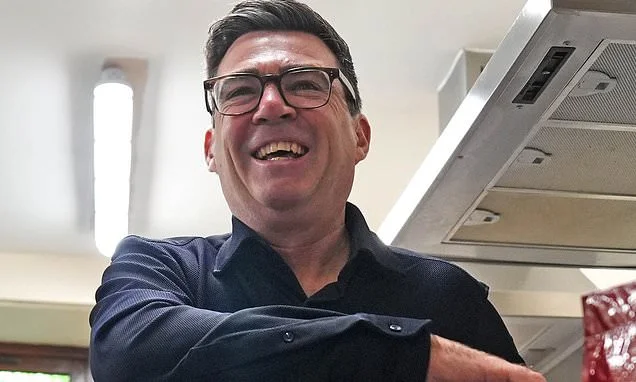
Andy Burnham took to TikTok last week for three minutes to discuss the relative merits of pork scratchings and scampi fries with his Chancellor of the Exchequer
In one of his most famous speeches in 1879, Gladstone enumerated the advantages of Free Trade, and discussed the folly of land reform. He then went onto argue that wealth creators should be free from every unjust and unnecessary legislative restraint
The problem at the heart of Burnham’s Labour, so far as we have seen him attempt to govern so far, is not the scale of its progressive goals, but the poverty of its ambition. The Burnham vision for working people is not to raise their sights to a more spacious, elevated and aspirational future but to settle for knowing their place.
We have seen it already not just in his communications style, but in the outline of his emerging policy agenda.
He has favoured social media posts with ‘influencers’ like Bus Aunty to signpost his commitment to lower fares, or knowing tweets about his T-shirts to signal relatability, instead of developing detailed intellectual arguments – tested, costed and rooted in data – to underpin his announcements.
Those announcements, insofar as they are developed, have also been cast in terms designed to roll back what Burnham sees as 40 years of failed ‘neoliberalism’ but which many others might consider times during which working people saw their opportunities expanded.
Take housing. One of the greatest achievements of Margaret Thatcher’s premiership, a period Burnham holds up as an era of failure where the dreaded march of neoliberalism laid the country waste, was the massive expansion of home ownership.
New homes were built and, crucially, council houses were offered for sale to their tenants. Millions benefited from the security and pride which comes from having a place of your own. Home ownership makes it easier to raise a family, weather the storms of life and hand on to your children an asset earned by your own hard work.
But for Burnham, the sale of council houses was the erosion of the state socialism he romanticises and wants to rehabilitate. He has indeed talked of building more homes. But his sole focus has been on building more council houses. He wants to recreate the council estates of the past, not help more on to the property ladder.
As a former housing secretary, I certainly agree we need more affordable homes for rent, but we need more homes of every kind, especially beautiful new homes for those currently locked out of property ownership.
The problem at the heart of Burnham’s Labour, so far as we have seen him attempt to govern so far, is not the scale of its progressive goals, but the poverty of its ambition, writes Michael Gove
But helping people to acquire their own home is nowhere in the Burnham agenda. Working people should – once again – be satisfied with a council house, with the public sector owning their family home. They should know their place.
It’s the same, even more sadly, in education. One of the rare cross-party successes of recent decades has been the improvement in our state schools. Starting under Ken Baker in 1988 – when ‘neoliberalism’ was just getting into its stride – there has been a steady focus on the policies which give children a brighter start in life.
More freedom for heads to run schools independent of municipal socialist control. A stretching curriculum. Regular testing. Rigorous exams. Tough inspections. Giving more and more pupils the sort of education that used to be available only to the rich or the lucky few who made it to grammar school.
Tony Blair, whatever his other sins, built on these successes. He set up academy schools outside council control and appointed tough chief inspectors like the late Chris Woodhead to drive up standards. When I was education secretary under the Coalition government we accelerated that drive, with a majority of schools becoming academies. We set up new ‘free schools’ and they are now among the most successful educational establishments in the world.
Schools such as Katharine Birbalsingh’s Michaela in Wembley Park or Mercia Academy in Sheffield give children from disadvantaged and working-class backgrounds stunning GCSE results – which open up the prospect of university study to students from every home.
More than half of Mercia’s pupils go to one of our top 30 universities. Fewer than 3 per cent of their students – and they come from some of the poorest neighbourhoods in Sheffield – end up ‘Neet’, not in education, employment or training.
We also made exams tougher – and demanded mastery of the basics – with tests for spelling, punctuation and grammar and a wider range of knowledge in the curriculum.
The result has been that England now has the best state schools in the Western world, according to international comparisons. Our students outperform other countries in literacy, numeracy and science. By contrast, in Scotland and Wales, where students are just as bright but our reforms were never introduced, educational performance has crashed, with those nations tumbling behind our competitors.
Now Burnham and his Education Secretary Lucy Powell want to turn back the clock on that progress. They want more municipal control of education – an end to ‘neoliberalism’ – even though freeing schools from council control has improved outcomes, especially for the poorest, who were once stuck in sink schools.
Powell has criticised the spelling, punctuation and grammar tests which have improved literacy outcomes and which are the building blocks of fluency and creativity. And she has even promised to reverse what she considers an ‘over-focus’ on academic outcomes which she thinks alienates children from more disadvantaged backgrounds. In other words – working-class children should know their place and not aspire to excellence – that would be getting above themselves.
They’ll be expecting to go to uni next and buy a house – and then where would we be…
Well, following exactly the route which Burnham and Powell took, actually. Burnham is, although he does his best to disguise it, a deeply cultured, literate and highly educated Cambridge graduate. He has read every Shakespeare play, is devoted to George Eliot’s 900-page masterpiece of Victorian social realism, Middlemarch, and can talk bewitchingly about poetry from Chaucer to Larkin.
But his Government is now saying the ‘over-focus’ on academic outcomes which opens up the best that has been thought and written to all must end. Working-class kids don’t aspire to academic excellence. Do as I say, not as I do.
Powell, too is, in person, a fearsomely bright and articulate politician. She is engaging, warm, witty and sharp. As Robert Hardman reported in these pages last week, she was one of a number of students from an outstanding sixth-form college in Manchester who won a place at Oxbridge.
But she now damns her time at Oxford in the 1990s – saying her college, Somerville, was ‘stuffy’ and she felt like a ‘fish out of water’ as a state school pupil there. That would have come as something of a surprise to another state school girl who studied chemistry at Somerville in the 1940s – Margaret Thatcher.
And anyone who remembers Oxford University in the 1990s – with state school presidents of the Union and the Labour Club dominating student politics –would hardly consider it a model of the early chapters of Brideshead Revisited. Again, Powell is signalling to aspirational working-class children that they should not try to get above themselves by thinking they’ve as much right to be at the top table as anyone else. They’ll only be a fish out of water.
Powell and Burnham have both recently reinforced the idea that the aspiration they appear to embody is not a path to emulate – Burnham by saying that he felt ‘imposter syndrome’ at Cambridge and arguing the job market for even top graduates like him was rigged in favour of the privileged. So, by implication, working-class kids shouldn’t even try to compete in those environments. And Powell by saying that her ideal job was working at TopShop – not immersing herself in the study of complex inorganic structures at college. The message from both is, again: working-class kids, stay in your lane.
Trivial as it may be, even the clothing choices of Team Burnham are subtly and not so subtly designed as a rejection of the idea of the aspirational – what the French call ‘epater le bourgeoisie’.
Burnham’s ubiquitous T-shirts – even worn when meeting President Zelensky – are not so much relatable dad chic as a determined eschewal of the whole notion of suited and booted upward mobility. Put on a tie? That would mean joining the boss class – not for the likes of us.
There is everything to be said for pride in working Britain – its traditions, solidarity and sentiments. It was working-class voters who saw through the dangers of appeasement in the 1930s and delivered the Brexit liberation in 2016. Many working-class communities have been overlooked and undervalued, their principal economic engines hollowed out by globalisation. Burnham is not wrong to want greater respect for working Britain – and if Labour pays more attention to working-class communities on questions like gender, crime and migration on his watch, there will be cause to cheer.
But alongside respect for those sentiments, there should also be equal value placed on the working-class tradition of aspiration, improvement and ambition.
My mum and dad both left school at 15 and were Labour voters – but they were also Brexit-supporting, home-owning believers in the liberating power of education – voracious readers who encouraged their children to devote themselves to learning and hard work.
In the academic Jonathan Rose’s magnificent study, The Intellectual Life Of The Working Classes, he charts how, from the time of Gladstone onwards, the universal experience of working-class communities was a commitment to self-improvement with weavers propping up classics on their looms to read at work and miners borrowing works of philosophy and history from their local lending library to inform their debates with workmates.
Maybe, this summer, the private, scholarly, Burnham could read Rose’s great work, perhaps alongside a biography of Gladstone, and indeed my colleague Charles Moore’s superlative life of Margaret Thatcher, and come to reflect on the fact that working people are not served by the soft bigotry of low expectations but liberated by higher standards, expectations of excellence and the ambition to learn, earn and own.
Perhaps he can be persuaded that communicating with people in 90-second social media reels is not greater accountability but a surrender to the lowering tendencies of the attention economy.
And, though this may be too much to hope, he will enrich his future speeches with the Shakespearean knowledge, critical wisdom and deep humane learning he acquired.
Andy Burnham has achieved his long-term ambition by becoming Prime Minister. Now it is up to him to make ambition – raising it, praising it, extending it – the defining mission for his premiership.