January 13,1984: I was 16, and it was the first football match I had watched with my own eyes rather than through the grain of a Doordarshan transmission. My father and I were among the 80,000 football fans crowded into Eden Gardens, for a Nehru Cup encounter between an unfancied India and mighty Argentina.
A video clip of that game resurfaced on YouTube a couple of weeks ago and refreshed three of my lasting memories of the game. The first is of disappointment: Diego Maradona, already reckoned to be the best player of his generation, had stayed home. But the Argentines were not lacking in quality. Carlos Bilardo was in the dugout, and his team that evening included Nery Pumpido, Oscar Garré, Ricardo Giusti and Jorge Burruchaga, all of whom would be World Cup winners in Mexico two years later.
The Indian team may have lacked players of that class, but it had a coach of genuine international pedigree: Milovan Ćirić of Yugoslavia (as it was then) who had managed Lazio and Valencia.
The second memory is of euphoria: it was a fantastic game, and by any measure other than the scoreline, one best an Indian football team has ever played. Hopelessly outgunned in attack, Ćirić’s men nonetheless defended magnificently for 79 minutes before Ricardo Gareca scored. India lost 0-1, but not one of the 80,000 went home unhappy.
And now for the third memory: The kit. The Indian team were in saffron shirts, white shorts and green socks. This was a striking departure from the light blue, which had long been the standard of Indian sporting teams, and which I had always regarded a feeble sort of colour – apologetic, provisional, the shade of the paint used for the walls of government hospitals.
I am not the only one who remembers the tricolor kit. Shabbir Ali, who played up front that evening, credits the change to Ćirić. Alas, the strip didn’t stick: A year later, the coach was gone, and the team returned to the hospital-wall hue.
Which brings me, unwillingly, to hockey.
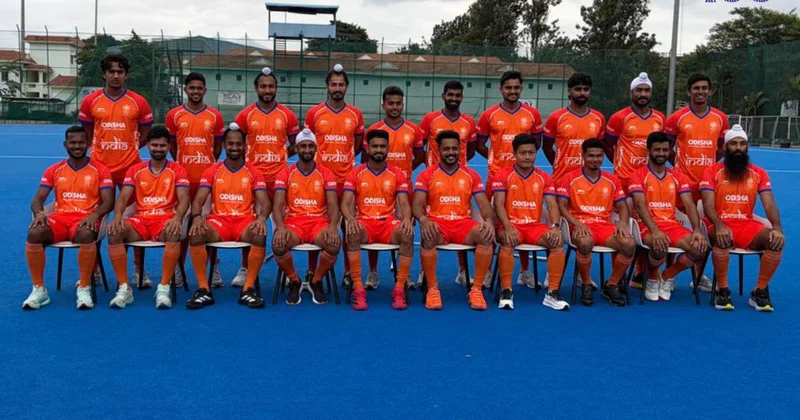
Early this week, Hockey India unveiled the new jersey that both the men’s and women’s teams will wear at the World Cup in Belgium and the Netherlands next month. It is an all-saffron kit; you’d have to strain your eyes to catch the navy trim and tricolour piping.
In most countries, this would be a matter for the design pages, but saffron in India is no longer merely a colour. It is the signature of the Bharatiya Janata Party, of the Rashtriya Swayamsevak Sangh and of the Hindu-nationalist project the two have carried into every institution they have reached. Dressing the national team in it cloaks the two hockey squads in a shade freighted with politics and sectarianism.
The blowback was not long in coming. Within 48 hours Viren Rasquinha, a former India hockey captain, had posted on X that the change was “embarrassing”. Pargat Singh, another ex-skipper who is now a Congress MLA, told ANI he wanted the BJP to “at least spare sports” such politicisation. Priyanka Gandhi Vadra of the Congress dismissed the choice of colour as yet another attempt to divide Indians.
Only then, three days after the announcement, did the hockey federation deign to explain itself. The change, it said, was technical. Modern hockey is played on blue turf, and a blue shirt can blur into that background. It was the players and coaches who had asked for something more visible.
But here’s the thing: the players actually proposed two colours: yellow or saffron. Both solve the problem of contrast; yellow arguably does it better, which is presumably why India wore yellow at the 2014 World Cup, a precedent Hockey India itself cites.
So the tie between the two choices was broken on other grounds. The federation claims that something else was symbolism – saffron stands for courage, sacrifice. Oh, and it is one of the colours on the national flag.
Nice try. The committee responsible for making the choice cannot have been unaware of what it was choosing. Or at least how the choice would be interpreted – as an endorsement of a religio-political movement that excludes large sections of the population.
There was a third option, which nobody seems to have considered, and which I watched India wear at Eden Gardens in 1984. Saffron shirt, white shorts, green socks – and, to finish the job, the names and numbers printed in the navy of the Ashoka Chakra. That strip contrasts with blue turf, and it carries the whole flag rather than a third of it. And it is hard to attack on political grounds, because a team carrying the tricolour in full is no party banner.
Now, with your indulgence, a short detour into the antecedents of that hospital-blue tradition. I have never understood why Indian teams wear it, and the standard explanation – that blue is the colour of the Ashoka Chakra on the Indian flag – doesn’t hold up to the most perfunctory examination. The chakra is navy and the shirts have mostly been sky, and the explanation has the feel of something worked out later to justify a choice nobody could account for at the time.
The likelier origin is less flattering. The crest of the Board of Control for Cricket in India is lifted more or less directly from the star of the Order of the Star of India, the knighthood the British Crown created after 1857 to bind loyal princes to itself.
India’s sporting colour, in other words, is a hand-me-down from the Raj, worn for so long that habit is mistaken for heritage. In 2017 an information commissioner formally asked the prime minister’s office why the national team still plays under a colonial decoration rather than something Indian. He did not receive much of an answer.
So I, for one, am glad to see the back of the hospital-wall blue. What I cannot follow is why, having finally decided to leave it, Hockey India reached for a third of the flag when the whole thing was available.
Bobby Ghosh is a columnist who writes about food, football and foreign affairs — not necessarily in that order. Read his work at Ghoshworld on Substack.
We welcome your comments at letters@scroll.in.