More students can take mother tongue language elective programme from 2027
AI generated
SINGAPORE - More students can deepen their study of mother tongue languages from 2027 as the Education Ministry expands the Language Elective Programme at both the secondary and junior college levels.
The Chinese Language Elective Programme at junior college level will be expanded to a sixth school, Anderson Serangoon JC.
The Tamil Language Elective Programme at both secondary and junior college levels will be expanded to the Umar Pulavar Tamil Language Centre.
Students from schools that do not offer the Tamil language elective programme can take it up at the centre. It also organises cultural programmes and showcases Indian performing arts.
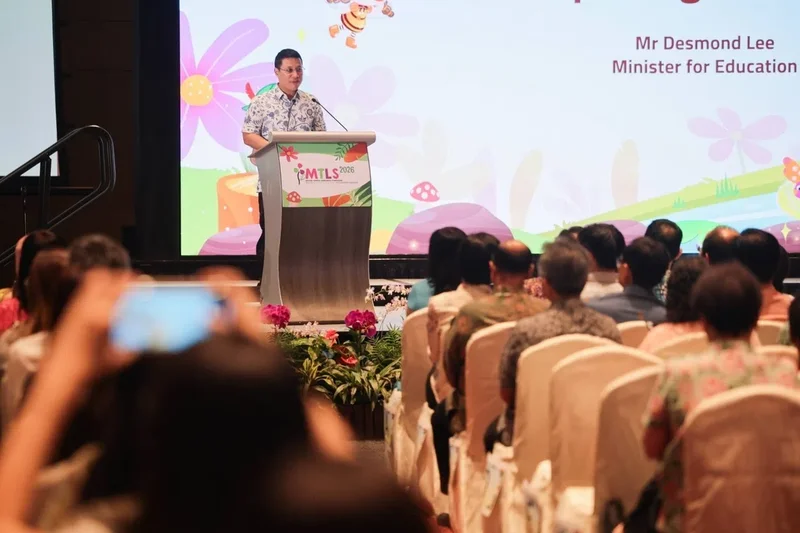
Education Minister Desmond Lee announced these changes at the Mother Tongue Languages Symposium 2026, held at the Singapore EXPO on Aug 1. The event is held every two years.
To provide more students with exposure to Malay language and culture, those who wish to learn Malay as a third language can look forward to the expansion of the Malay (Special Programme) to a fifth centre at National Junior College.
The four-year Malay (Special Programme) is currently offered at 12 secondary schools and four ‘centres’ – the MOE Language Centre (Bishan), Bukit Batok Secondary School, Tampines Secondary School, and Zhonghua Secondary School. Students whose schools do not offer the programme will attend lessons at the centre nearest to their school.
This will allow those whose mother tongue is not Malay to learn the language and build an understanding of the socio-cultural aspects of the Malay community in Singapore and the region, said MOE on Aug 1.
Addressing parents and educators at the event, Lee said home exposure to mother tongue has become more challenging as fewer families use it predominantly as the main language at home.
Lee said it was encouraging many Singaporean families continue to use both English and their mother tongue.
He said: “Raising a bilingual child in an English-dominated environment is not easy at all. Some parents worry that their own mother tongue is not strong enough for them to model the language to their children.
“But we do not need to be perfect speakers.... What matters is effort and consistency.”
He encouraged parents to start small — reading a picture book at bedtime, talking about their day in mother tongue, or listening to a song with their children.
The Mother Tongue Language Elective Programme was introduced in 1990 at pre-university level to nurture students with a high level of proficiency in their mother tongue languages and enhance their appreciation of literature and culture.
MOE said the programme aimed to develop a sustainable pipeline of bilingual and bicultural talents who can forge meaningful connections with the region and contribute to Singapore’s cultural fabric.
Students on the two-year programme will study literature in their mother tongues and participate in local camps, overseas immersion trips, and school-based activities such as literary lectures.
The Chinese Language Elective Programme was the first to be launched in 1990. The Malay Language Elective Programme was introduced in 2001, followed by the Tamil Language Elective Programme in 2020.
The programme was expanded to the upper secondary level in 2020 across the three languages.
MOE has made efforts to shore up bilingual education in the last few years.
Pupils who do well in the subject in the Primary School Leaving Examination (PSLE) are now able to take higher mother tongue languages in Secondary 1, regardless of their overall PSLE score.
While higher mother tongue is an advanced-level academic subject focusing on higher language proficiency, the elective programme delves into culture and literature.
Marking essays with AI
In September, MOE will launch the new AI Essay Marking System (AIMS) in secondary schools to help Chinese language teachers handle routine marking – such as grammar, spelling and sentence structure – for both handwritten and typewritten essays.
MOE said this will allow teachers to focus on providing feedback on students’ creativity, depth of expression, and the quality of their ideas.
MOE said teachers will retain full authority to review and curate the feedback, ensuring it is contextually appropriate and tailored to students’ learning needs.
Teachers can customise AIMS’ parameters to suit different language proficiency levels, enabling more targeted feedback for students of varying needs, it added.
In his speech, Lee encouraged parents to expose their kids to their mother tongue languages from when they are babies.
He said a new programme was launched in July to help parents engage infants in Chinese through sight, sound and touch. He said similar programmes will be developed for Malay and Tamil.
Six MOE Kindergartens have also been piloting more mother tongue language exposure, increasing it from one hour to 1½ hours a day, said Lee.
He added: “We are studying the pilot further to assess whether and how it should be scaled up.”