Listen to this article in summarized format
Let’s explore how compounding can accelerate your wealth growth. Unlike simple interest, which is earned only on the initial investment, compound interest generates returns on both your principal and the accumulated interest, allowing your investments to grow faster over time.
Also Read |Technology sector funds dominate July returns; 9 mutual funds deliver over 10% gains. Should investors ride the rally?
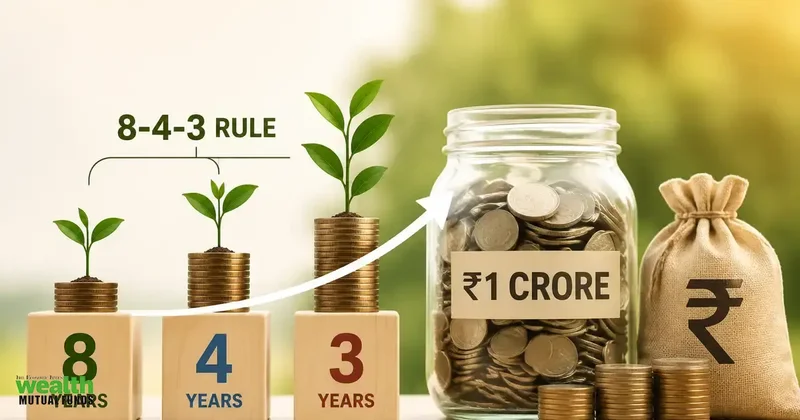
Rule 8-4-3 of compounding
You can effortlessly grow your wealth by following the 8-4-3 rule of compounding. Here's how it works: Suppose you invest a lump sum of Rs 21,250 every month in an instrument offering a 12% annual return, compounded yearly. In just eight years, your investment would grow to Rs 33.37 lakh.This is where the magic of compounding comes into play. The next Rs 33 lakh will take just half the time—only four years. The third Rs 33.33 lakh will accumulate even faster, in just three years. As a result, in 15 years, you can build a corpus of Rs 1 crore.
By the end of the 21st year, your savings will grow to Rs 2.22 crore—doubling your Rs 1 crore in just six years.
interest is added once a year.
Period of compounding may change with return
The higher the return on your investment, the faster your wealth will grow. However, if the returns are lower, the compounding process will take longer. For example, investing in fixed-income instruments or debt products may yield lower returns. If you earn a 7% annual interest (compounded quarterly) on such an investment, you may need to invest a higher amount—Rs 22,000 per month. As a result, your corpus will reach Rs 33.09 lakh in nine years, grow to Rs 69.89 lakh in the following six years, and surpass Rs 1 crore in the next four years.Also Read |Wealth creators: 12 equity mutual funds turn Rs 1,000 SIP to nearly Rs 3 crore since their inception
Choose the frequency correctly
When investing, it’s crucial to consider the frequency of compounding, especially with fixed-income investments. While some schemes offer annual compounding, others calculate interest multiple times a year. For example, in a bank fixed deposit (FD), interest is compounded quarterly.If interest is compounded quarterly (four times a year), a monthly investment of Rs 21,250 with an annual return of 12% grows to Rs 34.14 lakh in five years. With monthly compounding, the same investment reaches Rs 34.32 lakh in eight years. When investing larger amounts, the frequency of compounding significantly impacts returns—the more frequent the compounding, the faster your money grows.
Many people worry that saving a large sum takes too long. While it's true that wealth accumulation is slower in the early years, starting early and staying consistent can make a huge difference. The longer you invest, the greater the benefits of compounding. Time is your biggest advantage, allowing your money to grow significantly. To maximize this growth, ensure you invest every month without fail. Once compounding kicks in, your wealth will multiply faster than you expect.
(
Disclaimer
: Recommendations, suggestions, views and opinions given by the experts are their own. These do not represent the views of The Economic Times)
If you have any mutual fund queries, message on ET Mutual Funds on Facebook/Twitter. We will get it answered by our panel of experts. Do share your questions on
ETMFqueries@timesinternet.in
alongwith your age, risk profile, and twitter handle
(Catch all the Mutual Fund News, Breaking News, Budget 2024 Events and Latest News Updates on The Economic Times.)
Subscribe to The Economic Times Prime and read the ET ePaper online.
(Catch all the Mutual Fund News, Breaking News, Budget 2024 Events and Latest News Updates on The Economic Times.)
Subscribe to The Economic Times Prime and read the ET ePaper online.