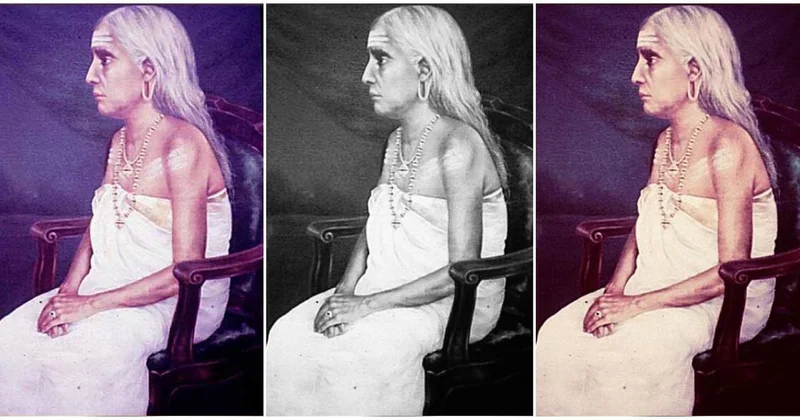
A gaunt elderly woman, her face sombre and framed by wispy grey hair left loose over her shoulders, gazes out in the side-profile. She wears the unmistakable symbols of an upper caste elite woman from 19th-century Kerala: the mundu mulakacha wrap tied across her chest, layers of gold around her neck, and a yawning ear piercing that signals a lifetime of wearing heavy gold earrings. Yet to dismiss Kuttykunju Thangkachi as merely a privileged noblewoman would be a profound mistake.
The tumultuous 84 years of her life, which ended in 1904, were packed with triumphs virtually unheard of for women of her era. She was the earliest female dramatist in Malayalam with her play Ajnatavasam, the first woman to write attakathas, or librettos, for Kathakali, and a prolific creator across Kerala’s indigenous musical forms, including kummi, thiruvathira pattu, kurathipattu and thullal. Crucially, she was the first female Carnatic composer from Kerala at a time when only men were accorded the elevated title of vaggeyakara (writer-composer).
Thangkachi’s oeuvre is well known within a tight circle of Kerala’s musicians, historians and literary scholars, but beyond these circles it has received relatively little attention. That dynamic shifted recently. At a Chennai concert organised by the Sruti Foundation to celebrate Carnatic composers of Kerala, vocalist KS Vishnudev selected Thangkachi’s popular kriti, Pahi Mohanaakrute in raga Khamas, to highlight her underestimated artistry.
“Her contributions to music and literature were incredible,” said Vishnudev. “Pahi Mohana, for instance, is a sthala kriti [dedicated to a particular place and its deity, in this case the Krishna at Neyattinkara in Thiruvananthapuram]. It needs poetic and musical skill to compose and many of her compositions, like that of other Kerala vaggeyakaras, appear influenced by the poetry of dance and the music of Kathakali.”
Are the melodies known today identical to how she set them two centuries ago? Were they reworked, partially or fully? The questions that apply to all classical composers of centuries past, including her contemporary Swati Thirunal, apply to her as well. Pahi Mohana, for instance, Vishnudev notes, was tuned by master musician Cherthala Gopalan Nair. “All great work is collaborative, never that of a single genius, and that must be credited,” he said. “Which is not to deny Kuttykunju Thangkachi’s greatness, for which we have historical evidence.”
Private limits
Starting in the late 18th century, several women from the royal and noble families of Kerala – highly educated in Malayalam, Sanskrit and Tamil – began writing prose and poetry. However, their creativity was strictly contained within private spheres.
“Patriarchy exerted its power over woman by equipping her privately in accomplishments relating to the arts and letters, and then demanding non-expression of them in public,” writes researcher and literary critic Jancy James in the journal Social Scientist in her paper From Veneration to Virulence: A Case for a Women’s Literary History in Malayalam.
Thangkachi shook off those shackles through her sheer output and versatility spanning multiple musical forms. Her rich repertoire of padams, kritis, tillanas and amorous poetry, which scholars say can be interpreted as Carnatic javalis, found their way out of private drawing rooms and still remain visible on concert, dance and theatrical stages.
Privilege undoubtedly smoothed part of her path – she was born into nobility and married into it as well. She was the daughter of Irayaman Thampi, a literary icon, brilliant satirist and counterculturist who defied Sanskrit’s dominance in the performing arts by shaping Ottanthullal, a dynamic vernacular theater style. Thampi was also an unusually supportive father.
Yet Thangkachi’s work was far more than a byproduct of lineage. In his classic multi-volume history Kerala Sahitya Charitram published in 1953, poet and literary historian Ulloor Parameswara Iyer praised her pathbreaking achievements, even as he framed her as a virtuous, pious and dutiful wife. Assessments of this kind, feminist historian J Devika argues in a Sahapedia essay, “do not grant her a full literary persona”, reducing her to “capable homemaker and virtuous woman who managed to write poetry tolerably well”. Devika points out that Thangkachi’s career actually formed a vital bridge between pre-modern and modern Malayalam literature, dismantling rigid barriers of form and style along the way.
Radical art
Thiruvattar and Padmanabhapuram are neighbouring towns in Tamil Nadu’s Kanyakumari district, just south of Thiruvananthapuram. Up until the late 18th century, Thiruvattar was an integral part of Travancore’s royal capital at Padmanabhapuram. It was here that the fabled amma veedukal (mother’s homes) were built to house the consorts of the kings.
It was into such a Thiruvattar neighbourhood that Leela Omcherry, a renowned scholar of Kerala’s traditional music styles, was born. A professor at Delhi University’s Music Faculty, she built a formidable body of research rooted in early exposure to the musical legacies of the royal households.
“My mother learnt music from her grandmother, singer and veena player Gowrikutty Pillai, who was a direct disciple of Kuttykunju Thangkachi,” said Deepti Bhalla Omcherry, Mohiniattam stalwart and a respected scholar of Carnatic music as well as Sopanam, Kerala’s indigenous music style. “So we can say with certainty that what she received from the latter’s repertoire, through the oral tradition, was how the songs were composed. For example, her kriti in raga Kalyani is dedicated to the Adi Keshava (Vishu) of Thiruvattar temple.”
In the late 1990s, Carnatic vocalist TR Subramaniam, then a professor at Delhi University’s Music Faculty, asked Leela Omcherry to trace whether javalis existed in Malayalam. These lilting sringaric compositions in the Carnatic style were predominantly written in Telugu and Tamil, and had no known equivalents in Malayalam. That search led Leela and Deepti to Thangkachi’s Vathilthura Pattukal, songs belonging to a distinct amorous genre specific to Kerala. Roughly translating to “songs to presage the opening of a woman’s boudoir to her lover”, they mirrored the javali format in theme, rhythm and language.
“Like javalis, her Vathilthura Pattukal too featured the khandita nayika (the aggrieved woman) asking her lover to leave after he arrives bearing obvious signs of having spent the night with another,” said Deepti. “But here she asks for forgiveness after multiple passages rebuking him and lets him in – my belief is that the reference here is to divinity. My mother recalled these tunes from her childhood.”
These compositions included Dayithe thurakka ni vathil (Beloved, open the door) in raga Todi, Yahi yahi mohanakarte (Come, O valorous hero) in raga Madhyamavati and Kaama komalaakaara (O man with Cupid’s form, leave) in raga malika. Some of them were later adapted by Deepti for Mohiniyattam performance.
Several of Thangkachi’s compositions were published in Abhinaya Sangitam, a compendium compiled by Leela Omcherry. Deepti notes that while these works belong theoretically to the Carnatic repertoire, they are heavily infused with the aesthetic of Kerala’s Sopanam music. Her padams, such as Bandhurangi enthu cheyvu, are set in expressive Manipravalam (old Malayalam) and lend themselves to dance choreography.
“If you listen to her compositions, or those by many old Kerala composers, you will notice that they are more fluid, simple and bhava (emotion) centric – all elements of Sopanam music,” she said. “When they are adopted by mainstream Carnatic singers they acquire a different sound – more brighas (fast note cluster), more elaborate raga exposition.”
Yet focusing solely on her classical compositions risks underestimating Thangkachi’s broader musical and literary eclecticism – a versatility rooted in her early years.
Lasting influence
“In pre-modern Malayali society, belles-lettres were accessible to Kshatriya and upper-Shudra women,” writes Devika in the Sahapedia essay.
By the time Lakshmi Pillai – better known by her pet name Kuttykunju – was born in 1820, at least two women of royal lineage had made a mark in Sanskrit literature and music. Manorama Thampuratti of Calicut’s royal Zamorin family was recognised in the 18th century as a scholar of exceptional finesse. Closer to Thangkachi’s lifetime, Rukmini Bai, the elder sister of Swati Thirunal, displayed rare musical talent before her early death.
Thangkachi is believed to have spent much of her life at Kizhakke Madom, part of her father’s estate in the Karamana region of Thiruvananthapuram. Taught mathematics, Malayalam, Sanskrit and Tamil, she was initiated into music and epic poetry by her father. In his essay in Kerala Sahitya Charitram, poet Iyer notes that Irayaman Thampi was initially reluctant to encourage his daughter’s literary ambitions.
She was married off at 14 to Kunjan Thampi, a nobleman from Cherthala, but continued her writing with quiet discipline. “Around this time, her father recognised her exceptional poetic talent and commendable musical ability, and arranged for her advanced training in music,” Iyer writes. “The mastery our poetess later achieved in Thiruvathirakkali (a traditional dance form) was the result of this training. That skill also helped her compose many fine devotional hymns.”
Kerala has music forms that fall between the folk and classical and while these are everyday songs of festivity and rituals for women, they need thorough proficiency in language and music to sing and write. Thangkachi is believed to have composed at least three Thiruvathira songs for the festival celebrating Parvathy’s devotion to Shiva, refining their rhythmic meters to inject greater dynamism into the tunes. She also authored works in the kilipaattu (parrot song) genre to honour regional deities, alongside highly regarded kurathipattu compositions, tribal folk narratives built around epics, deities, and everyday lives.
Her crowning accomplishment, however, lay in the male-dominated world of Kathakali. She was the first woman to write attakathas, or Kathakali librettos, authoring Seetha Swayamvaram, Parvati Swayamvaram and Mitra Sahamoksham – all three of which continue to be performed to this day.
Throughout her creative life, Thangkachi endured profound personal tragedies. Widowed twice while raising eight children, she nevertheless remained unwavering in her artistic pursuits. She continued to write and compose until the age of 82, stopping only when she lost her eyesight.
Malini Nair is a culture writer and senior editor based in New Delhi. She can be reached at writermalini@gmail.com.
We welcome your comments at letters@scroll.in.