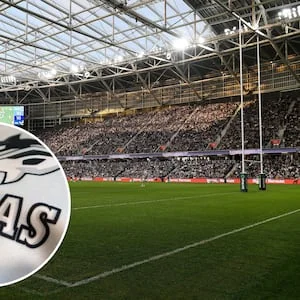
Christchurch could have an NRL team by November 1 if the Southern Orcas’ bid for the 20th licence is successful, according to their managing director. In an extensive and exclusive interview with the Herald, Orcas boss Andrew Chalmers reveals details of how the bidding group planned to bring a permanent
“We believe 2029 is the most realistic and strategically appropriate commencement date,” he says.
“That would provide sufficient time to establish the club properly while allowing the NRL to capture the commercial, broadcast and participation benefits of a second New Zealand team during the next phase of the competition’s growth.”
That would mean their first pre-season would begin on November 1, 2028.
“We have considered earlier scenarios, but our focus is not simply on getting a team on to the field as quickly as possible. It is about building a sustainable competitive club that can compete from its first season,” Chalmers says.
The NRL expands to 18 teams in 2027 with the inclusion of the Perth Bears, while the Papua New Guinea Chiefs will become the competition’s 19th team in 2028.
The expansion has led, in part, to the record-breaking seven-year broadcast deal announced less than a month ago. The A$5.3 billion ($6.4b) agreement with Foxtel, Nine and Sky NZ means up to nine games will be broadcast across each weekend in the regular season. The addition of a 20th team would increase that to 10 games.
If the Orcas were to be awarded the 20th licence, they could begin recruiting “off-contract” players by November 1 next year. That is players who don’t have a contract for 2029.
“An early decision would benefit everyone involved. Establishing a new NRL club is a major undertaking, and the more certainty that can be provided, the stronger and more professionally the successful club can prepare for entry into the competition,” Chalmers says.
The coach
Alongside Chalmers in the Orcas’ bid is a man who has achieved more than most in the sport of rugby league, Sir Graham Lowe.
The 79-year-old is chairman of the Orcas and brings a wealth of experience in coaching and management.
Lowe coached the Manly Sea Eagles from 1990-92 and guided Queensland to State of Origin success in 1991. He also had a successful stint at Wigan, as well as with the North Queensland Cowboys and the Kiwis in a career that was notable for player development.
Lowe returned to Manly in 2009, spending two years as the club’s CEO. He knows how important it is to have the right leader.
“The football department is the heart of any successful rugby league club. We are well advanced in identifying the people we believe can build the right culture, develop players and create a team that the whole South Island will be proud to support,” Lowe says.
Lowe, like Chalmers, believes an early decision is vital.
“You do not build a competitive NRL club overnight. The head coach and director of football need time to establish the standards, pathways and playing roster well before the team runs on to the field for its first match.”
Chalmers reiterates Lowe’s assertion that the search for a head coach and director of football is well advanced.
“These are foundational appointments. The right football leadership needs to be involved well before the club’s first competition season to shape recruitment, roster strategy, player development, high-performance systems and the culture of the organisation,” Chalmers says.
“We have received significant interest from high-quality coaches, football executives, football managers and other experienced people across rugby league and elite sport. That level of interest reflects both the strength of the Southern Orcas’ proposition and the attraction of establishing a foundation NRL club in Christchurch.”
Chalmers says formal appointments and player contracting will need to be carefully aligned with the NRL licence process, the confirmed entry date, salary-cap rules and player-contracting regulations.
“However, we are not waiting for a licence decision before undertaking the planning required to ensure the club can move quickly and professionally once approval is received,” he says.
“A new club cannot enter the player market at the last minute and expect to assemble a balanced and competitive roster. The head coach and director of football must have sufficient time to develop the club’s football philosophy, identify priority recruitment targets and establish a roster capable of competing from its first season.”
Players can seek permission from their clubs to speak with rivals before November 1, as has been seen with recent negotiations involving the PNG Chiefs.
Chalmers doesn’t rule out targeting some rugby union players, either. Sir Graham Lowe famously brought Matthew Ridge to Manly in 1990 and had Zinzan Brooke signed to follow him in a deal that never came to fruition.
The money
NRL licences don’t come cheap, and establishing a new franchise from the ground up will require some serious cash. Chalmers and Lowe announced in 2024 that their bid carried a value of some $360 million – but the source of that investment remains unidentified.
“The Southern Orcas are supported by a group of credible and experienced businesspeople and investors rather than a single individual,” Chalmers says.
“The group includes significant South Island-based commercial and property interests, together with parties who have experience in investment, governance, sport and major development projects.
“We prefer not to name the members of the investor group. We respect their commercial confidentiality and their desire to stay out of the limelight and avoid the distractions that can bring.”
The announcement by the Carter Group regarding the Orcas’ Centre of Excellence being located within their proposed Rolleston development was the first to tie Christchurch money to the bid. The Carters are among the wealthiest and most influential families in Canterbury, though the extent of their involvement in the bid thus far is limited to land.
Ten hectares will be set aside for a future “world-class multi-sport Centre of Excellence, which would become the long-term elite training and athlete development base for the proposed Southern Orcas NRL franchise” should an NRL licence be secured.
“The facility is proposed to be owned or controlled through a not-for-profit structure and shared by a range of high-performance sporting organisations, academy programmes, education partners and specialist service providers, with the Southern Orcas operating as a major anchor tenant,” read Carter Group’s statement.
The Herald understands the cost of the licence could be between $50m and $60m. Chalmers would neither confirm nor deny.
“The financial terms associated with any future NRL licence, including any licence fee, capital requirements, guarantees and funding commitments, are commercially sensitive and form part of confidential discussions.”
He says it would be inappropriate to comment on “specific figures, funding structures or financial assurance requirements” at this stage.
“What we can say is that the Southern Orcas understand the scale of the financial commitment required to establish and sustain a new NRL club, and our planning is being undertaken on that basis,” Chalmers says.
“We also expect the wider economic contribution of a Christchurch-based NRL club to be significant, but any specific estimate should be supported by independent economic-impact analysis rather than speculation.”
According to Venues Ōtautahi, the financial impact of the New Zealand Warriors match against the North Queensland Cowboys at One NZ Stadium in June pumped $4.6m into the local economy from visitation alone. The Orcas would have 12 regular season home games per year.
“The Southern Orcas would bring regular economic activity to Christchurch rather than a single weekend of major event spending. Home games, visiting supporters, corporate events, employment, tourism, hospitality and year-round development programmes would create recurring value for Christchurch, Selwyn and the wider South Island,” Chalmers says.
Lowe is also adamant the time is right for Christchurch to have its own club.
“The foundations are here – the challenge now is to bring the right people together and build the club properly,” Lowe says.
Up the Wahs / Up the (Or)Cas?
There is no doubt the case for a second New Zealand-based NRL team has been built on the off-field success of the NZ Warriors.
The “Wahs” have become a juggernaut in terms of support, with fans packing out all but one home game in the past three years. They’ve also bolstered away crowds, taking over Suncorp Stadium for Magic Round earlier this year. The “Up the Wahs” movement has arguably thrust the sport into the most prominent position it has ever enjoyed on these shores.
“This is not about taking anything away from the Warriors,” Chalmers says.
“A second New Zealand club would strengthen the Warriors by creating more local content, more pathways, more rivalry and a larger national market for rugby league. The Southern Orcas can create one of the NRL’s great rivalries while also opening a new market across the South Island.”
It was the Warriors, again, who showed the rugby league world that Christchurch was ready – by bringing NRL powerbrokers to the city’s new world-class enclosed stadium for the Cowboys match.
Current NRL CEO Peter V’landys and his former lieutenant Andrew Abdo attended the match and took the time to meet with the Orcas.
“It was a constructive and important discussion,” Chalmers says.
“They clearly understand the strategic case for Christchurch and the South Island, including the quality of One New Zealand Stadium at Te Kaha, the size and growth of the regional market, the strength of the corporate base and the opportunity to expand rugby league in a part of New Zealand that has never had permanent representation in the NRL.
“They also made it clear that any proposal must satisfy the NRL across a wide range of areas, including capital, governance, football operations, pathways, commercial performance, venue arrangements and stakeholder alignment.”
V’landys is well known for being a straight shooter and a shrewd businessman, able to get the best out of negotiations. Chalmers knows there is still plenty of work to do.
“We came away encouraged, but also very conscious that the Southern Orcas must continue doing the work required to demonstrate that Christchurch is not simply an attractive location – it is the strongest and most sustainable option for the 20th licence,” he says.
The Orcas face credible competition from Ipswich, which would be a fifth Queensland team in the NRL. Chalmers is urging all of the stakeholders behind the Christchurch proposition to “put their best foot forward”. Expansion beyond 20 teams would not likely come before the next broadcast deal in 2035.
The future
Chalmers has three Southern Orcas-related companies in his name, including Southern Orcas Academy and Southern Orcas Sports High School.
Whether or not a high school eventuates, clearly the plan is to develop strong player pathways across the South Island. That model has fuelled the sustained success of the Penrith Panthers (winning four consecutive NRL premierships from 2021-2024) and is a key driver in the renewed belief at the Warriors.
“The long-term objective is to create a connected pathway from grassroots and school sport through regional academies, elite development programmes and ultimately the NRL and NRLW,” he says.
“A key part of that strategy is the development of rugby league academies that support the regions rather than drawing all talent into Christchurch. These academies would provide local access to quality coaching, strength and conditioning, player welfare, education support and structured competition, while allowing talented young people to remain connected to their families, schools, clubs and communities for as long as possible.”
South Island-grown talent within the NRL right now includes Jordan Riki (Broncos), Jamayne Isaako (Dolphins), Griffin Neame (Cowboys), Tanner Stowers-Smith (Warriors) and Makaia Tafua (Warriors).
Another wave of players is expected to make their debut in the next year or two – largely products of a successful St Thomas of Canterbury College (STC) programme, including the highly regarded Bishop Neal (Warriors). STC officially partnered with the Warriors earlier this year. The Orcas plan would mean more young players benefitting from an association with an NRL club.
“The Southern Orcas would work with existing clubs, schools, regional rugby league structures, education providers, Māori and Pasifika organisations and high-performance partners. We want to strengthen the rugby league system already operating across the South Island, not replace it,” Chalmers says.
“Our objective is to give each region a meaningful role in identifying and developing talent, with clear progression into higher-performance programmes and ultimately the Southern Orcas. We want to provide a visible destination and stronger opportunities for talented young people who currently feel they must leave the South Island to pursue professional rugby league.”
The opportunities the franchise could create for young players excite Lowe.
“This is bigger than putting a football team on the field. It is about creating pathways, developing young people, strengthening communities and building an institution that the South Island can be proud of for the next 50 years,” Lowe says.
“The South Island has produced outstanding rugby league players, coaches and administrators for generations, but it has never had a permanent place in the NRL. The Southern Orcas would finally give this region a team of its own and give our young players something they can see, believe in and aspire to.”
Black and white
Chalmers says the Southern Orcas have enjoyed constructive engagement with Christchurch City Council and Selwyn District Council.
He and Lowe met with Christchurch Mayor Phil Mauger and the city council team last week.
“Mayor Mauger has been extremely supportive of our efforts and was clear that he wants to see the 20th NRL licence secured for Christchurch. The key focus is now on co-ordination and alignment across all relevant stakeholders,” Chalmers says.
He says discussions with Selwyn District Mayor Lydia Gliddon have been similarly constructive and supportive.
“Selwyn is strategically important because of its rapid growth and the proposed location of the Centre of Excellence within the district.”
The Orcas created an online storm when they released renders of a proposed playing kit in recent weeks. Chalmers says he’s since received queries about how they can be purchased. He produces two jerseys from his satchel – but they’re unlikely to be in stores for Christmas, even if the bid is successful before then.
“People have connected strongly with the orca as a symbol of intelligence, power, teamwork, resilience and family. It is also visually distinctive and has a natural connection to the Southern Ocean and the South Island,” he says.
“The design released publicly is part of the continuing development of the club’s identity rather than necessarily the final playing jersey. Our objective is to create one of the most recognisable brands in Australasian sport – something that is unmistakably New Zealand and unmistakably Southern Orcas.”
Like the playing strip, Chalmers’ vision for the Orcas’ bid is black and white.
“Our objective is not simply to recruit a team for season one. It is to establish an integrated football programme covering elite performance, recruitment, pathways and player development that can sustain the Southern Orcas over the long term,” he says.
“Our message to the NRL is straightforward: Christchurch is ready, the South Island is ready, and the Southern Orcas are prepared to do the work required to build a successful and sustainable 20th club.”
Mike Thorpe is a senior multimedia journalist for the Herald, based in Christchurch. He has been a broadcast journalist across television and radio for 20 years and joined the Herald in August 2024.