See more DutchNews articles in your Google search results
See more DutchNews articles in your Google search results
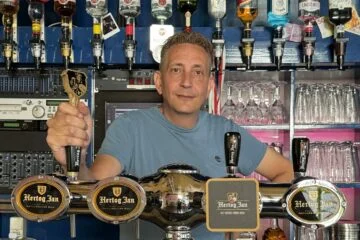
Add as a favourite source on Google Add DutchNews as a favourite source on GoogleFor over two decades, Michiel Hoogkamer has single-handedly managed Leiden’s sole gay bar. As it approaches its final weeks in business, he and others speak to Brandon Hartley about the challenges facing the country’s ‘ homohoreca’ [gay nightlife scene].
Michiel Hoogkamer, the owner of De Roze Beurs, Leiden’s only gay bar, is ready
to call it quits.
After 24 years of catering for everyone from introverted university students to boisterous drag queens, the final night has been set for 15 August.
There’s no single reason why Hoogkamer decided to close down the bar he lovingly described as his child during an interview with Dutch News, but it comes at a difficult time for LGBTI+ oriented businesses all across the Netherlands.
While De Roze Beurs continues to host a stream of regulars, similar businesses across the country have struggled over the past decade.
“Here in the Netherlands, little bars like this one aren’t doing well,” Hoogkamer said. “Young people aren’t loyal to one place anymore. They go to monthly or quarterly parties at nightclubs instead or go to restaurants in the middle of the day.”
Hoogkamer and others say the country’s homohoreca is facing an increasing number of challenges.
Homohoreca is a Dutch term for hospitality businesses that cater for a gay, lesbian, transgender, and bisexual clientele, such as bars, saunas, nightclubs, and restaurants.
Saunas disappearing
Even Amsterdam is not immune. Cafe Getto, a popular gay-oriented restaurant that became famous for its ‘Diva Burgers,’ closed down a few years ago.
Lola the Green Aardvark, a queer food bar, and the lesbian/bisexual/queer café B’Femme both shuttered in 2025.
“The decline is drastic among gay saunas,” Peter Koop told Dutch News. “In 2020, there were still 12 gay saunas, but only eight remain.
“The closed saunas have not found successors. This is likely because there is hardly any interest in such establishments among young people anymore.”
Koop is the current writer and editor of homohoreca.nl, a website that has been tracking the industry since 2001.
However, a precise forecast of what’s to come could prove more difficult than predicting the weather in April.
“Although we do not have hard figures, we also have the impression that there are fewer bars and clubs aimed at the LGBTI+ community,” Philip Tijsma, spokesperson for the national LGBTQ+ rights group COC Nederland, said.
Changing habits
Many clientele are less reliant on these businesses to serve as safe spaces or
dating venues.
“We also have the impression that people’s nightlife behaviour has changed,’ Tijsma said.
“People go to a bar or club less often, and are more likely to attend a large LGBTI+ party or festival a few times a year. General nightlife venues have also sometimes become more inclusive and LGBTI+ people feel at home there more often.”
“In the Netherlands, there is indeed a decline in the number of gay bars, but that decline is very slow,” Koop said.
He said an average of two close in the Netherlands every year, but at least one new one usually appears.
Gay tourism
Koop also noted that, despite a downturn between 2010 and 2015, the number in Amsterdam has been holding steady.
“Amsterdam’s gay establishments benefit from gay tourism, which is not the case in the rest of the Netherlands,” he said.
The decrease is less severe than many people think, but the blow can be hard locally, as is the case with Leiden.”
The city still has a local chapter of COC Nederland but, aside from periodic club nights, it’s more of an advocacy centre than a social organisation.
Potential buyers
The building that houses De Roze Beurs has primarily served as a bar since it was built in 1636.
The name is somewhat difficult to translate into English, as beurs can mean various things such as stock exchange, marketplace and coin purse.
Hoogkamer said the name is partially a tribute to the years it was used as a meeting hall for officials and accountants from the Beestenmarkt, a nearby square where livestock was once sold.
He doesn’t know what the future holds for the building, but he doubts it will remain a gay bar.
A few interested parties have approached him about taking over De Roze Beurs, but the discussions didn’t go far. His landlord will make the ultimate decision about what happens next.
Homophobia increasing
Additional challenges new owners might face include what Hoogkamer says has been a rise in anti-gay hostility.
He said his first few years behind the bar could be rough at times. At one point in the early 2000s, the building was attacked by someone who threw paint bombs at the windows.
Things were largely quiet throughout the 2010s, but there’s been an uptick in aggression after De Roze Beurs reopened following the pandemic.
The rainbow flags out front have been stolen several times. On a busy Saturday night, a vandal smashed one of the windows and shouted anti-gay slurs at his customers.
Berlin attack
Hoogkamer also says there’s been an increase in passers-by heckling patrons seated outside on the terrace.
Recent studies suggest gay tolerance has declined in the Netherlands, especially among youths.
The Berlin Pride attack paints an even darker picture of the situation elsewhere
around the world.
“With the extreme right coming up, like Wilders and the FvD, it’s getting worse,” Hoogkamer said.
“They all say they’re woke and they’re attracting a lot of young people, but it simply isn’t true.”
Late nights
There’s also no denying that running any sort of bar can be incredibly difficult, especially once you enter middle age.
De Roze Beurs is essentially a one-man operation. “It’s hard work and I sometimes have 80-hour working weeks,” Hoogkamer said. “As you get older, you start to feel it, and there’s the long nights.
“I don’t get to bed until four or five in the morning. Everybody else gets to go home and I have to stay here and clean the toilets.”
When Dutch News recently visited De Roze Beurs, many of the rubber ducks that once stood watch over the bar itself had been packed up and placed into bags with other memorabilia.
Stripper pole
Along with an iconic stripper pole and pretty much everything else, the ducks will be sold at an auction scheduled for 20 August hosted by local drag queen Christine Carrington.
Hoogkamer will be sad to see it all go, but he said he was ready to move on.
“I’m going on sabbatical for a year,” he said. “I’m 46, I have good legs, and I want to see something of the world after managing a bar for so many years.”
While he himself wouldn’t take over a gay bar nowadays, he said Leiden could still use one, especially if there’s a person out there who knows what they’re getting themselves into.
“There’s plenty of potential in this city for a gay or queer bar, but you have to work hard,” he advised. “You’re not going to get rich and your social life is forever on hold.
“You can’t go to parties and you can’t go to birthdays because they’re all on Fridays and Saturdays. When do you make your money? On Fridays and Saturdays.”
Thank you for donating to DutchNews.nl.
We could not provide the Dutch News service, and keep it free of charge, without the generous support of our readers. Your donations allow us to report on issues you tell us matter, and provide you with a summary of the most important Dutch news each day.
Make a donation