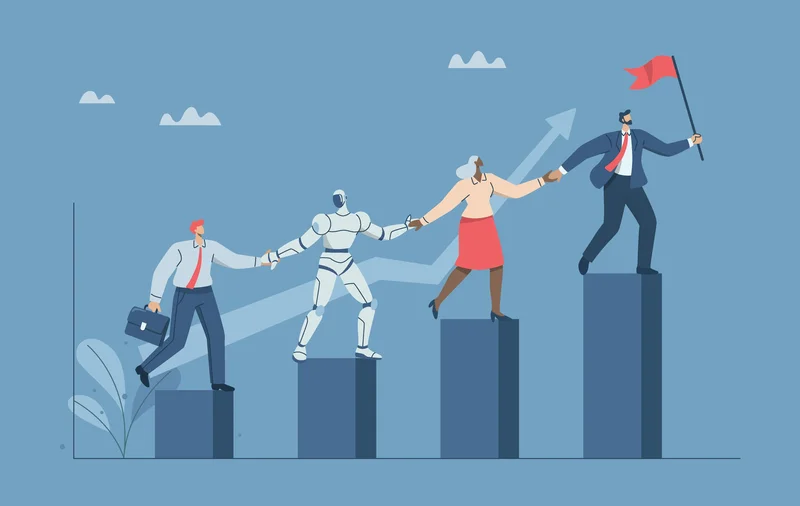
Every organization investing in AI wants to know if it's paying off. Most answer that question by looking at productivity, efficiency, or cost savings. Those are reasonable measures, but a new Wharton study suggests there is another measure leaders should pay attention to. Organizations may be spending so much time measuring AI performance that they overlook the value created through human-AI collaboration. That may be where some of AI's greatest returns are found. If that's true, leaders may need to rethink not only how they evaluate AI, but also how they evaluate the results people achieve by using it.
Why Human-AI Collaboration Changes AI Performance
If AI completes a report in half the time it used to take, that's easy to measure. If an employee finishes more work because AI handled repetitive tasks, that's easy to measure too. What isn't nearly as easy to measure is what happens when people and AI improve each other's performance.
AI can generate content in seconds. But it is people who bring experience, context, and the ability to recognize when an answer doesn't fit the situation. The value comes from how they complement each other. Yet most organizations still evaluate the employee and the technology separately.
The Wharton research found that people and AI working together often achieved stronger outcomes than either could alone. That raises a practical question every leader should be asking. If your people and AI are creating more value together, how do you know whether your organization is recognizing it?
When I interviewed Dave Ulrich, professor of business at the University of Michigan, he told me that value is defined by the receiver, not the giver. The same principle applies to AI. AI doesn't create value simply because it produces an answer. It creates value when people use that information to make better decisions or achieve better outcomes. That suggests organizations should pay as much attention to the outcomes people achieve with AI as they do to AI's output.
Why AI Performance Doesn't Tell You Enough About Collaboration
Most organizations already measure AI adoption. They know how many employees use AI, how often they use it, and whether it saves time. Those numbers don't tell you whether employees are becoming better problem solvers because AI is part of their work.
Imagine two managers who receive the same performance review. Both completed their projects on time and within budget. One simply used AI to work faster. The other used AI to challenge assumptions, test alternatives, and identify a solution the team might never have considered. Traditional performance measures may treat those managers exactly the same. I don't think they are.
One employee used AI as a shortcut. The other used AI as a thinking partner. Those are very different capabilities, yet many organizations have no way of distinguishing between them.
What Effective Human-AI Collaboration Looks Like
Many leaders assume employees are using AI effectively simply because they're using it frequently. An employee who copies AI's recommendations into a report without questioning them isn't creating much additional value. Using AI more often doesn't necessarily mean using it better. The employees who create the greatest value are usually the ones who challenge AI's recommendations, improve them, and apply their own judgment before acting on them.
Leaders should spend less time asking whether employees are using AI and more time asking how they're using it. Are they accepting the first answer they receive, or are they improving it? Are they using AI to replace their thinking, or to strengthen it? Those questions provide a much clearer picture of whether human-AI collaboration is creating value.
Human-AI Collaboration Should Change What You Measure
I've found that leaders often measure what is easiest to count. Measuring the quality of decisions is much harder. Measuring whether employees consistently improve AI's recommendations is even harder. That doesn't mean it shouldn't be done.
Instead of asking whether AI made someone more productive, ask whether it helped produce a better business outcome. Did the employee identify a risk that might have been missed? Did AI help uncover a new opportunity? Did the final recommendation improve because the employee questioned AI's first answer instead of accepting it? Those questions begin measuring something much closer to the value AI creates inside an organization.
Human-AI Collaboration Should Influence Performance Reviews
Performance reviews have changed surprisingly little over the past decade, even though the way people work has changed dramatically. Most organizations still reward individual accomplishments without asking how employees use AI to improve the quality of their work. That may become a costly oversight.
Employees who know how to challenge AI, refine its recommendations, and combine technology with human judgment are developing skills that will become increasingly valuable. If those behaviors aren't recognized, employees have little reason to strengthen them. Leaders who want more thoughtful AI use should make those capabilities visible during performance discussions instead of assuming they'll develop on their own.
Measuring Human-AI Collaboration Starts With Better Questions
One of the easiest ways to improve your measurement system is to improve the questions you ask. When a project succeeds, don't stop with asking whether AI saved time. Ask how AI influenced the final decision. Ask whether employees improved AI's recommendations before acting on them. Ask whether AI helped reveal information that changed the outcome. Those conversations often reveal contributions that never appear in productivity reports.
Over time, those discussions also help identify employees who consistently create more value by combining their expertise with AI. Those are the people who can teach others how to use AI more effectively across the organization.
What Human-AI Collaboration Means For Leaders
AI will continue to become faster, less expensive, and more capable. That isn't likely to be what separates successful organizations from everyone else. The greater advantage may come from developing people who know how to collaborate effectively with AI, question it thoughtfully, and improve what it produces. Leaders who learn to measure those capabilities will have a much clearer picture of where AI is creating value and where future investments are likely to deliver the greatest return. The organizations that gain the greatest advantage from AI may be the ones that become the best at recognizing, measuring, and encouraging effective human-AI collaboration.