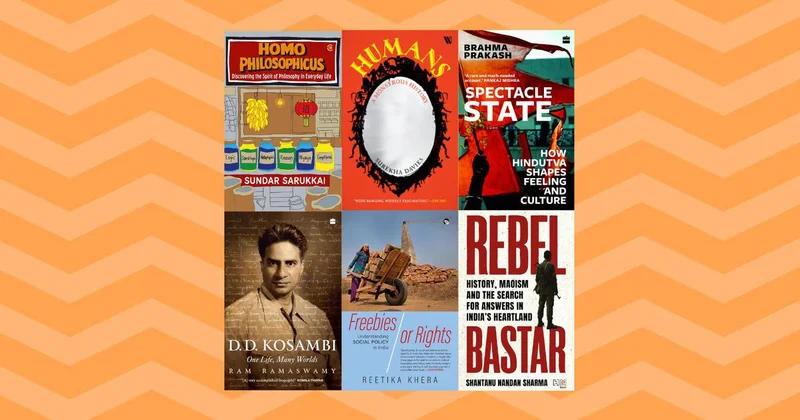
All information sourced from publishers.
DD Kosambi: One Life Many Worlds, Ram Ramaswamy
Historian. Mathematician. Marxist. Polymath. DD Kosambi defied labels. The range and intellectual heft of his scholarship was truly astounding, with fundamental contributions in differential geometry and analyses in mathematics, the Kosambi distance in genetics, a statistical analysis of ancient coin hoards, a radical reinterpretation of Indian history and stellar compilations of the poetry of Vidyakara and Bhartrhari-all this in addition to a firm commitment to world peace and environmental activism.
Yet, for a man who contributed so much to the Indian intellectual tradition, he remains largely unknown. Sixty years after his passing, there is scant recognition of his talents-he is quoted more often than he is read and praised more often than he is analysed.
Ram Ramaswamy’s biography of Kosambi seeks to correct this lapse. Set against the backdrop of fascinating social, political, scientific and historiographical transformation in the subcontinent, and drawing from letters, journal entries, family accounts and unprecedented archival material, DD Kosambi: One Life, Many Worlds reveals a rare incandescent genius and a fearless independent spirit with boundless curiosity-whose relevance in the fields of pedagogy, research and invention can be seen even today.
Rebel Bastar: History, Maoism and the Search for Answers in India’s Heartland, Shantanu Nandan Sharma
Journalist Shantanu Nandan Sharma maps the deeper history of a gravely misunderstood region, which for centuries has stood at the intersection of uneven state presence and popular resistance. Bastar first unfolded for him in the aftermath of India’s 2016 demonetisation, when newly issued currency notes surfaced deep inside the insurgent-held territory. In the successive years covering the wooded pocket, Sharma’s findings challenged the familiar narratives of the Red Corridor, underscoring the land’s millennia-long turbulent past.
We move from human sacrifices in Dantewada to British-sponsored incursions into Bastar’s forests and kingdoms for teak wood and minerals, from a tribal uprising led by a tragic, beloved prince to developmental failures and the gradual rise of Maoist influence. Steadily, Naxalism surfaces as a recent chapter in a much longer history of contestation and administrative mistrust.
Rich in reportage and historical insight, Rebel Bastar examines how armed movements in India’s heartland, embedded within its tight indigenous societies, why they endured and whether their decline is only conditional.
Homo Philosophicus: Discovering the Spirit of Philosophy in Everyday Life, Sundar Sarukkai
Why does philosophy matter? How does it influence ordinary lives and individual actions across the world? What makes ideas that originated centuries ago relevant today, in an age that is redefining the idea of the human? And, relatedly, there is the question that philosophers have long struggled with: what does it mean to be human?
Sundar Sarukkai explores these ideas and more in this unique account of philosophy. The outcome of three decades of teaching the subject to a wide range of students and interested others, the book focuses attention on what it is to think philosophically, why philosophers produce the narratives they do, and how philosophical ideas enter the realm of the everyday. Drawing from Indian, Western, Chinese and other world philosophies, it presents a unified picture of how philosophy can help us engage with language, gender, class, caste and other issues of the contemporary world. With fascinating insights and historical examples that provoke as well as guide, Sarukkai tells another story of philosophy, sweeping yet rigorous.
Homo Philosophicus is an invitation to learn, and engage with, the art of philosophical thinking and practice.
Spectacle State: How Hindutva Shapes Feeling and Culture, Brahma Prakash
In today's India, political power does not merely govern as an invisible force-it marches, roars, dances and displays itself in colour, sound and action, as spectacle. From the beating of drums and the blare of loudspeakers to the rise of symbols such as the bulldozer and intimidating stickers and statues, depictions of political might surround us – bold, sensorial and all-pervasive.
In Spectacle State, Brahma Prakash looks beyond leaders, ideology and speeches, towards everyday life, objects and culture in India-religious processions, street performances, monuments, music and festivals. For it is in these charged liminal spaces that violence appears in the garb of celebration, hate as preservation of self-identity and devotion as display.
This book traces how fear, pride, victimhood, anger and piety are produced and circulated in today's India as spectacle. It asks how Hindutva is changing our day-to-day expressions and relationships beyond ideology.
Humans: A Monstrous History, Surekha Davies
Monsters are central to how we think about the human condition. Historian of science Surekha Davies reveals how people have defined the human in relation to everything from apes to zombies, and how they invented race, gender, and nations along the way. With rich, evocative storytelling that braids together ancient gods and generative AI, Frankenstein's monster and ET, Humans: A Monstrous History shows how monster-making is about control: It defines who gets to count as normal.
In an age when corporations increasingly see people as obstacles to profits, this book traces the long, volatile history of monster-making and charts a better path for the future. The result is a profound, effervescent, empowering retelling of the history of the world for anyone who wants to reverse rising inequality and polarisation. This is not a history of monsters, but a history through monsters.
Freebies or Rights: Understanding Social Policy in India, Reetika Khera
This book asks a simple but urgent question: when the state provides food, healthcare, education, pensions, or employment support, are these “freebies” - or are they rights that make a dignified life possible?
Drawing on over two decades of field research across rural India, economist Reetika Khera examines how social policies actually shape everyday life. From Anganwadis and school meals to the Public Distribution System, maternity benefits, pensions, public healthcare, and the MGNREGA, the book traces India’s evolving welfare architecture from “cradle to grave”.
Blending rigorous research with vivid stories from villages, classrooms, government offices, and field surveys, the book moves beyond political rhetoric to ask deeper questions about inequality, citizenship, and the role of the state. Do welfare programmes create dependency, or do they expand freedom and opportunity? Why are social protections, considered essentials in many countries, often dismissed as handouts in India?
We welcome your comments at letters@scroll.in.