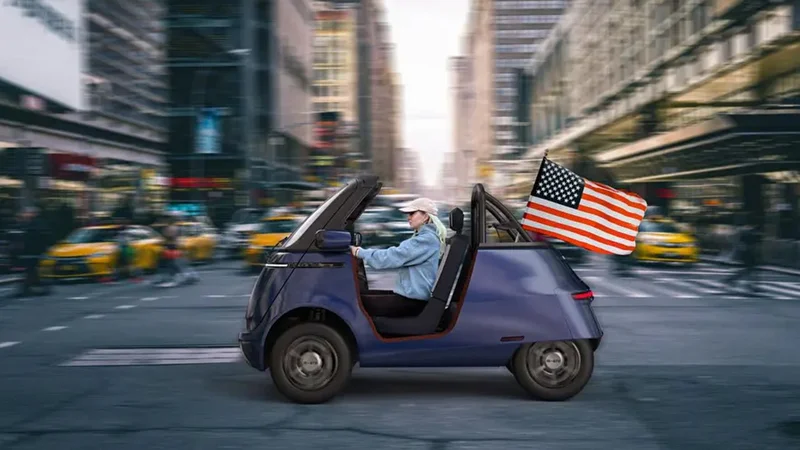
America has spent decades building some of the biggest, most powerful and least apologetic vehicles on the planet.
Full-size pickups have dominated the US charts for generations, while SUVs have gradually swallowed up everything from family sedan to station wagon sales.
But something strange is happening at the other end of the automotive spectrum. Golf carts are spreading beyond perfectly manicured golf courses.
Electric bike sales are also booming, with an estimated 2.2 million e-bikes imported to the US in 2025 alone, while various low-speed vehicles (LSVs) are becoming more common on public roads — and manufacturers are suddenly talking seriously about tiny electric cars designed for short hops rather than cross-country road trips.
We reported recently that Fiat has just brought its tiny, sub-$14,000 Topolino EV to the US for the first time, while Swiss company Microlino has gone as far as designing an "anti-pickup truck" specifically for American customers. It's called the Spider, and it's awesome.
Even established automotive and mobility companies are increasingly interested in vehicles that occupy the space between an e-bike and a conventional car.
None of this means Americans are falling out of love with large vehicles. In fact, quite the opposite is true. The EPA's 2025 Automotive Trends Report found SUVs accounted for 60% of all vehicles produced in the US in model year 2024.
Sign up for breaking news, reviews, opinion, top tech deals, and more.
But perhaps that is missing the point. The more interesting question isn't whether a tiny EV can replace a Ford F-150. It's whether Americans are finally realizing that they don't need an F-150, a three-row SUV or even a conventional crossover for every single journey.
Americans love a short journey
For anyone from the UK (or anywhere in Europe, for that matter), America's obsession with hopping in the car for every journey can be baffling.
Granted, this isn't the case for those living in densely packed cities, such as New York or Washington D.C, but in suburban areas it is the norm.
The Washington Post recently reported that roughly 80% of daily US trips are under 10 miles. It's perhaps no surprise, then, that federal rules already recognize low-speed vehicles (LSV) as a distinct category.
Under NHTSA rules, an LSV is a four-wheeled vehicle capable of traveling faster than 20mph but no faster than 25mph, with states and local authorities able to set additional rules around where and how they can be used.
This goes some way toward explaining the recent golf cart boom that has occurred in certain neighborhoods.
According to The Wall Street Journal, the US golf cart market has grown from around $1 billion before the pandemic to roughly $5 billion, with street-legal carts increasingly appearing in suburban communities and being used for everyday trips rather than just on golf courses.
But these aren't the indistinct boxes that ferry players and clubs around the course, as Americans are increasingly turning to "tricked-out" rides that better mirror their personalities.
Modern street-focused carts can come with seat belts, headlights, turn signals and sophisticated equipment, such as navigation technology and booming sound systems.
"Governments, businesses, and facility operators are adopting electric mobility solutions to reduce emissions while improving operational efficiency across campuses, airports, resorts, and residential communities," a recent report by Persistence Market Research reads.
With more sophisticated carts on the way from the likes of Yamaha, Persistence Market Research says the next few years could prove lucrative for established names.
The automotive industry wants in
The arrival of the Fiat Topolino in the US feels almost like a joke at first glance. It has a $13,995 starting price, a 5.4 kWh battery and a top speed of just 19mph in its initial specification. Even after the planned low-speed vehicle conversion, it will only reach 25mph.
But in much of Europe, these are already commonplace and are categorized as light quadricycles.
The segment allows teenagers as young as 14 to hop behind the wheel in some countries, while also offering the benefits of a small footprint for easier parking, lower taxes and often lower insurance costs.
In the US, a Topolino still might seem absurd, but Fiat has a very specific use case in mind. The tiny runaround is designed around low-speed, short-distance mobility, putting it much closer to a neighborhood EV or golf cart alternative than a conventional highway car.
It has already targeted luxury hotel chains, which will be able to personalize the Topolino with bespoke branding and design touches, while upmarket private residential estates could also benefit from the small electric vehicles as a mode of local transport.
The Verge also reported on Micro's introduction of the Spider to the US market last year. The company's founder claims it isn't built for the 5% of trips where you need to haul a lot, but for the 95% of trips where you are alone. He described it as the "antithesis of massive electric pickup trucks."
The small-car comeback is well underway
Kelley Blue Book reported in 2025 that Americans had started choosing smaller vehicles again, noting that compact SUVs became the country's best-selling vehicle type in 2020 and have continued to grow while midsize SUV sales have retreated.
The publication also noted that three compact SUVs — the Toyota RAV4, Tesla Model Y and Honda CR-V — outsold Ram's full-size pickup in 2025.
However, America's love affair with large vehicles clearly isn't over. According to Cox's June 2026 US sales forecast, full-size pickups and midsize SUVs accounted for more than 30% of the market.
But the growth of compact SUVs alongside low-speed vehicles and other micromobility options suggests there is a growing appetite for something smaller than the traditional American default.
The financial argument is becoming harder to ignore, too. Fortune reported that compact SUVs were gaining in popularity because that's "all Americans can afford", reinforcing the idea that smaller vehicles can offer a more accessible entry point for buyers who don't need the extra size.
As a result, a number of automotive newcomers are looking to exploit this newfound interest, with Rivian spin-off Also revealing its innovative, modular e-bike in the TM-B last year, as well as its fully electric TM-Q cargo platform.
Also's President Chris Yu spoke to me about the "pent-up demand" for something more convenient than a car on America's busy streets, with his team investigating how to reduce the pain points of making the switch to an electric bike or quadricycle.
It's not just the US, either, as Honda recently introduced its tiny Super-N EV to the UK, marking the first time it has offered something from Japan's ever-popular kei car segment outside of its domestic market.
With fuel prices spiraling, the cost of vehicles increasing and cities becoming increasingly congested, consumers are looking for innovative ways to get around, and micromobility could be the next big trend that helps keep the world moving.
Leon has been navigating a world where automotive and tech collide for almost 20 years, reporting on everything from in-car entertainment to robotised manufacturing plants. Currently, EVs are the focus of his attentions, but give it a few years and it will be electric vertical take-off and landing craft. Outside of work hours, he can be found tinkering with distinctly analogue motorcycles, because electric motors are no replacement for an old Honda inline four.