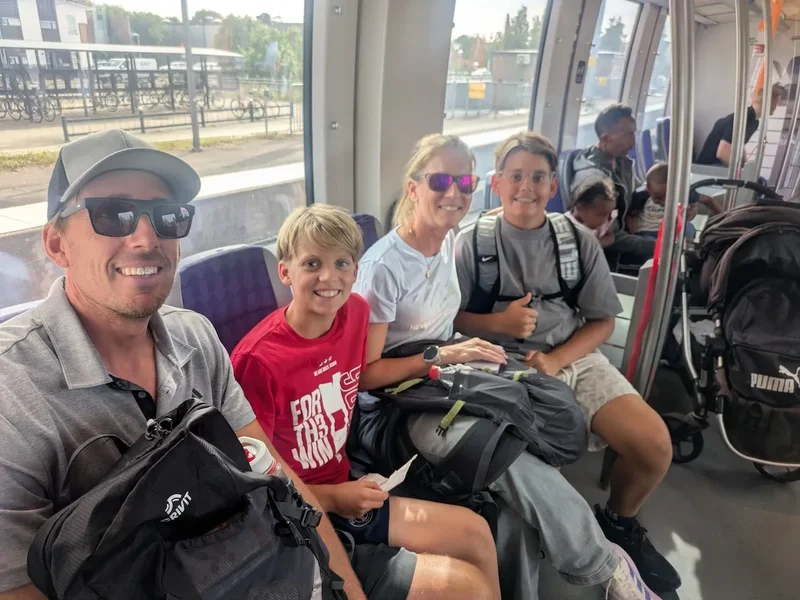
I'm writing this on a train out to the east coast of Skåne, sitting next to a bubbly Italian family who have just told me they are in Sweden for a 'coolcation'. It is, I think, the first time I've heard a real person use the term (which The Local first wrote about in 2024 after Conde Nast Traveller declared it the travel trend of the year).
"It's 39 degrees in Rome, and that is before you add in the 80 percent humidity. It's just too much," Anniina, the mother, grimaced. She wasn't alone, she said.
Their best friends were in Ireland, and they knew several more families who had fled the heat to cooler climes.
Summers in Rome had been bearable 15 years ago, Matthias reflected. Then you'd only get a few days a year of sweltering 40C heat. But now, he said, you suffer from June right through to September, so a few weeks' break somewhere cooler is almost a necessity.
It was actually their second coolcation, he continued, as a few weeks previously they'd been hiking in the Alps.
Matthias turned out to be half Swedish, and Anniina, judging by her Finnish-seeming first name, probably isn't 100 percent Italian either, but they had both been living in Rome for well over 20 years and the family spoke Italian together.
It makes me wonder whether Swedish seaside towns like Ystad, where they were staying, Båstad, or the Stockholm and Gothenburg archipelagos, might end up serving a similar function that hill stations like Mussoorie, Dharamshala, Ooty, or Murree do in Southeast Asia.
Will a new type of mass tourism coolcation resort spring up? How are Swedes going to react if they have to share their glorious summer idyll with hundreds of thousands of happy and relieved southern Europeans?
As it happens, we published no fewer than three stories on coolcations this week. We wrote about tourists from Spain and France coming to Sweden for coolcations, we published an AFP analysis on the issue, and we wrote about the strange but apparently real insistence of Swedes on taking summer holidays in southern Europe despite near-unbearable temperatures and raging wildfires.
I asked Matthias if the changing Italian summer had generated a new determination among the Italian public to address the underlying causes of climate change.
"Not at all," he laughed.
**Migration news **
We've been quite busy understanding the new civics test for citizenship. We went through the example questions put up by the Swedish Council of Higher Education, we spoke to five of those who have been invited to do the test, of whom two have applied and three did not (four if you count the partner of one of those we spoke to).
The main reason people didn't apply is that they couldn't prove their language skills, so we did a story on the email one shared with us, which he had received from the Migration Agency. The email explicitly instructed him not to apply if he could not already prove that he met the language requirements for citizenship.
Others reported receiving the same email.
We reported on the June jump in rejected citizenship applications, indicating that the new stricter citizenship rules are having an impact. In another statistics story, we reported on the rise in work permits awarded in July, which largely seems to follow from the decision to put berry pickers on the list of jobs with lower salary requirements.
Sweden's parliament is meeting next month to vote on new stricter requirements for family reunion. I looked at whether the opposition might be able to defeat parts of the bill and so soften its impact.
By far the most-read story on migration though, was the one about an Ethiopian football team which disappeared on the final day of the Gothia Cup youth football tournament.
**What else have we been writing about? **
In our Politics in Sweden column, I looked back at the previous elections I've covered in 2014, 2018 and 2022 (yes, I've been in Sweden that long!) and considered how each has marked a change in how immigration and the leading anti-immigration party, the Sweden Democrats, are handled.
Our reporter Mandy Pipher looked at the other end of the political spectrum, doing a profile of the Left Party as part of our series of guides to the eight parliamentary parties.
There were also three election stories, the vandalisation of the Social Democrats' office in Sölvesborg by a man shouting Nazi slogans, the decision of Meta to allow official Swedish election information on Facebook and Instagram, and the start of voting for overseas Swedes.
Finally, thanks to all of you who sent in our summer holiday pics. You can find the results here.
We still have a survey out on whether tipping culture is changing (unfortunately it ended up being published without the actual survey attached, for which we apologise. If you missed it then, you can fill it in now here.)
One more thing, the Sweden in Focus podcast is taking a break this week, and will (I think) be back next week.
Have a lovely weekend!
Richard