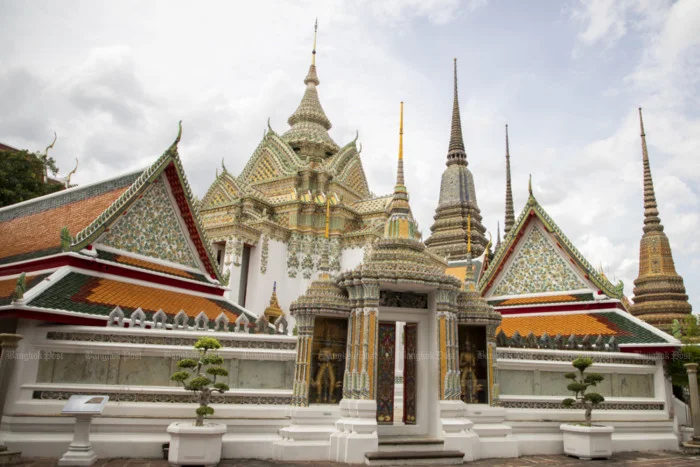
Most visitors to Wat Pho come for one thing: the 46-metre-long, gold-plated Reclining Buddha. Its massive spectacle never fails to impress, but beyond the temple’s most photographed landmark lie centuries of history that many visitors never discover.
Now, two architecture academics have developed and are continuing to expand an application called Insight Wat Pho to help visitors explore central Bangkok’s oldest temple in ways that go beyond a traditional walking tour. (Story continues below)
The idea emerged during a visit to the temple three years ago. Officially known as Wat Phra Chetuphon Wimon Mangkhalaram Rajwaramahawihan, the temple inspired the pair after they observed how visitors interacted with the site.
“We studied how visitors behaved while touring Wat Pho and noticed that, in many cases, some behaved inappropriately,” said Asst Prof Dr Wilasinee Darnthamrongkul of the Faculty of Architecture at Chulalongkorn University.
Some visitors showed little respect for the site or even climbed on historic structures, she said.
“Such actions can damage valuable historic monuments and artefacts.”
However, Ms Wilasinee acknowledged that such behaviour might not be intentional, but rather stemmed from a lack of understanding of the significance of what visitors were seeing. “This became the starting point for encouraging heritage education.”
“At Wat Pho, we often see people are packed around the chapel that houses the Reclining Buddha. They enter the building, walk around the statue and go back. But Wat Pho has much more than that,” says Asst Prof Dr Wilasinee Darnthamrongkul of the Faculty of Architecture at Chulalongkorn University.
Insight Wat Pho, available in Thai and English, offers seven main features: Plan Your Visit, Visitor Map, Wat Pho in History, Wat Pho from the Sky, Explore, Freeze-Frames and Yak Wat Pho.
Rather than filling the temple grounds with additional signs that could detract from the atmosphere, the developers wanted to provide engaging educational content through smartphones — devices that most visitors already use to navigate and take photographs. ”The Insight Wat Pho app supports both learning and the overall visitor experience in that way,” said Ms Wilasinee.
Why Wat Pho?
“The first reason is that we see Wat Pho as much more than a tourist attraction,” said Dr Spavit Darnthamrongkul of the School of Architecture, Art and Design at King Mongkut’s Institute of Technology Ladkrabang.
“It is both an important historic monument and one of Thailand’s significant religious sites.”
The temple has been regarded as the kingdom’s first open university since the reign of King Rama III, bringing together an extraordinary body of knowledge in one place, covering history, architecture, fine arts, literature and traditional medicine.
Despite being more than 300 years old, Wat Pho, unlike many historic sites, has a comprehensive and well-organised collection of documented information. It includes records, illustrations, layouts and architectural drawings showing the temple’s structures throughout different periods, including restoration work.
“That made Wat Pho the ideal place for us to transform a historic site into a kind of living museum — one that tells its own story and allows both Thai and international visitors to gain a deeper appreciation of the temple and its cultural treasures,” Dr Spavit said.
Phra Viharn photographs from different times are found in ‘Collections’ under the ‘Explore’ feature available on Insight Wat Pho.
Interactive experiences
Many features of Insight Wat Pho were designed to address problems commonly encountered by visitors.
“Visitors often get lost because Wat Pho has a rather complex layout with many small passageways,” the developers said.
To address this, the app uses augmented reality (AR) to create a three-dimensional virtual model of the temple, allowing visitors to view Wat Pho from a perspective they would never otherwise see. A bird’s-eye map helps users locate where they are and navigate the temple through a feature called Wat Pho from the Sky.
“Poetry Quizzes” is another notable feature. It introduces Klon Kon, or Konlabot, a traditional Thai poetic form whose verses must be deciphered using prescribed reading patterns. The feature teaches visitors how to decode the poetic word puzzles inscribed on the temple’s walls.
According to the developers, one of the app’s most popular features is Yak Wat Pho, which tells the mythical story of Yak Wat Pho and Yak Wat Jaeng, the guardian giants of Wat Pho and Wat Arun (Temple of Dawn).
According to the legend, the two giants, standing opposite each other across the Chao Phraya River, were once close friends until they fought over a debt dispute, devastating the surrounding area.
Phra Isuan, or Shiva, lord of the gods, then cursed them to be turned to stone and stand guard at their designated temples. The area where they fought has since been known as Tha Tian, or “flattened pier”, after being levelled during the battle.
As Wat Pho is home to several giant guardian statues, many visitors wonder which one is actually known as Yak Wat Pho.
“Is it this one? Or this one? The app helps visitors find the answer while learning about the others as well,” Ms Wilasinee said.
‘Visitors should not miss what is truly valuable’
After the Covid-19 pandemic, tourists began returning in large numbers. However, the developers noticed that although the ordination hall, or Phra Ubosot, contains many remarkable features — particularly its mural paintings — many visitors were unable to experience them properly.
Unlike most temple murals in Thailand, which depict the life of the Buddha, Wat Pho’s murals illustrate the Mahosadha Jataka, the fifth of the Ten Great Birth Stories, highlighting wisdom, ingenuity and the triumph of intelligence over force.
“The hall was often crowded, and at times it was closed for religious ceremonies,” Dr Spavit said. “Visitors would arrive only to find the building closed and miss the opportunity to see its interior.”
To overcome this, the developers adopted virtual reality (VR) technology to create a 360-degree tour, allowing visitors to explore the ordination hall virtually, navigate key locations and access detailed information at each point.
Even when the hall is open, the app allows visitors to zoom in on the murals and examine details that would otherwise be difficult to see from the ground.
“If visitors can stand in front of a site and immediately learn about what they're looking at, the experience becomes much more meaningful,” says Dr Spavit Darnthamrongkul of the School of Architecture, Art and Design at King Mongkut's Institute of Technology Ladkrabang.
Learning should be easy — and not costly
There is an enormous amount of knowledge about Wat Pho, which also reads as Bhodi that originally translates to enlightenment and wisdom. Yet much of that knowledge remains locked away in large, expensive reference books.
“We experienced this ourselves. We’d go to the library, only to find that the books couldn’t be borrowed or were too expensive to buy. We had to sit there and read them, and before long the library would close and we’d have to leave,” Ms Wilasinee said.
The knowledge already exists. Scholars, researchers and university lecturers have spent years documenting and writing about the temple. Insight Wat Pho was also created to overcome those barriers by gathering and putting verified knowledge at visitors’ fingertips.
Initially, the developers were concerned that the app might overlap with the role of tour guides. Instead, they found that it could become a valuable tool to support them.
Guides can use the app on an iPad to display close-up images while explaining details that are difficult to point out inside the temple, allowing visitors to see architectural features, murals and artwork more clearly.
With Wat Pho’s vast body of knowledge, the developers say Insight Wat Pho, now in use for three years, will continue to grow through new features and additional content.
As more research is added, the app will continue evolving, offering fresh knowledge and new experiences each time users return to Wat Pho, they noted.
The 46-metre-long, gold-plated Reclining Buddha of Wat Pho.