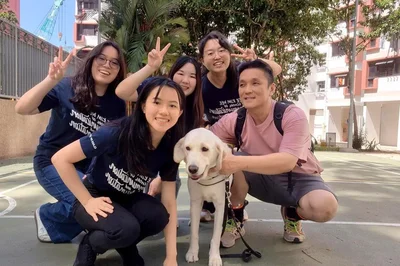
Before Mr Thomas Nathan Chan visits a new place, he makes the effort to find a contact number and call the place a few days ahead to tell them that he has a guide dog. If the staff express discomfort and there are alternatives to the place he plans to visit, he goes to one of those alternatives.
“(Awareness) is improving but I won’t push the boundaries,” said the visually impaired 47-year-old IT executive and bowling para-athlete. “Some of them are just not comfortable.”
Since he was paired with his labrador-golden retriever cross Eve in June 2022, she has been helping him navigate Singapore – while he has been navigating sticky situations. These include rejections from establishments which do not know that guide dogs are legally allowed in public places, or people who are unsure of how to appropriately interact with his guide dog and him.
To boost awareness of the purpose and rules surrounding assistance dogs such as guide dogs for the blind, four students from Nanyang Technological University’s Wee Kim Wee School of Communication and Information started a publicity campaign that ran from the end of 2025 to March 2026.
Unlike pet dogs, assistance dogs are trained to support people with disabilities.
The campaign, in the form of offline posters at public areas such as MRT stations and hawker centres, as well as online social media posts and videos on Instagram and TikTok, was their final-year project for their communication studies degree.
Mr Chan, who met the NTU team four times in the course of their project, also allowed the students to feature Eve in their publicity materials and videos, where she took on the persona of the campaign canine ambassador under the name Bark.
The online videos show the rigour that goes into training a certified guide dog, while the posters educate the public on proper etiquette, such as not to pet or distract guide dogs.
The NTU students – Ms Jaymee Tan Yi Xin, Ms Ruth Loo Hui En, Ms Tan Tze Wei, all aged 23, and Ms Jin Qiuhui, 25 – who call their team The Pawfessionals, met Mr Chan through the charity Guide Dogs Singapore (GDS), which they had approached for their research on the topic.
Said Ms Jaymee Tan: “Our biggest takeaway was being able to witness first-hand how guide dogs provide not just independence, but also joy and companionship to their handlers... It was especially meaningful for us to observe the bond between Thomas and Eve throughout our filming sessions with them.”
Assistance dogs can help people with a range of disabilities, though in Singapore, such dogs with full public access are currently seeing-eye guide dogs, said the NTU team.
Since 2024, government agencies in Singapore have been working out the details to allow other assistance dogs, such as those that support individuals with mobility issues, full public access in Singapore.
Ms Loo said: “Through our campaign, we hope to prep the general public to be more accepting of the guide dogs that are currently in society, so in future, when there are more assistance dogs and access for them, the public will be more gracious towards the handlers.”
One of the posters at Jurong West Market and Food Centre.
PHOTO: THE PAWFESSIONALS
Their research found a gap in awareness. From their survey of around 200 people, one-third of them said they would pet assistance dogs if they saw them in public. However, they should not do so as they could distract the dogs and put the safety of users at risk.
For instance, Mr Chan often meets people who want to interact with Eve, not realising that as a guide dog, she cannot be distracted while she works. Some people attempt to do so without speaking to him or asking for permission.
He said: “If you want to talk to the dog, you should talk to me. Generally, she’s a very PR dog – she likes to interact with people. Of course, I won’t let her do it when she’s working. But if we’re sitting down and waiting for something, if they want to interact with the dog and if I have time, I would take off her harness and let them interact with the dog.”
Assistance dogs wear harnesses to indicate that they are working dogs.
A spokesperson for GDS – which was set up in 2006 and has matched 14 guide dogs with handlers, with nine of these teams currently active – said: “It is evident that guide dog awareness and acceptance have improved over the years.
“However, despite the improvement in people’s attitudes towards guide dogs, this is still a work in progress as we often hear about the rejection that our guide dog users face in public spaces.”
Some examples include users being turned away from food and beverage outlets, or refused rides by taxi drivers or ride-hailing drivers.
“Such treatment is not just upsetting; it also affects the handler’s plans and overall feelings of acceptance and belonging in the community,” noted the spokesperson.
One of the posters at MacPherson MRT.
PHOTO: THE PAWFESSIONALS
GDS said the posters in the MRT stations were highly visible and eye-catching, and that the social media campaign was well done, “covering the crucial points about guide dog training and skills in an engaging manner”.
For Mr Chan, every bit of publicity helps contribute to awareness, noting that constant reinforcement is required so “people remember and don’t forget”.
Asked about how the team would gauge its campaign’s success, Ms Loo said: “Success for us would be sparking conversations and creating real-world impact. Beyond simply raising awareness, we wanted the campaign to tangibly reach physical touchpoints where the public are likely to encounter (assistance dog) teams in their everyday lives.”
Ms Jin said: “If our content manages to help even one Singaporean know more about this topic and help reduce the chances of guide dog teams being denied access, it’s considered a success.”
For more information on the campaign, visit @hey.its.bark on Instagram
- Do not distract them by calling out to them or by their name, petting or feeding them.
- Do not attempt to handle them as it could cause them to lose focus.
- If you want to offer help, speak to their handlers directly.