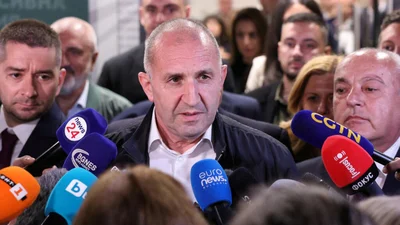
Bulgarian former president Rumen Radev, an EU critic who has called for renewing ties with Russia, has won an absolute majority in parliamentary elections that could spell an end to the country's half-decade of political uncertainty but also potentially push the EU and NATO member state closer to Moscow.
Issued on: 20/04/2026 - 12:46
2 min Reading time
Radev, 62, who resigned earlier this year after nine years as president, ran in Sunday's vote on a pledge to fight corruption, bringing together a wide spectrum of voters, with the turnout the highest since 2021.
His Progressive Bulgaria grouping secured 44.7 percent, after 91.7 percent of the ballots were counted, putting him on course to gain some 130 seats in the 240-seat parliament.
The party's sweeping victory suggests it could rule alone, but he has not ruled out a coalition with a pro-European group or a smaller party.
It marks the first outright parliamentary majority for a single formation in Bulgaria since 1997 when a centre-right, pro-European grouping won.
Progressive Bulgaria's tally put it far ahead of the pro-European We Continue the Change-Democratic Bulgaria (PP-DB) coalition with 13.2 percent, and the long-dominant GERB party, led by former prime minister Boyko Borissov, at 13.4 percent, according to the electoral commission's results.
The far-right Vazrazhdane party and the Turkish and Roma minority party MRF also made it into parliament.
From optimism to unease: Bulgarians count the cost as euro replaces lev
'Victory of hope'
"PB has won unequivocally - a victory of hope over distrust, a victory of freedom over fear," Radev told told a press conference late on Sunday.
A eurosceptic and former fighter pilot opposed to military support for Ukraine's war effort against Moscow, Radev stepped down from Bulgaria's largely ceremonial presidency in January to run in the parliamentary election after mass protests forced out the previous government in December.
He said Bulgaria would "make every effort to continue on its European path" but insisted that "a strong Bulgaria and a strong Europe need critical thinking and pragmatism".
He also favours engaging dialogue with Moscow.
"Of course, the words of Mr Radev ... as well as some other European leaders about their readiness to resolve problems through dialogue, appeal to us," Kremlin spokesman Dmitry Peskov told reporters Monday.
Radev rode a wave of frustration with political instability in the Balkan nation of 6.5 million, supporting anti-corruption protests last year that brought down the latest conservative-backed government.
The troubled legacy of Ion Iliescu, who rebuilt Romania but left it torn in two
Foreign policy uncertainty
Radev's campaign drew comparisons with Hungary's pro-Kremlin former prime minister Viktor Orban when he talked about improving ties with Moscow and resuming the free flow of Russian oil and gas into Europe.
He also criticised the European Union for relying too heavily on renewable energy.
However, Radev has been vague on policy and it is not yet clear how much he will change foreign policy in Bulgaria, which joined the euro zone in January – a move Radev has criticised.
Radev is expected to face "pressure" to lead Bulgaria down a "eurosceptic" path, both from within his own party and the far-right opposition, according to Daniel Smilov, a political scientist at the Center for Liberal Strategies.
"His initial signals are that he will pursue a pro-European policy and will not block the EU... The whole question is whether those signals will actually be followed through," he told AFP.
(with newswires)