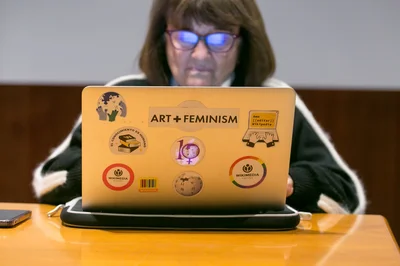
A group of editors meets every Tuesday — computer in hand — to correct a blind spot of digital knowledge: the absence and bias with which the history of women is told on Wikipedia, the platform co-founded 25 years ago by Jimmy Wales and Larry Sanger, in an internet age that today seems remote.
In the library of the Reina Sofía Museum in Madrid, eight of them are gathered around a table one afternoon in March. On their computer screens, a Wikipedia window and a Zoom window coexist, allowing them to chat and coordinate with other participants online. They have been editing voluntarily and for free for over 10 years. “Anyone who comes is welcome,” says Carmen Galdón (Madrid, 61 years old), a PhD in social sciences and founder of this project, called Cuarto Propio en Wikipedia (A room of one’s own on Wikipedia).
Their campaign aligns with similar initiatives around the world — such as Wikiesfera and Arte+Feminismo — and contrasts sharply with earlier projects of this kind, where the male scholarly elite of the time held a majority, as in D’Alembert and Diderot’s Encyclopédie, a project cited by journalist and writer Arturo Pérez-Reverte in his novel Hombres buenos (Good Men) about the coveted prize of two academics from the Royal Spanish Academy in the 18th century. Learning to recognize how a biography reduces a woman to being “the wife of” or “the daughter of,” the editors explain, is part of their work. “Language speaks volumes, and simply including women isn’t enough,” says the founder. “How you include them is fundamental. If you don’t follow up and carefully consider your approach, you perpetuate stereotypes.”
In over a decade — they began their work in October 2015 — they have created and improved hundreds of entries on Spain’s version of the website: contemporary scientists, forgotten athletes, victims of repression under the Franco dictatorship, key figures in Spanish art galleries, environmental leaders, a list of pseudonyms and artistic names of Latin American writers and collectives such as the Association of Women Affected by Forced Sterilizations, an organization that represents women who were victims in different provinces of Peru during the government of Alberto Fujimori. Stories that were scattered, poorly told, or simply absent.
A space not immune to gender bias
A study published in scientific journal PLOS One maintains that a mere 11.6% of editors on Spanish Wikipedia were women in 2021. Another study — an exploratory review of the well-known free encyclopedia from 2007 to 2022 — concluded that the gap was significant among volunteer editors and led to gender disparities in content. The work, conducted by researchers from the University of Barcelona and the STEAM group at the Open University of Catalonia (UOC), mentions several barriers preventing women from participating more on Wikipedia, including experiences of rejection, lack of time, and knowledge ownership.
The world’s largest online encyclopedia requires references. And finding them, especially for women from the past, can become a Herculean task. “If it’s already difficult to find sources on medieval writers, imagine finding them on female writers,” says Consuelo Fernández (Madrid, 72 years old), a retired graduate in economics and a collaborator on the project since its inception.
Carmen Galdón, PhD in Social Sciences and founder of Cuarto Propio on Wikipedia.Santi Burgos
Some of the collective: Carmen Galdón, Gema Mañogil, Mónica Fernández, Florencia Claes, Consuelo Fernández, Marisa González, Carmen Díez.Santi Burgos
Cuarto Propio en Wikipedia includes other contributors online.Santi Burgos
Mónica Fernández (left), a sociologist, and Florencia Claes, who holds a PhD in communication and is a professor at Rey Juan Carlos University.Santi Burgos
Much of that documentation resulted from discussions they organized. These generated names, topics, references, and questions that were later transformed into articles. “We talked about democratic memory, menopause, end-of-life care, science, and feminism,” Galdón lists. “We listened, gathered references, identified potential starting points, and then edited.”
Others appear in large-scale edit-a-thons (recovering women’s biographies narrated by other women) or workshops. Men are also welcome. “We work with every possible detail. We dig up sources from every corner,” says Marisa González (Bilbao, 82 years old), a pioneering artist in the application of new technologies and a member of the group for eight years. Editing Wikipedia, they say, is a job fueled by curiosity and obsession. “Everything published on Wikipedia has to be supported by solid sources: books, studies, newspapers. Having that information is fundamental,” Galdón explains.
AI and reactionary discourse
Wikipedia has just turned 25, and the anniversary comes at a delicate time for text editing and creation. Although it remains a central source of information, it receives fewer direct visits since the expansion of artificial intelligence in web search engines. “The paradox is that AI draws heavily on Wikipedia, but it makes it invisible,” explains Galdón.
The collaborative encyclopedia is funded through small donations. “If people stop visiting, they stop donating,” warns the sociologist. Added to this are ideological attacks like those from Elon Musk, who has openly questioned the project and launched his own personal, conservative alternative written with AI, Grokipedia. “If he wants to replace it with something else, it’s because something is bothering him. Wikipedia doesn’t represent a single viewpoint,” Galdón concludes.
The rise of reactionary rhetoric also permeates their work. Its founder acknowledges the existence of an antifeminist backlash, especially among some young people, but resists defeatism. “I prefer to focus on the percentage that isn’t there,” she says. “Discouragement leaves you unable to vote, to edit, to speak out.” Feminism, she affirms, is not exclusive; men are also welcome: “They must be involved. Without them, we’re going nowhere.”
After 10 years, the group has navigated motherhood, caregiving, illness, and grief. In the end, the idea returns to its initial premise: to occupy the internet, to exist online with its own name. “That’s why it’s so important to be here,” Galdón affirms.
Sign up for our weekly newsletter to get more English-language news coverage from EL PAÍS USA Edition