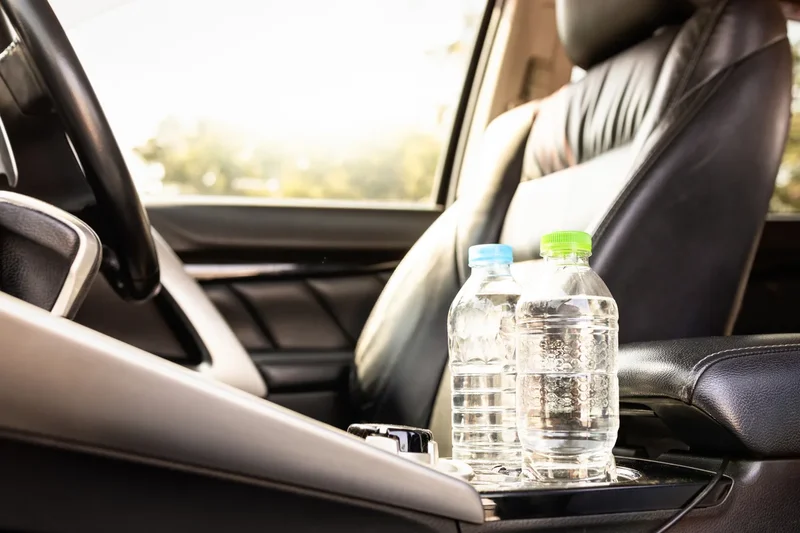
You’ve likely been warned at least once, with little explanation, not to drink water from a disposable plastic bottle left in a hot car. But what is the science behind these concerns?
Single-use plastic water bottles are typically made from PET, a durable synthetic polymer that is generally considered safe. However, research suggests there are several reasons to avoid drinking water that has been left in a heated PET-containing water bottle.
Chemical exposure
When plastic containers are left in the heat or direct sunlight, certain chemicals used in plastics can more easily migrate into food or drinks.
Phthalates, which are synthetic chemicals that are used to make plastics soft and flexible, can quickly leach from some plastic packaging when exposed to heat, Emily Barrett, an associate professor of biostatistics and epidemiology at Rutgers School of Public Health, told HuffPost in 2022.
Phthalates — along with other chemicals used to make hard plastics — are endocrine disruptors. This means “they interfere with the natural hormones in our body,” Jaime Ross, a neuroscientist at the University of Rhode Island, said in 2025 to The New York Times.
Exposure to these types of chemicals, such as BPAs (a chemical used to make polycarbonate plastics), has been linked to many health concerns, “including infertility, thyroid dysfunction, various types of cancer, metabolic issues, as well as behavioral problems in children,” Dani Lebovitz, M.S., RDN, a food and nutrition education expert based in Tennessee, said in 2023 to EatingWell.
The Food and Drug Administration’s position is that the current levels of BPA and certain phthalates used in food packaging are safe. Yet, multiple experts explained to HuffPost that, given the traces found in everyday objects, it’s best to limit additional exposure where possible.
A popular claim that has circulated on social media is that heated plastic water bottles release toxic, cancer-causing chemicals called dioxins. This urban myth, however, has been debunked by Dr. Nicole Deziel, an environmental epidemiologist at the Yale School of Public Health. They do not, she insisted to The Times.
Risk of microplastics
There is, however, also the potential for tiny pieces of plastic, known as microplastics, to migrate into the water. While bottled water often already contains microplastics, heat can accelerate the process by which bottles shed billions of microscopic fragments into their contents, Food & Wine reported in 2025.
The current literature about the effect microplastics can have on our bodies is still quite limited. “There are so many unknowns,” said Bernardo Lemos, an adjunct professor of environmental epigenetics at the Harvard T.H. Chan School of Public Health, in the University’s medical magazine, Harvard Medicine, “but we are seeing more data that suggest microplastics affect human biology.”
According to Harvard Medicine, studies done on cell cultures, marine wildlife and animal models indicate that “microplastics can cause oxidative damage, DNA damage, and changes in gene activity, known risks for cancer development.”
The magazine cited a few studies conducted in mice that found that microplastics harmed reproductive organs, causing ovarian scarring, reduced sperm count and quality, and metabolic disorders in offspring.
Bacterial growth
Another concern is that hot environments create a breeding ground for bacteria.
“Bacteria grow in bottles due to moisture, warmth and nutrients, from saliva or drink residue,” Dr. Bruno Silvester Lopes, a lecturer in microbiology and epidemiology at England’s Teesside University, shared with The Independent last year.
They can “start multiplying in as little as 20 minutes,” he shared, “and in 24 hours can reach a staggering billion or even trillions of cells.”
Consuming that water can lead to an upset stomach or, worse, make you sick, according to Jackson Health System, an online nonprofit academic medical system.
Safer alternatives
In recent years, there has been a shift toward reusable water bottles over disposable plastic ones. Not only is this better for the environment, as it reduces the amount of single-use plastic that will end up in landfills, but it can also be beneficial to your health.
The safest option is an insulated water bottle, such as the trendy Stanley or Hydro Flask. They are generally made from food-grade stainless steel, an alloy primarily composed of iron, chromium and nickel, and avoid many of the concerns associated with plastic bottles, including BPA exposure and microplastic release from the container itself. Glass water bottles are another similar option.
However, if you prefer a lighter-weight water bottle — like the popular Nalgene, made of harder plastics — these are still safer than single-use plastic bottles, since they are less likely to break down and leach plastic and chemicals when exposed to heat or direct sunlight, Dr. Deziel shared with The Times.
But the expert reminded readers that any type of plastic can be degraded by time, heat or general wear.
One catch for both stainless-steel and reusable plastic bottles is that you must regularly give them a good wash. Otherwise, bacteria and mold can grow inside.
Stainless-steel bottles remain a better choice, Dr. Suzanne Wylie, a GP and medical adviser for IQdoctor, noted in 2025 to The Independent because they “are generally more hygienic than plastic ones, as they are less likely to develop microabrasions that can harbor bacteria.”