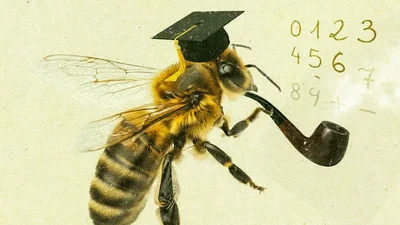
Scientists in a buzz over discovery that bees can understand numbers
Save
You have reached your maximum number of saved items.
Remove items from your saved list to add more.
Save this article for later
Add articles to your saved list and come back to them anytime.
Got it
AAA
European honeybees can “count” numbers up to six and understand the concepts of zero and “greater than” and “less than”, according to new international research led by Monash University.
Scientists have long debated whether honeybees – and other animals including fish and newly hatched chicks – can distinguish number values and process numerical information or simply rely on visual cues including patterns and size.
Counting this many honeybees may be a stretch, but new research shows bees can distinguish between numbers.istock
The Monash-led research, published today in the peer-reviewed Proceedings of the Royal Society B: Biological Sciences, finds that previous studies that dismissed bees’ capacity to discriminate between numbers did not take bees’ unique sensory and perceptual abilities into account when trying to answer this question.
Senior lecturer Dr Scarlett Howard, from Monash University’s School of Biological Sciences said the findings underscored the importance of avoiding human-centric biases in animal research.
“We see and experience the world quite differently from animals, so we must be careful [to not centre] human perspectives and senses when studying animal intelligence,” she said.
Howard prefers not to use the word “count” when describing what honeybees are able to do, but she and her research team agree that honeybees are capable of what they describe as “numerical cognition” in numbers up to six, and can learn a relative numerical rule of “greater than” or “less than”, as well as the concept of zero.
A European honey bee.Getty Images
Studies have also shown that honeybees can learn to sequentially count landmarks.
To arrive at their findings, the team from universities in Australia, Italy and France used modelling and statistic analysis, based on the visual capacity of real honeybees, to determine how they perceive the world.
“The way we’ve now redone the modelling is actually by using what the bees perceive and what we know they can see based on these previous studies that have looked at their vision,” Howard said.
“So what we’re saying here is that [bees are] doing number discrimination, like if we saw three apples versus four apples, we would be able to tell which one’s the bigger one, and which one’s the smaller one.”
So what are the real-world applications to the findings?
“Studying bee intelligence is quite a niche area, but it does have applications to things like understanding the evolution of intelligence in both animals and humans,” Howard said.
“It tells us whether the rise of mathematics and number ability is something related to human culture and human language, or if it’s something that’s quite widespread. So you kind of start to get to philosophical questions of what is it to be a human, or what is it to be a bee.”
A big unanswered question is how bees compute the information they receive.
“Their brains are completely different to ours,” Howard said.
“We have 86 billion neurons, and they have less than a million; their brains are the size of a sesame seed, and ours are much, much larger than that ... we’re not exactly sure if they’re processing numbers in a way that’s similar to us, or if they’re doing it in a completely different way.”
Get to the heart of what’s happening with climate change and the environment. Sign up for our fortnightly Environment newsletter.
Save
You have reached your maximum number of saved items.
Remove items from your saved list to add more.
Bianca Hall is The Age's environment and climate reporter, and has worked in a range of roles including as a senior writer, city editor, and in the federal politics bureau in Canberra.Connect via X, Facebook or email.