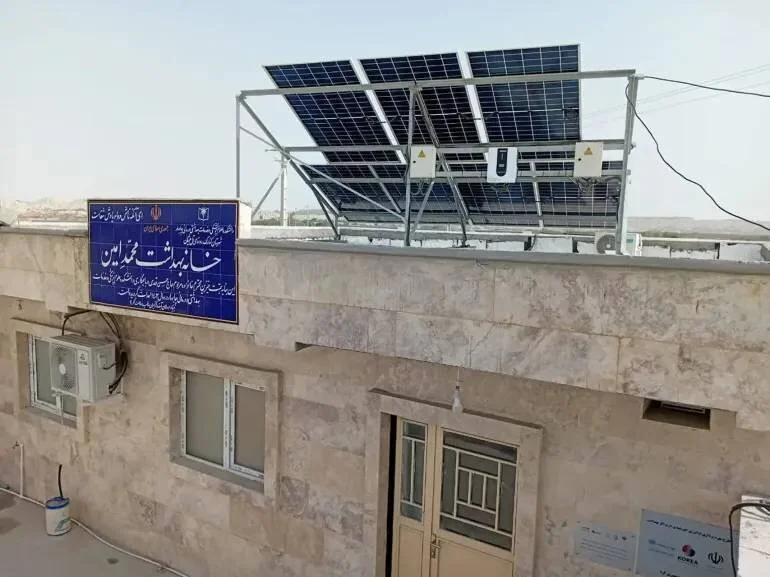
Seven rural health facilities in Chabahar equipped with solar power systems
TEHRAN – Funded by the Government of the Republic of Korea, the United Nations Children’s Fund (UNICEF), in cooperation with the Ministry of Health, has supported the installation and commissioning of seven hybrid solar power systems in rural primary health care facilities across Chabahar, southeastern Sistan-Baluchestan Province.
The systems, each with a capacity of 5 kW, have been installed in health houses serving more than 6,000 people in the villages of Tal Mishan, Dak Talang, Nadkan, Voshnam, Gazmanzel, Rado Bala and Faqirzehi. The facilities are located across Chabahar, Konarak, Qasr-e Qand, Dashtiari and Zarabad districts, including some of the most remote and underserved communities in south-eastern Iran, UNICEF website announced in a press release on July 27.
They now benefit from reliable, clean energy. Reliable electricity is essential for the safe delivery of health services. Power interruptions can disrupt vaccine cold storage, medicine preservation, patient registration, and routine health care operations. Equipped with backup capacity, the new hybrid solar systems help health workers maintain essential services during outages and protect temperature-sensitive vaccines and medicines.
Clean energy for self-sustained health systems
The initiative also contributes to environmental sustainability by reducing reliance on fossil-fuel-based electricity. Collectively, the seven systems are expected to generate approximately 70,000 kWh of clean electricity each year and reduce annual greenhouse gas emissions by nearly 49 tons of carbon dioxide equivalent. This environmental benefit is comparable to planting almost 2,000 trees.
Beyond improving energy security, the project is developing an innovative sustainability model that could help health facilities generate income from surplus electricity. Under the proposed mechanism, excess power produced by the solar systems could be exported to the national grid through dedicated metering systems and purchased under guaranteed power-purchase arrangements.
Revenue from the sale of surplus electricity would be directed back to the health facilities to support priority operational and maintenance needs. Current projections indicate that each health house could generate approximately 600 million rials (around 312.5 thousand dollars) in additional income during the first year of operation, with potential increases over time.
A sustainability model for future expansion
Once finalized, the model could be scaled across Iran’s health system and adapted for other public services, including schools. By combining reliable clean energy with a potential self-financing mechanism, the model offers a practical approach to strengthening essential services in underserved communities.
UNICEF, Health Ministry equip six health centers in Chabahar
UNICEF, in cooperation with the Health Ministry, has equipped six primary health care service delivery points in Chabahar to improve health service access and quality for 9,906 local residents, particularly children and mothers.
Funded by the Government of the Republic of Korea, the program focuses on providing essential equipment to selected health centers, houses, and posts that were previously unable to offer full services to children and families in remote areas, UNICEF website announced in a press release on July 1.
The initiative addresses the immediate needs of the whole population with a focus on boys, girls, and pregnant women in underserved communities. By equipping these service delivery points, the project ensures that the target groups can receive Routine immunizations: Protecting them from childhood diseases; Growth monitoring: Tracking nutrition and physical development; Maternal health services: Supporting safe pregnancies and healthy outcomes for newborns; and a full package of primary health care services.
With the full package of the new equipment, health workers can now provide full PHC services, including conducting early screenings for developmental delays. Identifying these needs early allows families to receive timely counseling and referrals to specialized care, ensuring no child is left behind.
In the scattered rural settlements of Chabahar, families often had to travel long distances beyond national standards to reach a functioning PHC clinic. This journey often led to delays in treatment or may cause them to skip the necessary services.
By reactivating five health houses/ posts and one rural comprehensive health center, UNICEF and its partners are bringing quality healthcare closer to home. This intervention reduces the burden on overcrowded facilities and ensures that families in hard-to-reach areas can access the care they need, when they need it.
MT/MG