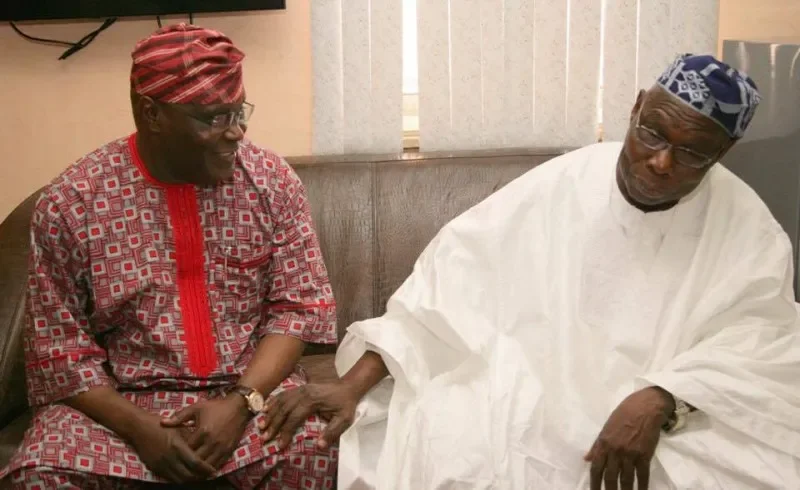
Former President Olusegun Obasanjo has described his decision to select Atiku Abubakar as his running mate in the 1999 presidential election as the biggest mistake of his political career.
Mr Obasanjo disclosed on Friday in Lagos while speaking with veteran entertainer Charles Oputa, popularly known as Charly Boy, during a fireside chat at the unveiling of the Charly Boy Foundation and the launch of the entertainer’s memoir, 999: A Memoir in Tribute to Late Justice Chukwudifu Oputa.
The former president was reflecting on his political career and the decisions he made during his time in office when he was asked about his choice of a running mate in 1999.
Mr Obasanjo said he would not have picked Atiku had he known at the time what he later learned about him.
| | |
|---|
“The man I picked as my running mate, my number two. If I had known him as I came to know him later, I would not have picked him,” he said.
When Mr Oputa asked whether he was referring to Atiku, Mr Obasanjo replied: “My vice president. I don’t know what name you want to give him, but my vice president, I mean that.”
He said his experience in office with Atiku later influenced his assessment of the former vice president.
“Of course, what I know about him later… I would not have picked him. Thank God that God did not allow his actions and reactions to overwhelm me, divert my focus from Nigeria or harm Nigeria,” Mr Obasanjo said.
Despite his criticism, Mr Obasanjo said he had no personal bitterness towards his former deputy.
“There’s no bitterness because he did what he believed he should do, and God did what God had to do, which enabled me to achieve what I was able to achieve,” he said.
How the relationship broke down
Messrs Obasanjo and Atiku initially worked closely during the administration’s first term, with the former vice president playing prominent roles in economic policy and government institutions, including the National Economic Council and the National Council on Privatisation.
Their relationship, however, deteriorated as political differences intensified.
One of the major sources of disagreement was the controversy surrounding Mr Obasanjo’s alleged attempt to amend the Constitution to enable him to seek a third term in office.
Atiku opposed the move and eventually fell out with the president. The disagreement deepened ahead of the 2007 general election when Atiku left the PDP for the defunct Action Congress (AC) and emerged as the party’s presidential candidate.
Mr Obasanjo subsequently declared the vice president’s office vacant, but the Supreme Court ruled that the president lacked the constitutional power to remove an elected vice president from office.
The court’s decision allowed Atiku to remain in office until the expiration of the administration in 2007.
Their political rivalry continued after they left office, with both men making accusations against each other over their conduct while in government.
Mr Obasanjo has also previously expressed strong opposition to Atiku’s presidential ambitions.
In a 2018 interview with PREMIUM TIMES, the former president said he could not support Atiku for president, arguing that he knew his former deputy differently by then.
“If I support Atiku for anything, God will not forgive me if I do not know, yes. But once I know, Atiku can never enjoy my support,” Mr Obasanjo was quoted as saying.
Fresh political tension ahead of 2027
The latest comments come amid renewed political activity involving both men ahead of the 2027 presidential election.
Atiku, who is now the presidential candidate of the African Democratic Congress (ADC), has recently accused Mr Obasanjo of covertly backing a preferred candidate for the 2027 election.
In a statement by his Senior Special Assistant on Public Communication, Phrank Shaibu, the former vice president challenged his former boss to publicly declare his preferred candidate rather than allegedly attempting to influence the election by criticising his political opponents.
The statement followed Mr Obasanjo’s revival of an allegation that Atiku gave the late Speaker of the House of Representatives, Ghali Na’Abba, ₦5 million to initiate impeachment proceedings against him while he was president.
READ ALSO: TRENDING: “If I had known him better, I wouldn’t have picked him as running mate” Obasanjo
Atiku rejected the allegation and described its resurfacing as an attempt to damage his political standing.
He argued that Mr Obasanjo should openly identify the candidate he supports and allow Nigerians to judge the candidates on their merits, particularly because Mr Na’Abba, who was identified as a key figure in the old allegation, is deceased.
Atiku did not expressly name President Bola Tinubu in his remarks but referred to Mr Obasanjo as allegedly supporting his “kinsman,” a description that, in the political context, was interpreted as a reference to the president.
Mr Obasanjo, a retired general and former head of state, emerged as the PDP presidential candidate for the 1999 election and picked Atiku as his running mate. At the time, the latter had won the governorship election in his native Adamawa State but had not been sworn in.