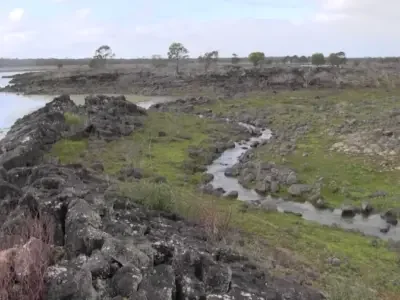
Australia has one of the world’s oldest aquaculture sites, a controlled aquatic farming environment, where eels were farmed by Indigenous people for thousands of years. Scientists estimate one of the five systems is around 6,600 years old, based on carbon-dating findings.
The Budj Bim eel farms’ cultural landscape in western Victoria was added to the UNESCO World Heritage List in 2019. Budj Bim is a dormant volcano with ancient basalt lava flows. It was the first site inscribed on the UNESCO list for its cultural significance alone.
This video was produced by the Gunditj Mirring Traditional Owners Aboriginal Corporation at the time of its nomination:
VIDEO
The Gunditjmara are the traditional Indigenous owners of the land. They resisted white colonization and dispossession in the hard-fought frontier Eumerella Wars from the 1830s to the 1860s. Many lived on a Church of England mission near Lake Condah from the 1890s till the 1950s.
This hand-drawn map of the Lake Condah area and fish trap systems was produced by Alexander Ingram in 1893:
Map of Lake Condah Aboriginal Fishery produced by Alexander Ingram. Reproduced courtesy of the South Australian Museum. Used with permission.
TikTok user, westvicbrolga, recently posted a video of a Budj Bim tour led by Gunditjmara man, Joey Saunders:
Local Winda-Mara Aboriginal Corporation conducts guided tours of the eel traps and stone houses. The Tae Rak Aquaculture center at Lake Condah has many stone holding tanks for eels, and visitors can have an eel tasting in their bush tucker cafe.
The discovery of the traps has helped to correct misconceptions about pre-colonial Indigenous peoples as being only nomadic hunter-gatherers. Ian J. McNiven, Professor of Indigenous Archaeology at Monash University explained the new findings in an article in The Conversation:
Rather than living passively off whatever nature provided, the Gunditjmara actively and deliberately manipulated local water flows and ecologies to engineer a landscape focused on increasing the availability and reliability of eels.
Manipulation of the landscape involved stone structures (such as traps and channels) dating back at least 6,600 years. Eel aquaculture facilities (ponds and dam walls) pre-date contact with Europeans by many hundreds (and possibly thousands) of years.
The remains of approximately 300 stone-walled structures, which may have been houses, have also been found near the eel traps. They could provide evidence of permanent occupation before European contact.
Remains of a stone hut at Budj Bim 2022. Photo by Heather Milton. Used with permission.
One of the world’s oldest creation stories also stems from Budj Bim, explaining the origins of the iconic volcano:
Post by @janggolan@mastodon.social
View on Mastodon