Football is often admired for the virtues it appears to reward: technique, speed, stamina, and tactical intelligence. Yet in elite football’s decisive moments, another contest unfolds beneath the surface. Players test nerves. Referees set—or fail to set—the limits of acceptable conduct. Crowds thicken the air. Technology interrupts the pulse of the match. The result is a sport that is never merely physical. At its highest level, football is also a contest of nerves—a mind game played beneath the beautiful game.
At times, the pitch becomes an arena of controlled intimidation. Bodies are used not just to tackle but to unsettle. Reputation becomes an instrument of pressure. Players test the referee’s tolerance through small provocations: a late shove, a delayed restart, a whisper before a penalty, a defender lingering near the ball, a goalkeeper turning the goal line into a stage. Each gesture is small. Together, they form a campaign against concentration.
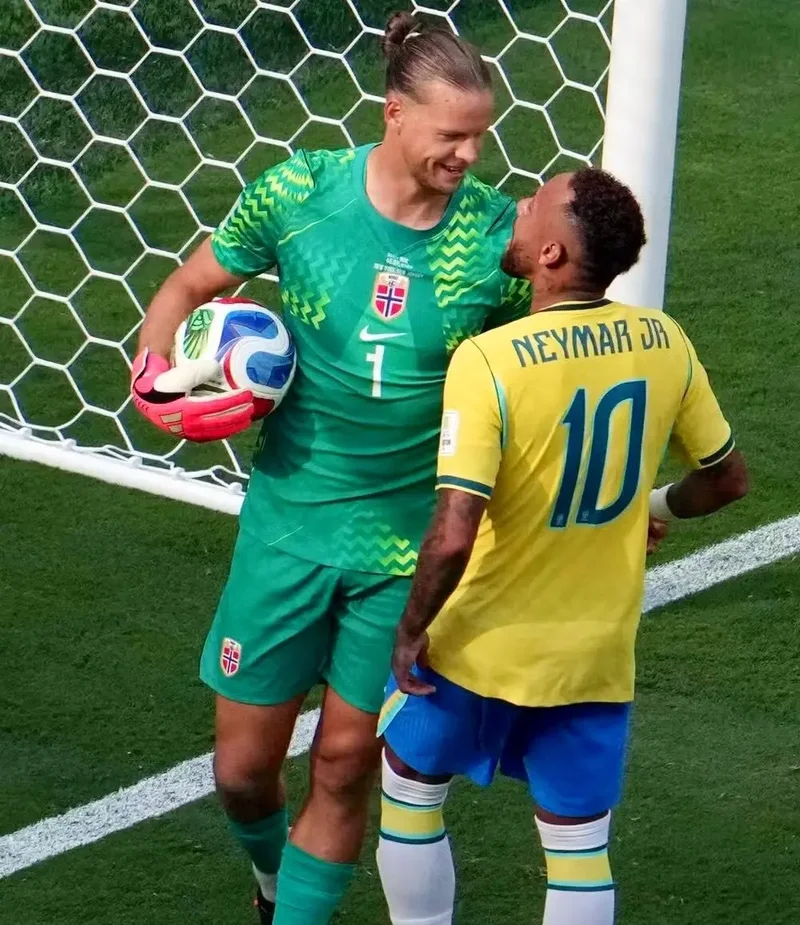
The most obvious version of this contest is verbal. Footballers compete not only for space and possession but also for mental territory. In Brazil’s 2026 World Cup defeat by Norway, Neymar and the Norwegian goalkeeper, Ørjan Nyland, appeared to exchange words around a stoppage-time penalty. Nyland had earlier saved a penalty from Bruno Guimarães and tried to unsettle Neymar, too. Neymar scored and answered back. Brazil still lost 2–1 but the episode captured something essential about the modern game: even a consolation penalty can become a contest of pride, nerve and psychological advantage.
Penalties are therefore football’s most concentrated mental duel. They seem brutally simple: one player, one goalkeeper, one ball, 12 yards. Yet the simplicity is a trap. Goalkeepers delay, gesture and talk. Defenders crowd the taker or scuff the spot. Referees intervene, retreat, consult and return. The taker must stand alone in a stadium full of noise.
In France’s 2026 World Cup quarter-final against Morocco, Kylian Mbappé waited more than three minutes while VAR confirmed a penalty decision before Yassine Bounou saved his spot kick. Mbappé later said the delay and confusion had disturbed his focus. He recovered, scoring in the second half and setting up Ousmane Dembélé as France won 2–0. The episode offered a fuller lesson: pressure can unsettle even the finest players but resilience is part of the same mental game.
Players do not control this psychological economy alone. Referees create its conditions. One who tolerates repeated tactical fouling, excessive contact or theatrical dissent invites escalation. One who applies the laws firmly and consistently can lower the temperature before aggression hardens into intimidation. This is not an argument for sanitising football. Contact, courage and competitive fire are part of its appeal. But when physicality becomes bullying and gamesmanship becomes harassment, the contest is diminished rather than enriched.
Technology was meant to support that authority. Instead, it has sometimes shifted the emotional centre of the match away from the referee and toward a remote review process. Under the IFAB protocol used by FIFA, VAR may assist the referee only in cases of a clear and obvious error or a serious missed incident relating to goals, penalties, red cards and mistaken identity. In principle, this protects justice. In practice, it can suspend emotion. Players wait while officials inspect slow-motion fragments. Celebrations freeze. Anger gathers. Momentum drains away. The decision may be right; the interruption has already changed the match.
That is why the argument about VAR cannot be confined to accuracy. Football also depends on rhythm. A technically correct decision, delivered after a long and opaque delay, can still leave players and spectators feeling that the game has been taken over by a distant authority. FIFA should not abandon technology. It should make it quicker, clearer and less intrusive, while restoring the referee’s role as guardian of the match’s emotional balance.
Rhythm is not disturbed only by VAR. Hydration breaks introduce a different kind of interruption. There is a strong player-welfare case for cooling pauses in extreme heat and FIFA has made three-minute breaks mandatory midway through each half at the 2026 World Cup, regardless of weather or whether a stadium is enclosed. Yet the universal rule changes the texture of the game. A 45-minute half is no longer a single arc of pressure and response; it is divided into two quarters. Teams with momentum must rebuild rhythm. Teams under pressure get a sanctioned pause. Players and spectators alike must adjust to a new rhythm.
If pressure can be misunderstood inside a match, it is often misread afterward, too. Late defeats are too easily explained as failures of mentality, especially when African teams concede in the dying minutes of major tournaments. That explanation is convenient and often simplistic. Late goals may reflect fatigue, delayed substitutions, poor game management, an individual error or simply the opponent’s quality. Great teams from every continent have lost control at the end of matches. To reduce such outcomes to a supposed absence of mental strength is not analysis. It is a stereotype dressed as insight.
The better response is not to moralise about mentality but to prepare for pressure as seriously as for tactics and fitness. Modern football invests lavishly in data, video analysis and physical conditioning. It should invest as deliberately in emotional control, penalty routines, referee management and resistance to provocation. The best teams do not merely endure pressure; they rehearse it. They know who speaks to the referee, who shields the penalty taker, who slows the game within the laws and who reminds the team of the next task after a setback.
Football will never be free of mind games. Nor should it be. Much of its drama lies in the struggle between composure and chaos. But the sport needs clearer limits: against intimidation masquerading as competitiveness, against physical duels sliding into calculated bullying and against interventions that protect fairness or welfare while eroding rhythm. The game is at its best when skill, courage, intelligence and composure decide the outcome—not harassment, confusion or endless interruption. That is the standard FIFA should defend.
Anthony Ohemeng-Boamah writes on development, governance, international affairs, and the political economy of sport.