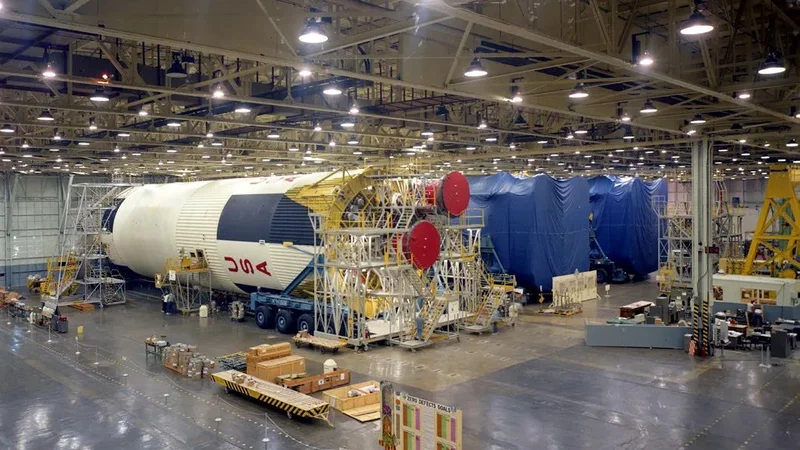
On Aug. 1, 1968, NASA canceled the production of its Saturn V moon rocket. At the time, the giant rocket was the only launch vehicle to have ever carried astronauts beyond low-Earth orbit, and it was then the largest, most powerful rocket ever.
NASA built 15 of these rockets but only flew 13 of them. When NASA made the decision to stop building the Saturn V, it was almost a year before Apollo 11 astronauts would walk on the moon for the first time.
A federal budget deficit and the rising costs of the Vietnam War led Congress to slash nearly three-quarters of the funding that President Lyndon Johnson had allotted for the Apollo program.
The last Saturn V launched in 1973, and it was originally supposed to send Apollo 18 to the moon. However, that mission was canceled, and that Saturn V launched the Skylab space station instead.
Why it mattered
From start to finish, NASA spent a reported $9.4 billion on the Saturn family of rockets (which would be an estimated $118 billion in today's dollars) to develop the Saturn V. That includes the Saturn I and Saturn IB blocks. But the decision to shut production down in 1968 over those costs spelled the end of NASA's Apollo program to send astronauts to the moon a year before the Apollo 11 astronauts even walked on the moon in 1969.
Without a steady supply of heavy-lift rockets (the Saturn V was the most powerful of its day), NASA only had a limited number of moonshots left. The final Saturn V rocket to carry astronauts sent the Apollo 17 astronauts to the moon in 1972. The Skylab mission flew a year later, with the final Saturn IB rocket launching an Apollo command module on the Apollo-Soyuz flight in 1975.
It would not be until 2022, when NASA launched the first Space Launch System on the Artemis I mission, that the space agency had another megarocket to rival the Saturn V. In April 2026, that new rocket launched NASA's Artemis II astronauts around the moon.
SpaceX has developed a new megarocket that is even more powerful than the Saturn V, with its Starship and Super Heavy booster.
Hanneke Weitering is a multimedia journalist in the Pacific Northwest reporting on the future of aviation at FutureFlight.aero and Aviation International News and was previously the Editor for Spaceflight and Astronomy news here at Space.com. As an editor with over 10 years of experience in science journalism she has previously written for Scholastic Classroom Magazines, MedPage Today and The Joint Institute for Computational Sciences at Oak Ridge National Laboratory. After studying physics at the University of Tennessee in her hometown of Knoxville, she earned her graduate degree in Science, Health and Environmental Reporting (SHERP) from New York University. Hanneke joined the Space.com team in 2016 as a staff writer and producer, covering topics including spaceflight and astronomy. She currently lives in Seattle, home of the Space Needle, with her cat and two snakes. In her spare time, Hanneke enjoys exploring the Rocky Mountains, basking in nature and looking for dark skies to gaze at the cosmos.