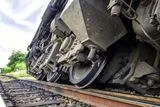
It was July 17, 1984, and that afternoon, a train traveling 100 miles per hour slammed into a nuclear flask on a test track near Old Dalby and Melton Mowbray in Leicestershire, in the U.K. The train jumped, buckled, and crunched together like an accordion. But contrary to the concerns of many British citizens at the time, the nuclear flask did not release its contents.
“[The train] smashes into [the nuclear flasks] at a great speed and it’s pretty spectacular,” Andrew McLean, head curator of the National Railway Museum in York in the U.K., told Discover.
This accident, after all, was no accident. It was a stunt orchestrated by the Central Electricity Generating Board of the U.K. in response to public concern about the safety of transporting nuclear material by train.
Read More: Determining Nuclear Fusion's Future
Why Did the U.K. Purposely Crash a Train into a Nuclear Container?
Public concern began to grow years earlier when British Rail started to transport nuclear fuel by rail across the country. There were always some concerns from the public about the safety of transporting nuclear material, and anti-nuclear protests happened frequently in the 1980s, McLean said.
Sellafield, one of the older and major multi-function nuclear plants, had been under fire for discharging radioactive waste into the Irish Sea for years, and protestors were fighting against the building of more plants, according to a study in the Journal of Environmental Radioactivity.
In response to concerns, the CEGB began to scale-model tests of nuclear flasks — the massive, steel-enforced rectangular containers used to transport nuclear fuel. But these models didn’t really allay the concerns of protestors.
The CEGB began to think of ways to test this in the field, and in 1984, they filled a nuclear flask with water and steel rods and dropped it from a height of 29.5 feet. The flask bounced off the ground at an angle calculated to exploit the weakest point of the container, according to the Railway Hub. The impact prompted only a tiny amount of water to escape, but it wasn’t considered enough to be of any danger, even if it was radioactive material. They also burned and crashed this type of flask in other demonstrations. But the stunts didn’t work.
“People still didn’t believe this was safe,” McLean said.
Not to be dissuaded, the CEGB and British Rail began to plan an even grander stunt that would help alleviate the fears of the public once and for all. The only way to show the public that the nuclear flasks could withstand the damage of a train wreck was an actual train wreck.
How did the U.K. Set Up a Nuclear Train Crash?
The CEGB bought a decommissioned locomotive that could go 100 miles per hour and modified it for the test. They eventually had a train with three standard-size coaches — about the size of your average passenger train.
They then took the same nuclear flask they had dropped from a crane in a previous stunt and fitted it with a new lid. They put it on the kind of flat-bed train car British Rail used to transport this material, then turned the whole car on its side, laying it across the rails of a test track near Melton Mowbray in Leicestershire so that the train would directly strike the flask itself.
The conductorless train started about 8 miles from its ultimate destination, accelerating until it hit about 100 miles per hour. A helicopter followed the train with cameras while radar guns verified its speed.
As the train barreled towards the flask in its path, 1,500 guests watched from a distance while cameras captured the crash from various angles. Upon impact, the locomotive was lifted into the air as a dramatic fireball ripped out, followed by a massive, non-mushroom cloud of billowing dust.
“You see the train’s an absolute wreck and the nuclear flask is pretty much unscathed,” said McLean, who remembers watching the event on TV as a teenager. You can still find plenty of old broadcasts about it online.
What Happened After the Crash?
Experts checked the pressure of the flask, which only showed minor exterior damage. They found that the flask only lost 0.26 pounds of pressure from the 100 pounds of pressure it had prior to the experiment.
All told, the various stunts — train crash included — cost about 4 million pounds sterling at the time, which would translate to about $22 million USD in today’s money considering inflation.
As far as the CEGB and British Rail were concerned, it was a smashing success.
“[The CEGB] believe this was money well spent to prove this was safe and quieten down many protests,” McLean said.
The stunt may not have won the war against nuclear, as opponents continue to fight the fuel to this day. But it may have won the battle in the eyes of public perception, proving that rail was among the safer ways to transport nuclear material by land.
“If you go by road, you’ve got far more chances of something going wrong,” McLean said. “There’s always a risk, but this was really seen as the safest.”
To this day, nuclear fuel is still carried by train in the U.K., McLean added.
Article Sources
Our writers at Discovermagazine.com use peer-reviewed studies and high-quality sources for our articles, and our editors review for scientific accuracy and editorial standards. Review the sources used below for this article:
- This article references information from a study published in the Journal of Environmental Radioactivity:A sediment history of sellafiel discharges
- This article references information from the Railway Hub: When British Railways deliberately crashed a train