I started paying for a third-party clipboard manager years ago, and until recently I was more than content to keep it that way.
I copy a lot and forget even more, so a dedicated app that holds on to everything became a small necessity over time.
When I set this up, stock Android's clipboard held exactly one thing. If you copied something new, the old clip disappeared, with no history to fall back on.
Losing an address or a chunk of text mid-task was irritating, so paying for an app that kept my clips around made sense at the time (and probably still does).
That first impression struck well, and for years I never checked whether Gboard's own clipboard had caught up. It had, and I only noticed because I started looking into Rambler and decided to poke around Gboard's current feature set.
What I found surprised me, and I'm down one long-term monthly subscription.
I thought I was getting my money's worth
Tons of mileage from one subscription
Clipboard fixed something the default Android clipboard couldn't do at the time. It stored my clippings instead of dropping them after a single copy.
I kept things like addresses and business details I often sent, a few screenshots I wanted close at hand, and more.
All of it was accessible outside any single text field, which made editing easier on its own.
Clipboard also synced across my phone, Mac, and the web, so a snippet copied in one place showed up on all my devices.
The app was cheap enough that I never canceled it when auditing my extensive subscription lineup.
While these features are truly great, I only used most because I was paying for them, not because I needed them.
I admired the sync, categories, and vault more than I actually reached for them in daily use.
The one feature I used constantly was the persistent stash of clips, and that was the only capability I couldn't get for free. Or so I thought.
Going back to basics
New device, new paradigm
I was already eyeing a Google Pixel upgrade when I learned about Rambler, the Android 17 Gboard feature that makes voice dictation usable for everyday use.
That got me curious, and it made me suspect Gboard had improved since I formed that first impression.
I was pleased to learn that Gboard has received even more upgrades with recent Android updates, and my entire user experience changed as a result.
When my new Pixel arrived, I decided to try the built-in features before reinstalling anything, and the clipboard was the first attraction.
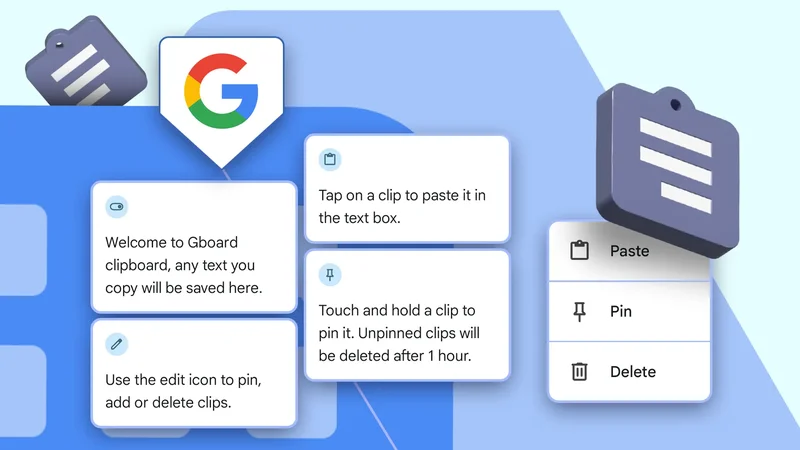
I hadn't set up Clipboard yet, so I opened Gboard's clipboard to see how far it had come. The moment it prompted me to turn on clipboard memory, I could tell something had changed.
One toggle let Gboard start saving a ton of clippings, like I'd wanted from the start. Unpinned clips stick around for about an hour by default, which covers most of what I copy in a normal session.
The retention was fine, but the feature that really mattered showed up right after. Gboard prompted me to long press a clip and pin it, which keeps it stored indefinitely, and (to my surprise) it works on images.
That pinning behavior was exactly why I'd been paying a subscription. Gboard now did it for free, and at that point it covered close to 90% of what I used my clipboard manager for.
Gboard's clipboard earns its keep
Solid out of the box, with room to grow
Gboard wasn't the bare-bones tool I remembered, and it didn't stop at merely being decent.
I can manage and edit clips inside the interface, which was one of the few extras I used on the paid app.
Gboard can also pull in your screenshots, though this one isn't automatic. You have to accept the prompt or turn on Save recent screenshots in clipboard under Settings > Clipboard first, and then new screen captures land in your clip list for easy resharing.
Pinned clips can survive restarts and updates, since Gboard holds them locally on the device rather than dropping them when you reboot.
After years of treating clipboard management as a workflow chore, going back to something integrated and effortless was truly a relief.
The paid app still does more, but I don't need it
None of this means Clipboard isn't worth the money. It still does more than Gboard's clipboard, with cross-platform sync across Android, Mac, and the web, plus a searchable history I could reach from anywhere.
However, those are also the features I was paying for and rarely touched. And when I looked closer, I felt even more uncomfortable about using the app.
Clipboard's Play Store data-safety section lists location and app activity among the data it may collect and share, states that the data isn't encrypted, and says it can't be deleted except by developer request.
This was hard to ignore, since I trusted the app with my addresses and account details. With a free, fully integrated option sitting right on my keyboard, I canceled the subscription and haven't missed it.
I'm still pairing Gboard with my Type Machine setup that saves my typed text as a safety net, but a dedicated clipboard app is off my phone for good.