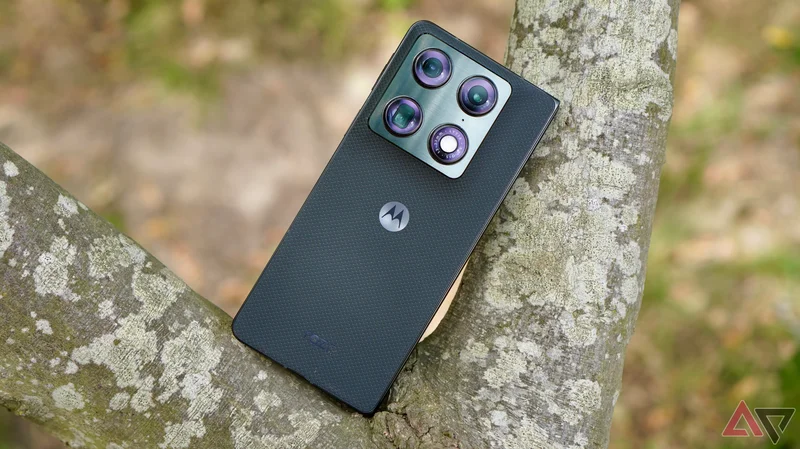
The Motorola Razr Fold has arrived at a difficult time. It comes just as Samsung launches its range of 2026 foldables, on the eve of Google’s Pixel 11 series which will almost certainly include a new foldable, plus just ahead of Apple’s first foldable iPhone.
That’s a lot of competition. However, my early days with the Razr Fold were really positive, and now it's time to see if the phone holds up over a few weeks.
Motorola Razr Fold
-
**SoC** - Qualcomm Snapdragon 8 Gen 5
-
**Display dimensions** - 8.1-inch inner / 6.56-inch cover
-
**Battery** - 6,000mAh silicon-carbon
-
**RAM** - 16GB
The Razr Fold is Motorola's first go at a big-screen foldable phone, and it has put everything it has learned from its compact Razr foldables into ensuring it competes with the best from Samsung and Google.
Pros & Cons
- Ergonomic design
- Vibrant, versatile camera
- Fast charging
-
Easy multi-tasking options
-
Hinge less refined than the competition
- Noticeable screen crease
Price, specs, and availability
You can buy the Motorola Razr Fold now for $1,900, or £1,799. It comes in either Pantone Blackened Blue, which is the model in our photos, or Pantone Lily White. Both look good, but Lily White looks stunning in person.
It competes with the new $1,900 Samsung Galaxy Z Fold 8 and $2,100 Samsung Galaxy Z Fold 8 Ultra, and with the $1,799 Google Pixel 10 Pro Fold in the US. Elsewhere, the £2,000 Honor Magic V6 and the Oppo Find N6 should be considered.
Specifications
-
**SoC** - Qualcomm Snapdragon 8 Gen 5
-
**Display type** - pOLED inner / pOLED cover
-
**Display dimensions** - 8.1-inch inner / 6.56-inch cover
-
**Display resolution** - 2484 x 2232 pixels inner / 2520 x 1080 pixels cover
-
**RAM** - 16GB
-
**Storage** - 512GB
-
**Battery** - 6,000mAh silicon-carbon
-
**Charge speed** - 80W wired / 50W wireless
-
**Operating System** - Android 16
-
**Front camera** - 32MP inner / 20MP cover
-
**Rear camera** - 50MP main / 50MP wide / 50MP 3x telephoto
-
**Wi-Fi connectivity** - Wi-Fi 7
-
**Bluetooth** - Bluetooth 6
-
**Dimensions** - 144 x 160 x 4.55mm open / 160 x 73 x 9.89mm closed
-
**Weight** - 243 grams
-
**IP Rating** - IP48 / IP49
-
**Colors** - Pantone Blackened Blue / Pantone Lily White
-
**Stylus** - Moto Pen Ultra
Motorola Razr Fold design
Don't take the numbers at face value
On paper, the Motorola Razr Fold appears quite thick and heavy when compared to Samsung’s modern foldable phones. The Galaxy Z Fold 7 and Galaxy Z Fold 8 Ultra are only 215 grams and 8.9mm thick, and very different to hold than the 243 gram, 10.1mm thick Razr Fold.
In real life, these specs don’t reflect the Razr Fold’s ergonomics. It never feels bulky or ungainly. A lot of the reason why is the clever chassis design, where the closed edge has a concave design that makes it easy to grip and open the phone.
Combine this with neat curves at each corner of the metal frame and on the screen, plus the curved camera module, and the Razr Fold is supremely comfortable to hold and use. It shows how thoughtful design can overcome the realities of making a large foldable phone.
One idiosyncrasy of this edge design is the tiny power and volume keys. The fingerprint sensor is set in the power key, and until you get used to its placement it can be a pain to locate and use.
The textured rear panel adds grip and looks great, plus the phone is suitably durable with an IP48 and IP49 dust and water resistance rating.
The hinge feels solid and doesn’t have any disconcerting creaks, but it’s quite heavily weighted. It feels less refined than other foldables, especially compared to the new Samsung Galaxy Z Fold 8.
I’ve used the Razr Fold as my main phone for the last few weeks and haven’t noticed any durability issues with the inner screen or hinge.
A check online shows up a few anecdotal cases of issues, and Motorola doesn’t seem to have put an actual number on how many folds its hinge is rated for. I don't consider this a cause for concern, certainly no more so than any other foldable phone.
I have carried, used, and enjoyed the Motorola Razr Fold for a while now, and consider it one of the most usable, ergonomic, and carefully designed big-screen foldables you can get.
Motorola Razr Fold camera
Fun, vibrant, and reliable
Motorola’s cameras can be hit-or-miss, but I’m happy to say the Razr Fold is in the hit category. There’s a trio of 50-megapixel cameras on the back, including a 3x telephoto, and it has proved to be a versatile, fun, and reliable system.
There's a strong visual punch to every photo you take. They pop off the screen and there’s detail in the shadowy spots, yet they remain balanced and surprisingly natural.
I find the 3x zoom to be more usable than a 2x or 5x zoom, and there’s great consistency between it and the main camera. I’ve had confidence using the Fold’s camera, and that rarely happens with cheaper Motorola phones.
Some Motorola camera issues remain, such as exposure problems that can wash out the sky, but they’re easily forgiven when, most of the time, the Razr Fold takes great photos.
I used the Razr Fold to capture all my photos during the Samsung Galaxy Unpacked 2026 event. These were shared on our live blog, and also on my own social media. Considering the environment — dark auditorium and big, very bright screens — the results were great and didn’t require much editing at all.
If there’s a complaint, it’s the app itself. It’s not quite as fast as I want, and there’s a noticeable delay when opening the camera app and switching between cameras, which caused me to miss a few shots during the Galaxy Unpacked event.
This is a small issue though, and the Razr Fold has one of the best Motorola cameras I've used in ages.
Motorola Razr Fold screens and foldable features
Foldable versatility
One of the biggest selling points of the Razr Fold is its foldable design. The high-spec displays look excellent, video is sharp and colorful, and the cover screen glass in particular has a beautiful sheen.
Multitasking is excellent. It’s easily accessed from a clear menu when in the helicopter view or with a long press on an app icon, plus a tap of the divider when using split screen quickly shows helpful options.
Motorola makes some big claims about screen brightness. The inner screen has a peak of 6,200 nits and the cover screen has a 6,000 nit peak.
Numbers like this suggest the Razr Fold will be brighter than the sun, but in everyday use, I found myself checking to see if the brightest was maxed out, simply because it was hard to see in even overcast conditions outside.
What’s more, the inner screen gets smudgy, which adds to the difficulty seeing it in bright sunlight. This isn’t an issue specific to the Razr Fold and affects many foldables, but something to note if you use your phone outside in the sun.
The Gorilla Glass Ceramic 3 over the cover screen is tactile and pleasant to touch, and the inner screen’s slightly plasticky feel is similar to most other foldables. The crease is noticeable, both visually and to the touch, and it’s far behind the brilliance of the Find N6 and the new Galaxy Z Fold 8 series.
Motorola has made good use of the foldable hinge with two different viewing formats. Some apps work in Desktop mode, where the upper half of the screen shows the app, game, or video, while controls or the keyboard appear on the lower half. When you charge the phone and rest the phone in tent orientation, the screen shows a large clock.
The screens are a high point, aside from Motorola’s dubious brightness claims.
Motorola Razr Fold software and performance
Always-on, and years of updates
The Razr Fold has Android 16 installed. There are several different claims online regarding how long the software update commitment is, including conflicting reports from Motorola itself.
Android Police checked with Motorola, and was told the Razr Fold will receive seven years of Android OS updates and bi-monthly security updates.
Android on the Razr Fold is slick, speedy, and mostly free from bloatware. I love the clean design, and the way it embraces the simplicity of Android 16 on its own, without feeling the need to change or supplement features and apps with its own versions.
The Moto AI features are not pushed on you, and even the AI button on the side of the phone is disabled by default or until you sign in with a Motorola account. I’ve used Google Gemini multiple times, and the performance was excellent, even during live conversations.
Most welcome of all is a true always-on screen when the phone is locked, something that isn’t standard on all Motorola phones. It’s one of the best versions too, with visible, easily seen text and icons.
Motorola chose the Qualcomm Snapdragon 8 Gen 5 processor for the Razr Fold, with 16GB of RAM and 512GB of internal storage space. Some may feel the lack of an Elite chip means the Razr Fold somehow isn’t a flagship, but this isn’t the case.
From Maps to video, and social networking to gaming, the Razr Fold is fast and reliable. However, it gets very warm when running high performance benchmark tests, but less so when playing games like Asphalt 9: Legends.
|
|
|
|
|
|
| 2280 | 6483 | 11916 |
|
| 1583 | 5390 | 19716 |
|
| 3621 | 7803 | 16804 |
A note on playing Asphalt 9: Legends. It makes use of a Dual Window option where the cover screen, located on the back of the phone when it’s open, can control the car. It’s a fun option, but not all that intuitive. Though it’s still good to see different things being tried with foldable screens.
|
|
|
|
|
|
| 5255 | 70% | 7% |
|
| 6554 | 56% | 11% |
|
| 5450 | 49% | 13% |
The benchmark results are not dramatically different to the Snapdragon 8 Elite Gen 5, and I haven’t seen any everyday use cases where the Razr Fold has felt slow. However, the buildup of heat, which is also present when charging the battery, may cause issues for very demanding users.
Motorola Razr Fold battery life and charging
Great everyday performance
There’s a 6,000mAh silicon-carbon battery in the Razr Fold with 80W wired and 50W wireless charging. Motorola says you can reach these maximum speeds using its own proprietary charging hardware.
I used an Anker desktop charger, and it charged the phone at a maximum of 50W. The battery reached 50% in 30 minutes, and fully charged in 75 minutes. This is good performance and makes the Razr Fold easy to live with.
The Motorola Razr Fold gets pretty warm when fast charging. It’s not too hot to touch, but you wouldn’t want to grip the metal chassis for long. It does indicate thermal management isn’t the Razr Fold’s strong point.
The battery powers the phone for about six hours of screen time on a single charge without gaming. The processor is efficient when used for general tasks, but when you push the phone through gaming, the screen-on time drops.
The 20-minute 3DMark Wild Life Extreme Stress Test took only 7%, and a 30-minute YouTube video at 1080p over Wi-Fi on the open screen took 2%. There's a genuine efficiency advantage to buying the Razr Fold and its Snapdragon 8 Gen 5 for those not interested in high-end mobile games.
Should you buy the Motorola Razr Fold?
Yes, if you want a big-screen folding phone, the Motorola Razr Fold is a very good buy.
It has a careful, considered design that prioritizes ergonomics, a fun, vibrant camera, decent battery life, fast charging, and a clean, easy-to-use version of Android installed. Both screens look great too.
However, like the Honor Magic V6 before it, the timing of its release will cause it problems. Unless you’re set on owning the Razr Fold, it would be wise to consider the Samsung Galaxy Z Fold 8 series, see what Google has for the Pixel 11 Pro Fold, and even hold out for Apple’s foldable iPhone too.
All these phones cost at least $1,800, so it's not a purchase to be made lightly. I’d also recommend you go to a store and try them all out before buying, if possible. The hinge feel varies a lot, so checking it out is worthwhile, and establishing if you like the size of a big foldable is a good idea too.
The good thing is, the Razr Fold absolutely belongs on your shopping list alongside the Samsung and Google models, and the Honor Magic V6 and Oppo Find N6 too. How wonderful it is to have such a strong lineup of big-screen foldables in 2026, giving us a true choice when going to buy one.
Motorola Razr Fold
-
**SoC** - Qualcomm Snapdragon 8 Gen 5
-
**Display dimensions** - 8.1-inch inner / 6.56-inch cover
-
**Battery** - 6,000mAh silicon-carbon
-
**RAM** - 16GB
The Motorola Razr Fold is the best Motorola phone I've used in ages, combining a modern design with a great camera, slick software, and good overall performance. However, the price is high and the competition is strong, so don't rush into buying it without considering the other options. If you do decide to get the Razr Fold, you'll be very happy with it.