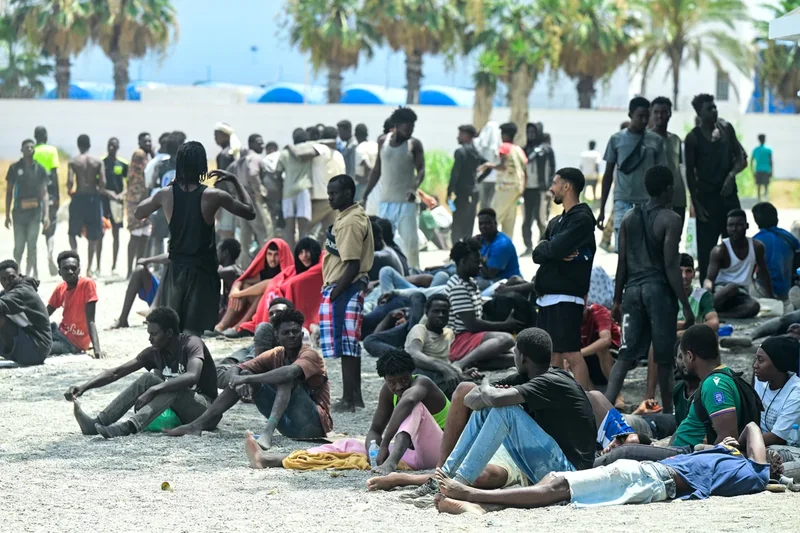
The migrant crisis sparked by a border breach in the Spanish enclave Ceuta deepened on Saturday, as Spain accused EU countries of a “selfish” response.
More than 60 people are now reported to have died after around 60,000 crossed into the North African territory from Morocco on Thursday in extraordinary footage.
The incident has caused division in the EU, with Italy temporarily suspending the border-free Schengen arrangement with Madrid in a move backed by Finland and Denmark.
The EU has now called an emergency meeting of national ministers on Tuesday to discuss the issue, after separate calls from Spain and 22 other members of the block.
“In the current international context, the European Union cannot afford this kind of selfish, polarising and unlawful reaction,” Spain’s prime minister Pedro Sanchez said in a letter addressed to European Commission President Ursula von der Leyen, raising “serious concerns” about the response of some countries.
US Donald Trump has also waded into the row, calling the Ceuta incident a “catastrophe”. In a further statement, his administration accused Mr Sánchez’s left-wing government of “deliberate efforts to enable and facilitate mass illegal migration into Europe” while vice president JD Vance described the situation as an “Invasion of the West”.
“I saw Spain yesterday, and I watched the catastrophe that took place. It looks like an invasion of a country,” Trump said in a cabinet meeting on Friday.
Italian prime minister Giorgia Meloni described the footage as “shocking” and called on European nations to urgently respond to illegal immigration.
“It is an important signal: the line that Italy has long supported is today shared by an ever-growing number of European Nations,” she said, after 22 of 27 EU members signed a letter calling for tougher action.
“Defending the external borders of the Union is not the interest of a single Nation. It is a shared responsibility of Europe.”
In the letter to Ireland, which holds the bloc's rotating presidency, the countries said the crossings challenged the EU's external frontier and risked encouraging further illegal migration.
The Schengen Area is a large zone in Europe, comprising of 29 countries including France, Germany, and Italy, where people can travel freely without border passport checks.
Danish prime minister Mette Frederiksen urged the EU to “consider all options, including a suspension of Schengen co-operation”. France has tightened checks on its border with Spain and said it would increase its police presence by Saturday.
Mr Sánchez and his senior officials have criticised the response, stating: “Solidarity and empathy are optional. Respect for European treaties and data is not.”
“Such an attitude – driven by prejudice, fake news, ignorance or political interest – is contrary to European law, humanitarian law, and the principles of solidarity that bind us together,” he added.
Meanwhile the UK’s prime minister Andy Burnham has offered to support Spain, without going into specifics.
“I have been in touch with the Spanish prime minister and (we are) providing what help we can,” he said in brief remarks at rally to celebrate Labour’s Greater Manchester mayoral win on Saturday.
Officials in Spain have said that the vast majority of those who reached the Spanish territory on 30 and 31 July have been returned to Morocco, and blamed the crisis on human traffickers and criminal networks.
Police have begun installing a 500-metre floating barrier to act as a further deterrent, after dozens of migrants drowned or died in a stampede as they reached the border.
During a visit to Ceuta, the Spanish leader called the incident a “violation of Spain's territorial integrity”.
“Trafficking mafias took a self-serving interpretation of a Supreme Court ruling” which “spread like wildfire”, he said.
In June, Spain’s supreme court had ruled that migrants stopped at sea while trying to reach Ceuta or Melilla could not be summarily returned to Morocco without due process.
Chaotic scenes emerged on Thursday as tens of thousands of migrants attempted to make the crossing into Ceuta, a city of around 84,000 residents.
Moroccan forces beat back crowds with batons and tear gas at the gates to Ceuta, trying to prevent more from entering the tiny territory. More than 48,000 migrants returned to Morocco within 48 hours without major incident, Spain said.
“The return of people has begun satisfactorily but the process must be completed,” said the region’s president Juan Jesus Vivas on Saturday. “The city has not yet returned to normal.”
Moroccans who tried to cross into Ceuta have spoken out having returned to their country, to explain why they attempted the dangerous crossing.
Abdulah Buji, a 21 year-old aspiring teacher, had sped to the border on his motorbike after hearing about the security breach.
“Spain gives you the chance to make your future, not like Morocco,” he told the Associated Press. “I am a talented boy. I just want a chance.
“I’ve spent perhaps 14 years studying, but there’s nothing at home, and I’d have to work 12-hour shifts for a meager wage.
“That’s why I came here, but I haven’t found any opportunities here either, so I have to go back.”