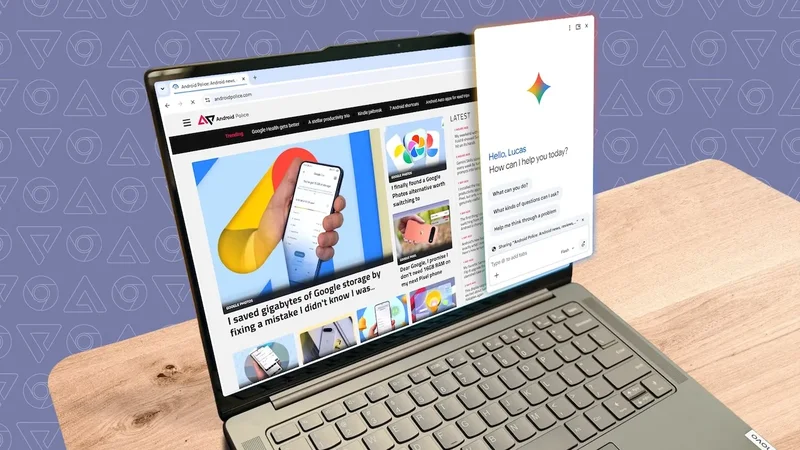
It feels good to be back on Google Chrome after a year with Apple Safari.
Google has spent that time bringing its computer browser and Android closer together. My biggest surprise was Gemini's Sidebar.
I left the app before I had the chance to see it evolve. So, returning felt like discovering an entirely different feature.
Using it now feels like the upgrade I expected when I got a .
The tool has become my companion in many cases. Here's why I rely on it frequently in Google Search.
It's an unconventional copy and paste tool
Who doesn't want a smarter way to move information around?
Traditional copy and paste is efficient enough for a single task. But it has its limits in many of the things I do daily. They include research and unifying ideas across devices and apps.
On Android, I have many ways to get information.
Circle to Search is the most fluid one. It lets me pull answers from my screen without hitting a wall.
Normally, I'd have to copy the on-page context, but it's not possible when the text is part of a UI element like a button, menu, or dialog.
Lately, I've spent more time on Google Chrome to catch up on everything that's changed. I haven't put it down since. Gemini's Sidebar is my second monitor in the experience.
The AI-powered panel expands beside my tabs when I click the Ask Gemini button in the upper-right corner. It reads the tab I'm on by default, and I can add up to 10 more for it to reference.
So, it answers using pages I already have open instead of a fresh search. I enjoy the deep visibility it provides into my research as it happens.
My consumer tech work especially takes me down a comparison trail to find the best device or tool. I like to run these comparisons in tandem with other tasks.
Split-screen mood on PC hits different
It makes the ultimate multitasker out of me
When I need extra space to work in Chrome, I'll right-click a second tab and select the New split view with current tab option to divide the view into two. Then I'll expand the Gemini sidebar to make three.
I never have fewer than five tabs open when doing research, so it's a cleaner way to browse without overwhelming myself.
I'm always scanning past articles on a topic, case studies, official documentation, and more. I used to read each one separately and switch between them a lot.
Now, I group tabs and enter @ to ask what sources agree on and where they contradict each other.
Before I pitch or write for websites, I search for the keyword I'm targeting and open the top four competitor results that are already ranking.
I'll also ask what they have in common in headline length, structure, subheadings, and angle. It tells me what's currently working for that keyword.
Then I'll open their published piece next to my own draft in Google Docs, group both tabs, and ask Gemini to point out what they covered that I didn't.
I shop till I drop my phone
But I'm more strategic about it now
I love to shop. It doesn't matter whether it's clothing, gadgets, or décor. Left alone in a store with an open limit, I've made bad calls before.
I bought my way into debt once because there was no system behind my spending to build savings. I'd just gotten out of undergraduate school.
It doesn't help that the market arranges itself to make your escape hard. Discounts and promotions exist to trigger your impulse buying.
I'm always glad to hand over the cost analysis to a tool that's emotionally unavailable. Bundles are a major red flag for me.
So, I like to group product pages with the individual item pages open in different tabs.
I may go as far as reaching the checkout page and asking it to scan for any auto-renewal, free trials, cancellation conditions, and other terms. I don't want to be blindsided by extra charges.
Next, I'll ask Gemini to add the total costs separately against what the bundle charges, since it isn't always cheaper than buying the pieces on their own.
It helps to pull up the CamelCamelCamel website for Amazon, Google Shopping's price history graph for most other retailers, or a tool like Honey or PriceHistory. They tell me if an item ever sold at the "was" price.
I might resell or rotate out items later, so I'll group the page with eBay, Facebook Marketplace, or local platforms. It helps me know what similar items sell for in used condition.
Master your AI workflow with saved prompts
It takes well. Feed it the wrong tabs or a vague question, and it repeats the gap in your own thinking. Thankfully, I don't have to repeat myself multiple times anymore.
Prompting is a large part of getting a useful answer from AI. So, I make sure to save my strategic and complex commands with Gemini Skills and reuse them with a few clicks.
The experience is wholesome, despite the full in-app version not being available in my region. It also requires a qualifying AI subscription elsewhere.