Tracing a tycoon’s roots
JINJIANG—Just a two-hour drive from the sprawling SM City Xiamen —Fujian’s largest shopping mall complex and the Sy family’s crown jewel in China—lies an industrial city that cradled some of Southeast Asia’s wealthiest tycoons.
Among them was the late Henry Sy Sr., a native son of Hongxi Village in Jinjiang, who had left at the age of 12 and became part of the Fujian diaspora that found great success in the Philippines.
Article continues after this advertisement
But these days, Jinjiang City is no longer the impoverished city that drove out many of its scions. It has made its mark as a global powerhouse for footwear production. It is now the one attracting migrant labor from other parts of Fujian and mainland China.
This is also the city where Sy, founder of the SM group, built his first shopping mall in China as the tycoon heeded the state’s call for wealthy overseas Chinese to invest in their homeland in the 1990s. (However, SM City Xiamen opened ahead of this Jinjiang mall).
Sy, who himself started his business empire selling shoes in the Philippines after World War II, contributed to Jinjiang’s rise as a global shoe capital.
From 1999 to 2004, he hosted state-backed shoe expositions inside the SM Jinjiang structure as the mall was not yet operational then. When the mall opened to the public in 2005, the shoe expo relocated to an exhibition center that had likewise been built by the tycoon.
To date, SM City Jinjiang still stands as a testament to Sy’s pioneering retail property venture and his role in the development of the city’s footwear industry.
Article continues after this advertisement
Jinjiang now produces one in every five athletic shoes in the world. The city’s biggest homegrown brand is Anta Sports, the world’s third most valuable athletic brand next only to Nike and Adidas. Anta is the largest shareholder of the company that owns brands like Arc’teryx, Salomon, Wilson, Peak Performance and Atomic. Early this year, it became the largest shareholder of Puma.
Not too far from SM City Jinjiang, the SM group has also developed a cluster of residential towers, in partnership with Anchor Land. It includes a dormitory for SM employees.
Article continues after this advertisement
By the time Sy passed away on Jan. 19, 2019 at 94, his business empire had become the largest player in property, banking and retailing in the Philippines.
While he is no longer around, he has been immortalized in his hometown.
A few steps from his ancestral home in Hongxi Village, a museum was built to honor their diaspora. One entire salon of the museum is devoted to the Sy family.
While the village has produced several other notable leaders, Sy was its most prominent son.
Immortalized
The museum shows how Sy built his empire in the Philippines, from the time he opened the first Shoemart store in downtown Manila in 1958, alongside other key milestones of the SM group. One wall of the salon is devoted to the six Sy children.
On June 2019, more than 30 members of the Sy family returned to Hongxi Village as part of a journey to retrace their roots and pay homage at the ancestral home.
READ: SM stepping up China expansion
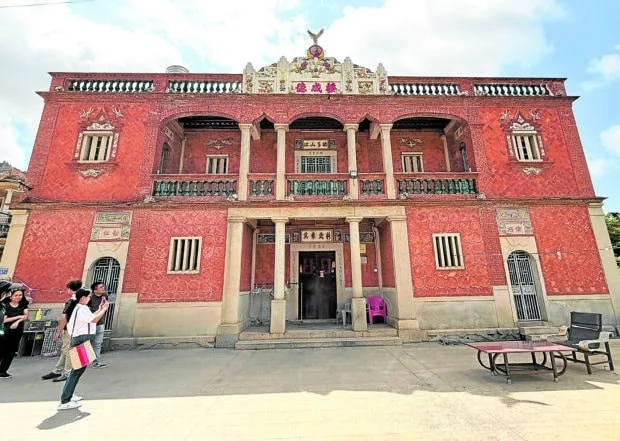
At the ancestral home itself, a marker stands to say that Sy Chi Sieng (Sy’s Chinese name which means “to attain ultimate success”) lived here.
Installed at the low wall near the entrance is a plaque of dedication:
“Although Henry T. Sy Sr. had permanently settled in the Philippines, he did not forget his roots and in the spring of 1952, he built Decheng Building at the east of Xun Creek in honor of his ancestors. However, more than 50 years of exposure to the natural elements seriously damaged the Decheng Building. Hence the children of Henry T. Sy Sr., who through the mentorship of their father are now business leaders in their own right, had Decheng Building repaired in 2010 in appreciation of the filial piety their father had shown to their ancestors.”
“The repair of Decheng Building was completed in 2011 and it is now as majestic as the time it was built. In consideration thereof, the village committee would like to express its most profound gratitude to Henry T. Sy Sr. and his family for their unwavering love and contributions to our village.”
When he was alive, Sy used his own money to build a road to connect Hongxi to the main thoroughfare. Down the road lies a memorial built by the tycoon for his father, which contains a vow that even though his father was no longer around, this devoted son would continue to show his love by caring for the village. Even the lamp posts that light up the village at dusk had been donated by Sy. The tycoon had also significantly contributed to upgrade the facilities of the elementary school in the area.
Village landmark
Located at No. 37 Sanxing Road in Longhu Town, the two-story, 450-square-meter residence is a classic example of Fan Zai Lou architecture—a Western-influenced Minnan style favored by returning overseas Chinese. Sy built the home for his parents, Sy Siu Tek and Tan O Sia, following their return to China.
The structure reflects both the family’s Fujian roots and the cross-cultural influences of the diaspora. Traditional Minnan architectural features anchor the design, while Western motifs emerge in the shaded porches, open balconies, sweeping corridors and decorative window grilles.
At the center lies an open courtyard, flanked by east-west corridors and side gates that invite cross-ventilation and natural light across both floors. Upstairs, behind the second-floor main hall, twin doors open onto a balcony overlooking the property.
Exterior craftsmanship defines the facade: finely carved white stone lines the lower walls, giving way to classic red-brick abode. Stone pillars frame the recessed entrance porch, anchored by an inscribed lintel adorned with floral clay sculptures. Along the gables, gates and window frames, intricate Qianci porcelain mosaics depict flowers and birds in rich detail. Outside, a perimeter wall encloses a generous front courtyard paved in granite.
Today, the house serves as something far greater than a family landmark: it is an enduring bridge between a legendary tycoon and his roots, grounding a vast legacy in a simple commitment to never forget where it all began. INQ