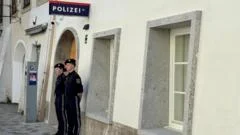
The interior minister at the time, Wolfgang Sobotka, said the building should be torn down and a new one erected in its place. It was an echo of an earlier offer by a Russian MP who said he wanted to buy the house and blow it up.
But there was a storm of criticism, with many saying that destroying the house would be tantamount to denying Austria's Nazi past.
In 2019, the government announced plans to turn it into a police station, and initiated a EU-wide competition for architects to submit designs.
Millions of euros were spent refurbishing the old yellow building, which now looks substantikdifferent from before.
Not everyone is happy with the decision to open a police station there, saying it sends the wrong signal. Some had wanted the house to become a centre of responsibility, confronting the Nazi past.
There is no sign on the house about its history and the building is bristling with security cameras to record the activities of any potential Neo-Nazi pilgrims.
All that links it to Hitler is a stone on the street outside, which was erected in 1989.
It says "Never again Fascism; In memory of millions of dead."
The stone comes from the nearby former concentration camp at Mauthausen.
Hitler's name doesn't appear.