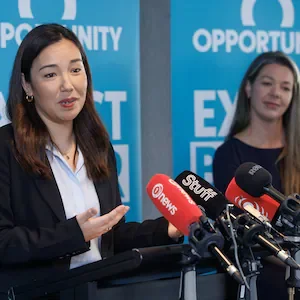
There once was a young woman. She had long dark hair and a nice smile. She was a politician. She came out of nowhere. She was bright and charismatic, communicated well, and the media adored her. The people adored her too, despite not knowing that much about her or the
Back home, the country she had led struggled. The health system was in tatters and education was such that many young people simply stopped going to school. Aimless kids led a crime wave against retailers, and the police seemed unable to stop it. Patched gangs closed roads and sometimes even small towns were shuttered for short periods.
At the same time, in another town, an entire street became a wasteland of families living in motels. They called it emergency accommodation. The emergency was short-lived and overstated. But the damage appeared permanent.
A little over three-and-a-half years later, the country is slowly clawing its way out of its demise. It’s been hard yakka, and it’s not over yet. But it’s getting better, bit by bit.
Education is returning to the basics and achievement is better. A massive investment in health has seen elective procedures increased, additional new cancer medicines introduced and better access to bowel and breast screening. The gang patches are gone and the resilience of our police force is returning. Most of the motels are motels again.
Confidence is returning too. International events have made it harder and the inflation that entered our households a few years back is proving difficult to overcome. The people are finding it tough going. But it feels like things are improving.
In three months’ time, that country faces another parliamentary election. Despite the lingering memories of three short years ago, advance polling suggests that the people are divided.
Today, there is a young woman. She has long dark hair and a nice smile. She came out of nowhere. She wants to be a politician. She is bright and charismatic, communicates well, and the media adore her. But we don’t know much about her, or the team around her.
Her name is Qiulae Wong. She applied for a job, as leader of a political party, just a few short months ago.
That party is called The Opportunity Party. Behind the scenes, the party’s general manager is Iain Lees-Galloway. If the name sounds familiar, he was a senior minister in the Labour Government from 2017 to 2020 and was sacked by the Prime Minister prior to the 2020 election.
Opportunity is running a clever social media campaign and it’s working. The trouble with social media is that parliamentary hopefuls can tell their story directly to the voter without the cross-examination that used to come from sceptical journalists.
The traditional news media, far less sceptical these days, can’t get enough of Opportunity’s new leader. Sound familiar? As a result, the party is featuring in news bulletins with the regularity and profile usually reserved for the established parties occupying our Parliament.
I imagine that, if polled, most New Zealanders would be unable to name the party’s leader. I would be surprised if any of us could name anyone else on their party list.
And yet, as we sit here today, that party is running at 5% in the polls, and apparently on the verge of getting six or more members elected into our Parliament.
Despite Opportunity’s anticipated rise to the seats of power, I don’t imagine that 5% of us, or even 1% for that matter could name more than one or two of the party’s policies.
If asked, there is probably one policy that some of us would refer to. It’s their headline act and it’s called a universal basic income or UBI. Opportunity has called it a Citizen’s Income and would like to ensure that almost every adult member of our society is paid $19,400 per year. That’s about the same as the current Jobseeker benefit. Just for getting up in the morning. In fact, you probably won’t even have to do that.
I did the numbers on Opportunity’s proposal. I’ve assumed that an adult is someone aged 18 or over. And the government statistics tell us that, of our population of 5.34 million people, 4.19 million of those people are over-18.
So, if every one of those people is paid $19,400 per annum, the cost will run to $81.3 billion per year. To be fair, there will be rebates bringing down this total because Opportunity is planning some offsets against existing benefits, and saying that Jobseeker, Sole Parent, Student Allowance and Supported Living Allowances will be rebated. So let’s be generous and suggest that the entire current Core Crown Social Security and Welfare expense of $25.5b is offset.
Opportunity’s website is silent on government superannuation. In the event that Super is also offset that’s another $24.7b. That leaves a new bill of $31.1b for our debt-laden country to pick up.
Let’s put that into perspective. Our current Core Crown expenditure runs at $150.3b per annum. This policy alone would increase our cost base by 20%.
The UBI has been trialled in other countries, albeit at greatly reduced levels to what Opportunity is promoting. In most cases, it was promptly terminated and deemed unsustainable. In other words, unaffordable.
“Ah”, I hear you say, “but they’ve worked out how they’re going to pay for it”. Have they?
Opportunity’s tax plans make interesting reading too. They’re proposing to introduce massive tax increases by changing our tax brackets.
Those changes will mean that a person earning, say $100,000 per annum will pay approximately $8000 more each year in tax on their earnings. Someone earning $70,000 per annum will pay approximately $7000 more each year in tax.
The commentary suggests that these increases will be offset by the Citizens Income. And for many, it will. Unless you’re a home owner.
The big one is their proposed Land Value Tax. Their website openly states that they want to bring house prices down. In case you haven’t noticed, house prices are already considerably lower than their peaks in 2021 and 2022.
You might recall the then Labour Party Finance Minister encouraging young New Zealanders to get out and buy their first homes, despite the record prices at the time. Recent price drops mean that those young New Zealanders are already out of the money.
Some two-thirds of New Zealanders own their own homes. Plenty own investment property or baches too. And here we have a political party that openly states that they want to “bring down” the values of those homes, baches and farms by 10 to 15%.
Their mechanism to do so is the introduction of a land tax on the property owned by most of us. Residential land, that is, the land our homes sit on, will attract an annual tax of 1.75% of its assessed value. Rural land will attract 0.5% tax.
Let’s look at Wellington’s struggling real estate market. Rateable residential property in Wellington is valued at $99b and there are 84,990 residential dwellings. That means that the average value is $1.165 million per dwelling. The land value is 51.8% of the $99b, meaning that the average home in Wellington has a land value of around $600,000. That’s a Land Tax bill of $10,500 per year. Every year.
So let’s do the maths. A person earning $100,000 per year, living in their own average value home in Wellington, will pay $8000 more tax on those earnings, but they will receive the Citizen’s Income of $19,400 per year to offset that. They will then pay $10,500 per year in Land Tax. A $900 surplus is theirs.
The same exercise for Auckland’s suburb of Ponsonby, shows a median land value of $1.65m. The land tax on that will be $28,875. Every year. The same maths applies except this time they’re going to have a shortfall of $17,500. In other words, assuming that most of the Ponsonby set earn $100,000 or more per year, they’re going to be paying $17,500 more tax every year. Where will that money come from?
If you think Ponsonby’s an extreme example, the average Auckland Council residential capital value is $1.29m of which 57.5% is the land value. Opportunity’s land tax will take $12,980 off the owner of that home every year. If that owner is earning $60,000 or more, they’ll still have a shortfall, even after receiving the Citizen’s Income.
Such a move will drop property prices all right. And based on current debt levels, such an outcome would likely see dreams relinquished, mortgages defaulted, and keys handed back to banks in record numbers. For a first home buyer who has just purchased a home with a standard 20% deposit, Opportunity’s policy would wipe out their equity immediately.
Opportunity’s website shows caricatures of a range of supposedly middle New Zealanders, highlighting how much better off each will be under their “handout first, tax later” policy. There wasn’t one calculation that I could make work in the party’s favour.
Opportunity’s candidate list reads like that of the Greens. People with unusually vague job descriptions like “music eco-system consultancy”, “tell stories about rural innovation” and even “animal behaviour consultancy specialising in parrot behaviour” feature alongside the party’s candidates for the upcoming election. Remember, this is a group that wants to portray itself as the “next generation of politicians”.
Elsewhere, they make claims that their “tax reset will lift 50,000 Kiwi families out of poverty”. Sound familiar?
And so, despite all the excitement brought about by a few polls, our electorate is faced with another fringe party, comprising average qualifications, seeking to be dragged into parliament on the coat-tails of a major party, in order to tax us more, introduce income structures that even communist countries won’t implement, and redesign the way we live. Let us not underestimate the financial ruin that these political hopefuls would inflict.
Earlier this week, Prime Minister Christopher Luxon ruled out working with Opportunity post-election. He said they were a high tax party. He was right. They are. And he’s right to rule them out.
If only Labour’s Chris Hipkins had the nerve to do the same.
Bruce Cotterill is a professional director, speaker and adviser to business leaders. He is the author of the book, The Best Leaders Don’t Shout, and host of the podcast, Leaders Getting Coffee. www.brucecotterill.com
Catch up on the debates that dominated the week by signing up to our Opinion newsletter – a weekly round-up of our best commentary.