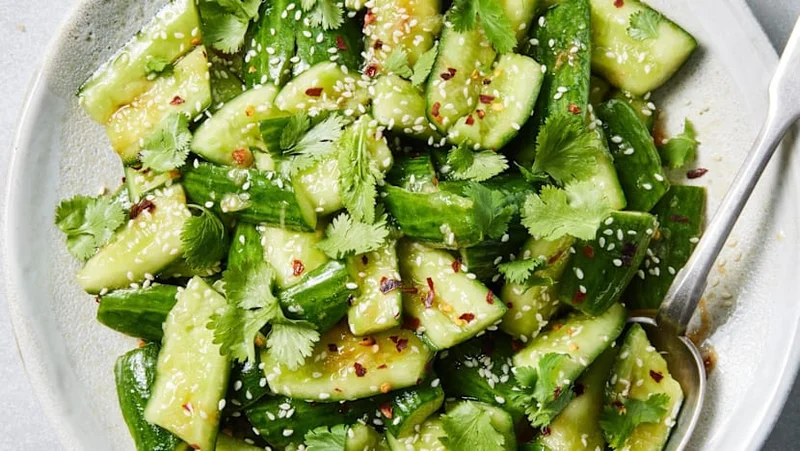
When Kimberly Dong, an associate professor of nutrition and public health at the Tufts University School of Medicine, names fruits and vegetables that offer the most nutrition per bite, cucumbers aren’t at the top of her list. Still, she said, there are good reasons to eat them.
Low in calories and full of water with some fiber, cucumbers are healthful, she said. And because they’re crunchy, with a mild, refreshing flavor, they pair well with many foods.
Cucumbers come in many variations: standard, fat, thick-skinned garden cucumbers; longer, more slender English (or hothouse) cucumbers with thin skin and smaller seeds; bite-size and bumpy gherkins; crisp, compact Persian cucumbers.
However you slice them (or don’t!), here’s why cucumbers are a satisfying hot weather staple.
THEY'RE HYDRATING
As temperatures rise, cucumbers – which are about 96 per cent water – are an excellent low-calorie source of hydration, Dong said.
A 10.5-ounce (297g) unpeeled garden cucumber, for instance, contains just over 1 cup of water and 45 calories.
Gina Jarman Hill, a professor of nutritional sciences at Texas Christian University, said there is a common misconception that cucumbers are “negative-calorie foods” – meaning they contain fewer calories than it takes to burn digesting them. “There’s no such thing as a ‘negative-calorie food,’” she said, but because the number of calories in cucumbers is so low, they’re about as close as you will get to one.
As long as you’re mindful of what you pair them with, Hill said, there is no reason to curb your cucumber consumption.
THEY MAY HELP SUPPORT METABOLIC HEALTH
Because a cucumber has so few carbohydrates (11g) and a little bit of fibre (1.5g), it has a minimal effect on blood sugar and is considered safe for people with diabetes, Hill said. Fibre helps to slow digestion, which keeps blood sugar levels in check, she said.
There is also some limited research in animals and humans showing that eating cucumbers – or their extracts – may benefit insulin, cholesterol, triglyceride and blood pressure levels.
In a clinical trial published in 2016, for instance, researchers split 47 patients with slightly elevated cholesterol and triglyceride levels into two groups: one that took a daily capsule containing cucumber seed extract and another that took a placebo. After six weeks, the cucumber group had improved blood cholesterol readings compared with those in the placebo group.
These studies are promising, Dong said, but still preliminary.
THEY'RE THE PERFECT SNACK AND MEALTIME COMPANION
With subtle flavours and a satisfying crunch, cucumbers can be an excellent complement to – or replacement for – many foods. Slices or spears can be healthier substitutes for processed snacks like chips and crackers, and can act as vehicles for fiber-rich bean dips and hummus, Dong said.
Cucumbers can also make meals feel lighter and fresher by adding volume with minimal calories, said Isaac Bernal, a chef in New York City.
Fermented pickles, made from cucumbers that have been soaked in a salty brine that encourages beneficial bacteria to grow, may offer some extra health benefits, said Heewon L Gray, an associate professor of nutrition and dietetics at the University of South Florida. Fermented foods have been linked to reduced inflammation and better gut health. (Regular pickles can also be a healthy snack, but they’re pasteurised or made with vinegar to inhibit the growth of bacteria.)
You can find fermented pickles in the refrigerated sections of grocery stores. They often have “fermented,” “probiotic” or “containing live cultures” labels, and don’t include vinegar among their ingredients, Gray said. Keep in mind that pickles – fermented or not – are salty. One dill pickle spear has 326mg, or 14 per cent of the daily recommended limit.
By Amanda Schupak © The New York Times Company
The article originally appeared in The New York Times.