Judge rules Crown must protect buried remains of ancient waka in Chatham Islands
A judge has ruled the Government cannot sidestep its statutory responsibilities for a centuries-old voyaging canoe buried in Rēkohu sand dunes, rejecting the Crown's argument that its obligations extend only to the excavated parts of the find.
In a recent decision by Māori Land Court Judge Michael Doogan, an archaeologist warned only 10 percent of the waka may have been recovered and that further remains could be destroyed if a major storm strikes the site.
The judge found the Crown's statutory obligations extend to the entire find, despite concerns about the cost of a full excavation.
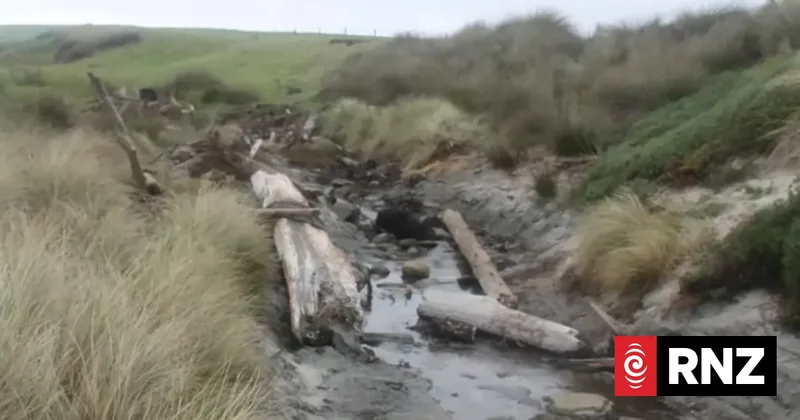
The waka was discovered in August 2024 on a private farm on the northern coast of Rēkohu Chatham Islands and is believed to be a pre-European Polynesian voyaging canoe.
Excavations, funded by the Ministry for Culture and Heritage, concluded in February 2025, revealing more than 750 pieces. Parties were invited to file applications for ownership.
A full archaeological report was then directed and was due to be released to the public this year but has stalled.
"This report was expected to be in final form by February 2026, but Heritage New Zealand has raised issues and it is not at this time known when the report will be in a form suitable for public release," Judge Doogan said in the decision.
Archaeologist Dr Justin Maxwell was engaged by the ministry to assess the site and provide a separate report.
He noted the waka was "one of the most important archaeological sites ever encountered in New Zealand and the wider Pacific".
In his controlled excavation, which was intended to recover the most at-risk portions of the waka, he noted less than 10 percent was excavated with a large amount still left in the sand dunes.
Only 55sq m was funded to be excavated of a potential 1100sq m.
"There is no practical way to determine the remaining extent of the waka by any means other than excavation," Maxwell said.
Throughout 2025, Maxwell and land owners the Dix family, became concerned the site was at great risk from weather and was only being protected by sandbags.
"Engineering solutions, such as sandbags and the like, are unlikely to prevent large-scale loss of the waka if there is a substantial storm event on the north coast of Rēkohu," Maxwell said.
"It cannot be overstated what an immense loss to culture and heritage it would be if more of this site and the waka itself were lost to a storm..."
The Crown filed memorandums with the court saying it did not have the funds to continue the excavation.
They noted the estimated cost would be approximately $3.5 million.
The Crown requested an ownership order so the determined party could raise funds independently to continue the excavation.
Dr Justin Maxwell: Why this ancient waka could transform what we know about Pacific voyaging
But the term "found" became a sticking point for the court.
Under the Protected Objects Act, the Crown argued, only the excavated parts of the waka had been "found" and were therefore deemed to be the Crown's property pending determination of ownership.
The Crown argued the existence of objects buried in the dunes is merely suggested on the basis of what has so far been excavated.
"It is argued that the ordinary meaning of 'found' is not necessarily synonymous with 'sighted'. To find something concerns a state of knowledge about the existence of the thing," Judge Doogan said of the Crown's position.
"Therefore, only the portion of the waka that has been actually uncovered and identified with certainty has been 'found'."
Crown counsel argued presumptive ownership does not arise from predictions of "what might lie below the surface".
"I do not accept this characterisation of the facts," Judge Doogan responded.
Judge Doogan placed significant weight on Maxwell's expert evidence and also conducted his own site visit, confirming he sighted timber protruding from the bottom of dunes.
"I have concluded that what has been 'found' are not just those parts of the waka seen or recovered, but also those parts of the waka that remain buried in the dunes."
The judge found the ministry's chief executive has a statutory duty that applies to the entire waka, not just the excavated portion.
"It was only once the scale of the find (and associated cost) became apparent that the Crown's position has become more ambiguous and non-committal," Judge Doogan said.
"It is entirely a matter for the government of the day to set its funding priorities and the chief executive has a broad discretion under s 11(4) of the Act.
"Nonetheless, the chief executive is under a statutory duty with respect to those parts of the waka that still remain at the site and that duty cannot be abdicated, avoided, or delegated to a third party."
The judge found it was unnecessary to determine ownership at this stage, saying those questions should be resolved after a full excavation.
He directed the Crown to file further memorandums, particularly around what action the chief executive considers appropriate to provide for the examination, care, recording and custody of those parts of the waka that remain buried at the site.
NZME contacted ministers and interested parties but did not receive a response.