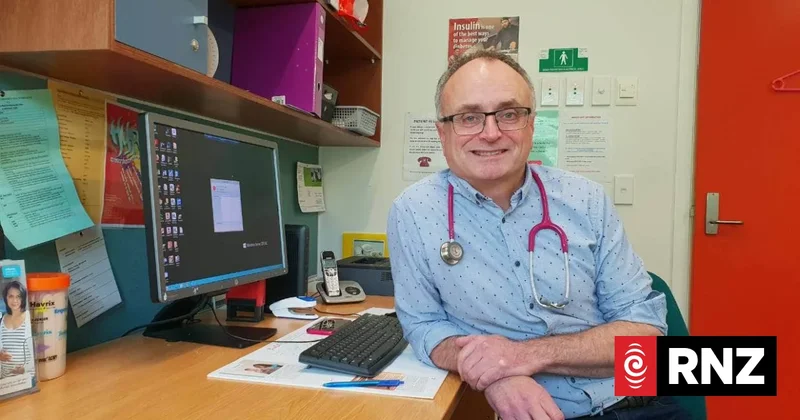
Top priority for the health system should be stopping deterioration, not promising a quick fix, says Dr Bryan Betty on his final day as chair of General Practice NZ.
His move from the role to the board of Health NZ was announced in April, after holding the position since 2023.
It is a path that's been taken before - his predecessor, Jeff Lowe, had also left to join the health agency's board.
Board members are appointed by the minister, a fact which GPNZ says reflects how important primary care expertise is to the overall sector across governments.
Betty told RNZ, in an interview the day before beginning the new role, it was the right time for a change.
"I think there's some big challenges for the health system going forward at this point," he said. "The decisions that are made now is where we'll be in five, seven years' time, 10 years' time."
The health system is under pressure. IT systems fail, leaving patient records inaccessible and forcing staff to revert to pen and paper.
Wait times for GPs, specialist appointments and at emergency departments have ballooned, leaving people without easily accessible healthcare, compounding health issues and putting pressure on dwindling staff and resources.
Experts blame years of underinvestment, and Betty criticised the previous centralisation reforms - where the DHBs were collapsed into one central agency - for being rolled out too fast.
"This devolution into a regional approach is probably the place we need to be," Betty said. "I think the structural reforms that occurred with the collapsing of all the DHBs [into one central agency] was really problematic. It probably happened too quickly and it was too much for the system to necessarily cope with."
Covid-19 had arrived on top of that, "so the whole thing became pretty complex."
Now, the system was battling the effects of years of underfunding, he said - particularly in primary care.
But, "$120 million did go into general practice this year, which is actually one of the biggest injections of funding into general practice," he said. "And I think we have to say that's a positive."
In the meantime, there were places around the country where patient care was being compromised by the lack of access to care.
Betty said he was worried by the increasing use of telehealth, and of seeing whichever doctor was available, rather than seeing the same GP over time.
"Long-term chronic conditions get missed," he said. "Diagnosing a disease or a condition and managing that over time is not a one-off issue - and so in general practice, it's a series of interactions over time that you build a picture of the patient."
And increasingly, GPs were able to manage conditions formerly handled by hospitals.
"We have seen a lot of services move out of hospitals, things like Mirena insertions, pipelles, gynaeological procedures, iron infusions. A whole range of them are now done exclusively in general practice, whereas previously they were hospital based. There's going to be a lot more of that over the next few years."
Meanwhile, ED doctors were having to manage conditions normally seen by GPs.
"I was speaking to an ED consultant up in Auckland a couple of years ago about this," Betty said. "And she said for the first time, she's having to go away and train on how to initiate antihypertensives because patients can't get into the general practice, they're presenting to ED with high blood pressure."
Major diseases like rheumatic fever, which had been eliminated elsewhere in the world, were still prevalent in New Zealand, and an increasing number of people were diagnosed with type 2 diabetes before they turned 20 - predominantly among the Māori and Pasifika populations.
Housing played a big part in reducing health inequities, Betty said. This was something he saw among his patients in Porirua, who he would continue to see alongside his board role.
"We have to resource [the system] to do something about it."