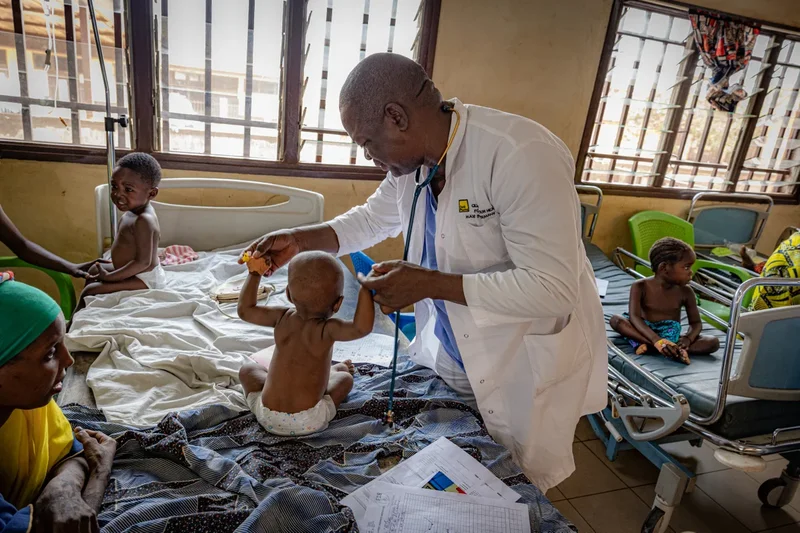
Deaths of newborns have risen by more than 80 per cent among the most vulnerable people across sub-Saharan Africa in the wake of global aid cuts, including by the UK and US.
Data covering more than three million refugee women across 20 nations, given exclusively to The Independent, shows that neonatal mortality – deaths within the first 28 days after birth – rose by 81 per cent between 2025 and 2026. That is a rise from 3.1 to 5.6 deaths per 1,000 live births, according to the UN refugee agency (UNHCR).
While the agency makes clear the data does not establish the cause, or that aid cuts were the sole factor behind the rise, it does show that indicators of child survival are worsening. Deaths within the first year of life have also increased by 111 per cent, from 8.3 to 17.5 deaths per 1,000 live births. Mortality for children under five also rose by 50 per cent.
Through an analysis of this data, plus that from other UN agencies, charities and NGOs, The Independent can reveal a grim picture of maternal and child health across Africa as sweeping cuts to international aid and the lifesaving programmes it funded begin to bite.
- More than 11 million people have lost access to essential sexual and reproductive health and protection services, according to the UN Population Fund (UNFPA).
- Almost 1,100 UNFPA health facilities and mobile clinics have been forced to close, while a further 727 are operating with reduced staff, limited hours or shortages of medicines and supplies.
- Nearly 6,000 healthcare workers, including frontline staff and midwives, have lost their jobs.
There are increasing fears among those working in the development sector that years of progress in reducing maternal and newborn deaths could be reversed by the steep decline in international aid.
“Global maternal mortality trends already show us where women’s lives are most at risk, and sub-Saharan Africa remains at the centre of this crisis,” said Dr Mitchell Sangma, a health advisor at Medecins Sans Frontieres (MSF).
“Countries depend heavily on external humanitarian and health system support to keep essential services running. When those lifelines are cut without health authorities stepping up, the consequences are predictable. I fear even more maternal deaths will happen quietly in communities, unseen and unrecorded.”
In Nigeria, 386 health facilities and mobile clinics – a significant number of which deal with maternal health – closed during 2025 and early 2026, cutting off care for around 380,000 people. Meanwhile, more than 100,000 people lost access to essential health services in the Central African Republic.
Both countries are featured in * * Hard Labour, the new documentary for Independent TV, by our chief international correspondent Bel Trew. It exposes how efforts to stop women and babies dying in childbirth have been blunted, with aid cuts playing a significant role.
Significant progress in tackling preventable maternal mortality across the globe had seen the rate decline by 40 per cent in the last two decades, but this had started to slow, even before the slashing of billions of pounds from global aid.
According to the WHO, the average annual decline in global maternal mortality rate was 1.5 per cent between 2013 and 2023, a figure significantly below the 2.6 per cent recorded between 2000 and 2010.
The benchmark is the UN Sustainable Development Goal, laid out in 2015, for the global maternal mortality rate to fall below 70 deaths per 100,000 live births by 2030.
The latest data puts the global maternal mortality rate at 197 per 100,000 live births, with a number of nations significantly above that.
Seventy-five per cent of deaths are due to either severe bleeding, infections, high blood pressure during pregnancy, complications from delivery, or unsafe abortion.
The Organisation for Economic Co-operation and Development (OECD), which works with more than 100 countries, has projected that official development assistance for health could fall by between 29 and 46 per cent between 2024 and 2026, equivalent to between $5bn and $8bn.
Funding for population and reproductive health, including HIV and sexually transmitted infection programmes, is expected to fall by as much as 54 per cent.
A study published in March estimated that the Trump administration's aid cuts could increase maternal mortality by an average of 45 per cent across Burkina Faso, the Central African Republic, Chad, Mali, Niger and Nigeria.
The researchers projected around 1,000 additional maternal deaths per 100,000 live births across the six countries within a single year.
"The world has made remarkable progress in reducing maternal deaths over the past two decades, proving that these deaths are not inevitable when women can access quality healthcare,” said Sarah Shaw, of advocacy group MSI Reproductive Choices.
“But across many of the countries where MSI Reproductive Choices works, cuts to global health funding, alongside conflict and displacement are making it harder for women to access essential reproductive services.”
In Somalia, CARE International says that, since January, it has been forced to close 50 of the 80 health and nutrition centres it supported because of funding shortfalls, with another 15 due to shut by October.
They are already seeing a spike in severe malnutrition – in a country that has one of the highest maternal mortality ratios in the world.
"This is a devastating blow to families who rely on us for basic healthcare and lifesaving nutrition,” said Ummy Dubow, CARE's Somalia country director. “When these centres shut down, pregnant women and young children pay the ultimate price.”
Save The Children estimates that Somalia also faces a shortage of around 20,000 midwives, while some hospital staff have faced up to a 90 per cent reduction in salaries, which has left midwives around the country effectively volunteering to keep services running.
Globally, the World Health Organisation (WHO) has said the shortfall of midwives could reach between 690,000 and 830,000 by 2030 – with Africa bearing the brunt of the burden as it will carry 46 per cent of the deficit.
The findings have renewed calls across the political spectrum for the UK, and the government under new prime minister Andy Burnham, to reverse cuts to the overseas aid budget, which will fall from 0.5 to 0.3 per cent of Gross National Income through to 2029.
Nine African countries are set to see their UK bilateral aid cut by more than 80 per cent, while overall bilateral UK aid to African countries is set to fall from £1.6bn to under £700m.
Sarah Champion, chair of parliament’s International Development Committee and a Labour MP, said: "The Trump administration has politicised maternal and sexual health. Not only has it dramatically cut funding, it has also orchestrated a chilling effect on other donor countries.
“It is the babies and mothers in the poorest countries who are bearing the brunt of his ideology. The UK has been very clear on its focus on women and girls, this is the right approach; but these stark finding show that is just not the reality on the ground.
“Unless the international community comes together to support low-income countries, I fear the situation will only get worse.”
Andrew Mitchell, a former international development secretary and Conservative MP for Sutton Coldfield added: "These figures lay bare the appalling effects of these cuts and the damage to the most vulnerable as well as to Britain's reputation.
"Surely it is not too much to ask that a new prime minister looks again at this and puts right the errors of judgment of [Boris] Johnson and [Keir] Starmer."
Monica Harding, the Liberal Democrat spokesperson for international development, called on Mr Burnham to take decisive action to prevent “further tragic loss of life”.
”The government cannot claim to be empowering women and girls around the world while pushing on with immoral and strategically illiterate aid cuts - gutting the basic healthcare, life-saving protection, and maternal services keeping them and their babies alive,” she said.
It was early 2025 when the Trump administration abruptly dismantled the US Agency for International Development (USAID), the world's largest provider of humanitarian and development aid. It cancelled thousands of health and aid programmes almost overnight.
The speed of the cuts left UN agencies and charities with little time to find alternative funding or wind down services safely. Then came the announcement that UK aid cuts would follow, in order to help pay for an increase in defence funding.
Internal USAID modelling found the funding freeze could affect services for 16.8 million pregnant women each year and eliminate postnatal care for 11.3 million newborns during their first two days of life.
France, Germany and the Netherlands have all announced further reductions to their aid budgets, with several governments citing the need to increase defence spending in response to growing security threats.
Aid organisations have warned that women and newborns are likely to bear the heaviest burden, as maternal healthcare, emergency obstetric services and reproductive health programmes are among those most affected.
Earlier this year, projections published in The Lancet suggested that reductions in foreign aid could contribute to 23 million additional deaths across 93 low- and middle-income countries by 2030.
“We know how to prevent the majority of maternal deaths. What we need is political will and international co-operation,” said Samy Ahmar, Head of Global Health at Save the Children UK.
George Ayres, from Plan International UK, added: “These deaths are preventable. Every cut to aid is putting more mothers and babies at risk. World leaders must act now to protect maternal health and ensure mothers can access the care they need.”
This article has been produced as part of The Independent’s Rethinking Global Aid project