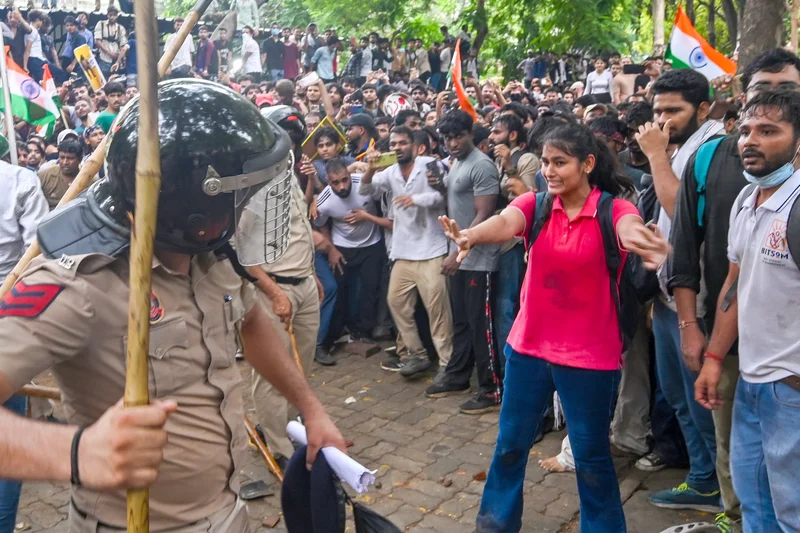
India's youth unemployment crisis has become one of the biggest vulnerabilities for Prime Minister Narendra Modi's government, exposing the gap between the country's economic ambitions and the reality facing millions of young graduates.
The frustration erupted into the open this month after a leaked paper forced a retest of India's ultra-competitive medical entrance exam, prompting nationwide student protests led by a viral, social media-focused youth movement called the Cockroach Janta Party.
While the exam scandal was the immediate trigger, economists say the demonstrations reflected something much deeper: a generation struggling to find secure, well-paying jobs despite spending years competing for an education.
Seeing footage of police fire tear gas at student protesters in Delhi on July 20 struck a nerve with 27-year-old Mumbai professional Abheet Mohanty (whose name has been changed due to the sensitive nature of the topic). He said he wasn't protesting because of one leaked exam paper, but because of what it represented.
The Gen Z students in the crowd were calling for accountability from the government after exam papers were leaked in May for a crucial medical entrance exam test, also known as the National Eligibility cum Entrance Test (NEET). While a retest took place in June, more than 20 students died by suicide in the aftermath of the leak.
"I felt for the students because I was a NEET student back in 2018," Mohanty told CNBC, recalling the immense pressure he felt as his parents pushed him to take the test, which would help him land a secure job with good pay.
Mohanty didn't pass the test and instead pursued a degree in communications. "It was very difficult to get a job," he said. After waiting a year, he landed a job in Mumbai, but his parents insisted that he take the NEET again instead.
They said his monthly salary of 20,000 rupees ($208) was "unsustainable" in Mumbai. Mohanty joined the Gen Z protests in the city on July 23.
His experience is increasingly common. India has the world's largest Gen Z population, but also faces one of its toughest employment challenges.
Graduate unemployment among 15-to 25-year-olds is close to 40%, according to the State of Working India 2026 report, while graduates accounted for two-thirds of the country's unemployed in 2023.
As good jobs become harder to find, millions of young Indians are pinning their hopes on a handful of ultra-competitive entrance exams for medicine, engineering and government jobs that offer one of the few reliable paths to secure, well-paid jobs.
Unsurprisingly, the number of students applying for the NEET exam rose 50% to over 2.2 million between 2019 and 2026, according to data from the National Testing Agency.
And the scramble extends well beyond medicine. Millions of students also compete for the Joint Entrance Examination (JEE) to enter the prestigious Indian Institutes of Technology (IITs), the Common University Entrance Test (CUET) for undergraduate admissions, and the Union Public Service Commission's (UPSC) civil services examination.
In India's tech city Bengaluru, 24-year-old graphic designer Aditi Garg faces a similar dilemma. Jobs are rare, applicants are many, and as a result, "companies pay peanuts," she told CNBC.
More than half a decade ago, Garg failed to get into the Indian Institute of Technology (IIT), a prestigious institute, despite a good score.
"I have lost count of the number of jobs I applied to last year," said Garg, adding that people of her generation are "barely able to find a job or settle for one that barely pays bills." There is little room for negotiating better pay, she explains, as there are "always a hundred other people" desperate enough to do the job for less.
This angst — and frustration at India's state of education and economy — is what Garg said drove her to join the offshoot of the Delhi student protest in Bengaluru.
Neelanjan Sircar, an associate professor in the division of social sciences at Ahmedabad University, told CNBC that the appeal of medicine and government jobs to young people is clear.
"In a country where 'nearly one in two graduates is not getting a job,' young people are choosing to take routes like the NEET that guarantee one," he said.
Seventeen-year-old Dimpy Gola (name changed) sat the NEET exam twice this year, first in May and then again when it was rescheduled in June. She did not score high enough to secure a medical college place and now plans to take a gap year before trying again next year.
Even if she gets a master's degree in science and a PHD, her prospects of finding a job will be "uncertain," she said.
Last week, India's Education Minister Dharmendra Pradhan resigned in response to the Gen Z student protests — which Gola welcomed. She said the paper leak had "distressed" many students, especially those who had dropped out for more than a year in an effort to pass the test.
The protests were notable because they targeted a government that has largely maintained strong electoral support among young voters. Experts say frustrations over education and employment are emerging as one of the biggest vulnerabilities for the Modi government.
While the exam leaks were the immediate trigger for the protest, the underlying issue is the limited supply of "secure, well-paid jobs" in India, Alexandra Hermann Prasad, lead economist at Oxford Economics, told CNBC.
India's graduate jobs problem has been building for years. Access to higher education has expanded rapidly, but job creation has failed to keep pace. Between 2004 and 2023, the country produced roughly 5 million graduates each year, but only 2.8 million found jobs, and even fewer secured salaried employment, according to the State of Working report.
Modi inherited many of these structural challenges when he took office in 2014, but much of his political appeal rested on promises of economic transformation and better employment opportunities. Economists say progress has been uneven, with India's shift from agriculture into higher-productivity manufacturing proving slower than many had hoped.
Global research house Bernstein, in a report in April, underscored the failure of India's economic policies to shift its workforce away from agriculture, boost the manufacturing sector, and direct investment into sovereign artificial intelligence tech.
The report highlighted that nearly 45% of the workforce remains in agriculture, which contributes just 15% to 16% of GDP, while manufacturing's share of the economy has remained largely unchanged. Bernstein also warned that artificial intelligence could eventually threaten India's IT services and business process outsourcing sectors, another traditional source of upward mobility.
It means that, more than a decade after Modi came to power, the government's economic record is increasingly being judged by a generation of young graduates whose expectations have risen faster than employment opportunities.
Twenty-one-year-old Arshia Mathur from Delhi attended the July 20 Gen Z protest because, despite graduating with an English Honors degree, she feels "nervous" and "skeptical" about finding a job.
"I have applied to a lot of roles" but no one responds, she said, adding that her college seniors and friends have a similar experience. She hopes that things will improve once she gets a master's degree.
Though Mathur said she is apolitical, she briefly followed the Cockroach Janta Party's Instagram page and supported the protests. The satirical youth movement — formed in response to comments comparing unemployed young people to cockroaches — resonated with her.
In the aftermath of the protest, Modi appointed a new Education Minister Pralhad Joshi and announced the creation of a task force, headed by Indian tech entrepreneur Nandan Nilekani, to overhaul the education system.
On Thursday, the parliament passed a bill to amend the anti-paper leak law, enforcing stricter punishment for those found to be involved with examination leaks, such as a jail term of up to 10 years and a fine up to 50 lakh rupees.
But as educated young Indians increasingly feel the promise of upward mobility has not materialized, economists warn that more will need to be done to prevent India's much-celebrated demographic dividend becoming a demographic burden.