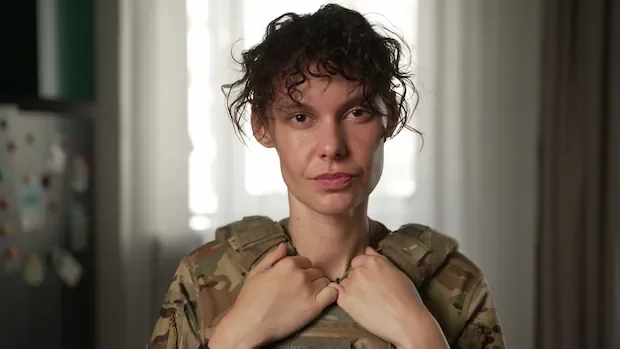
On Ukraine's front lines, female soldiers testing Canadian-designed body armour
U.K. donated 2,000 sets, including curved ballistic plates, that offer better protection
Ukrainian soldiers fighting on the front lines of Russia's war are now testing curved body armour designed specifically for women so they're better protected against bullets, shrapnel and drone strikes.
Ukrainian MP Iryna Nykorak said the majority of the more than 10,000 women serving in combat in her country are wearing ballistic plates for men that are too bulky, heavy and don't fit their chests. Some decide not to wear the plate at all, which makes it useless, she said.
"Right now, women must adapt to the current system, not vice versa," Nykorak told CBC News. "It's a respect to women's dignity.... She left her home, her family, sometimes in the majority of cases children, and joined the army. She sacrificed a lot."
Many countries around the world, including Ukraine and Canada, issue servicewomen standard body armour that isn't shaped specifically for them. Last month, Ukraine started handing out its first round of female body armour vests, saying there's a need for this protective equipment as the number of women serving grows.
In June, the U.K. also separately donated 2,000 sets of body armour to Ukraine that include curved female-specific ballistic plates by Canadian company NP Aerospace, paired with vest carriers designed by Logistik Unicorp, also based in Canada.
CBC News spoke to a female officer with the National Guard of Ukraine who's been serving for almost 15 years and is being identified only by her call sign, "Kudriava," in accordance with Ukrainian military rules.
She served in major combat operations across eastern Ukraine, including Bakhmut, Sievierodonetsk, Lysychansk, Chasiv Yar, and the Serebryansky Forest. Today her role on the front lines includes managing drones, electronic co-ordination and signal jamming.
Kudriava said she was on duty in eastern Ukraine when Russia invaded its neighbour on Feb. 24, 2022, and she wore standard body armour designed for men for the first year of the war.
"I have a typical body like slim man," she said. "But a lot of women have a different type of body, and it was hard to do something in the front line when your uniform and your armour are not for you — if you have a big chest, big hips or other types of body."
Kudriava started sourcing her own uniform and body armour over the years so that it's more comfortable during her operations, but she said it isn't ideal.
Military gear should fit like a "second skin," she said, and if it's uncomfortable, soldiers can become distracted instead of focusing on their mission.
"When you're in operation and you have some tasks [from] your commander, you shouldn't think about your uniform, you should think to save your life, to save life of your personnel and to do best in this operation," she said.
'Women are not just small men'
Michael Sandercott, part of a team at the NP Aerospace factory in Coventry, England, where the armour is manufactured, said women often size up so that men's body armour fits their breast tissue. This burdens them with extra weight they don't need, so they may give up other items like ammunition, water and rations, he said.
Flat ballistic plates rest again female soldiers' chests, causing the plate to angle outward creating gaps near the neck and lower torso.
"You're much more exposed to the risk of being struck with top-down munitions," he said. "A bullet or shrapnel or anything along those lines. You're less covered."
Erin Grieve, a sales manager for the company's personal protection team, said that "women are not just small men" and body armour shouldn't shrink to fit them. It should be designed to accommodate their breast shape to protect the organs they need to survive.
"You've got your heart, greater vessels, liver and spleen," she said. "So if you were to take an impact, you've got less than 20 minutes to get to a hospital. So what body armour is designed to do is make sure the impact doesn't happen in the first place."
Grieve said her company's ballistic testing and research show that its curved body armour fits tighter to women's bodies, providing better protection.
"So our modelling shows that wearing a curved plate, you are 48 per cent more protected than a flat plate," she said. "So in Ukraine, for example, where you've got drone threats and elevation threats, that gap is really significant."
MP leads charge for female body armour
Ukrainian MP Iryna Nykorak has spent years pushing for change. She founded Arm Women Now, an NGO supported by NATO that has provided 350 sets of female body armour with lightweight plates to servicewomen. She's also been donating uniforms, boots and gear to fit woman in the battlefield.
"Despite the fact that at the state level they don't have female body armour which will protect their body, their health and their lives, we support them," Nykorak said.
In 2024, Ukraine started giving women jackets and pants for the spring and summer designed for their bodies, she said. But Nykorak said dozens of other pieces of the uniform are not yet tailored to women's bodies.
Ukrainian officials said in July that women are performing in combat missions on an equal footing with men, so it's consistently implementing female-specific protective equipment.
Nykorak said she hopes her country's efforts to get combat soldiers gear that properly fits will lead to other allies, including the European Union, Canada and the U.K., following suit.
"Our experience teaches us a very important lesson that women's participation today is a matter of national resilience," she said. "So it affects a country's ability to defend itself and to survive."
Canada's Department of National Defence said last year it's working on releasing its first body armour system, with darting around the chest, shorter plates and tapering for women, this year for the army's light forces.
Plans are also underway, Canadian officials said, to procure more female-specific personal protective equipment.
With files from Halyna Yakushko