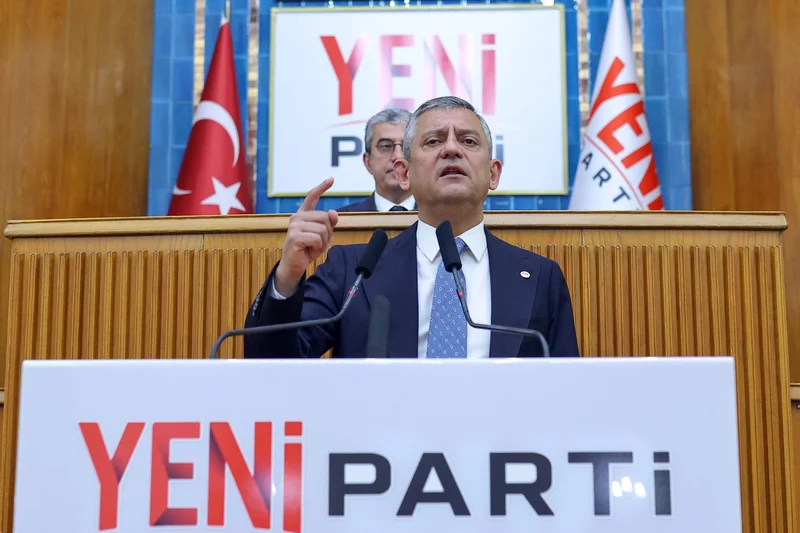
A new party has been founded in Turkish political life, while another has recently dissolved itself. Those who broke away from the Republican People's Party (CHP), bringing organization and cadres with them, founded the New Party (YP). According to media reports, even the furniture from CHP's party buildings is being moved to the YP. As a result, the debate over "just how new the New Party really is" looks set to continue for some time.
Those who split from the Justice and Development Party (AK Party), Ahmet Davutoğlu and Ali Babacan, founded two separate parties under their own leadership in 2019. A few days ago, Davutoğlu's Future Party (GP) ended its political life. It's also being discussed in political circles that the Democracy and Progress Party (DEVA) may merge with other parties.
Politics succeeds through grassroots movements. Sometimes pressure from the base gives birth to a new party. Sometimes politicians found a party by recognizing the expectations of the base and identifying gaps in the political landscape.
Populist parties that have risen around the world in recent years have built their politics around thematic issues. First, they manufactured an artificial sense of threat around subjects such as xenophobia, hostility toward migrants and Islam. From there, they managed people’s fears through the question of “who is one of us and who isn’t.” In this way, they built a base. Gradually, their support expanded. They influenced the political arena and forced centrist politics to transform. In this sense, new parties grew stronger in ways that reshaped politics.
Our country has diverged from the world in a positive sense. In Türkiye, too, parties were founded that sought to turn anti-migrant sentiment, xenophobia, economic grievances and identity anxieties into political capital. Yet, unlike their counterparts elsewhere in the world, they did not succeed. They were unable to produce an outcome that would weaken centrist politics.
Here, it is important to note that the AK Party and President Recep Tayyip Erdoğan have kept Turkish politics positively divergent from global trends. Even when facing pressure from within his own base over the refugee issue, he did not surrender the party’s politics to the populist wave.
Rather than pursuing exclusion, he prioritized a politics of integration that would expand his base over time. The Terror-Free Türkiye initiative, whose legal framework is expected to be presented to Parliament in the coming days, can be cited as the latest example of this approach.
Unlike other political parties, the AK Party has not allowed concrete policy areas such as the defense industry, energy independence, domestic and national development, and social policies to fall off the political agenda.
Of course, it has also foregrounded themes such as local identity, nationalism and security. But it has filled these themes with substance rather than using them as tools of populist politics. When speaking of the “national,” it did not turn inward. When speaking of sovereignty, it did not cut itself off from the world. Nor did it instrumentalize security as a pretext for excluding refugees.
As a result, neither the newly founded nor the existing parties in Türkiye have managed to turn politics toward populism. They have not been able to break up the political center. Instead, the newly founded parties have been forced to rely on “opposition to the government and to Erdoğan” as their political capital. But that capital was not enough to sustain them.
The opposition camp, with each new party and alliance, tried to build a base more through political engineering than through organic politics, leveraging the possibilities of digital media. For every newly founded party or alliance, poll results of unclear origin and methodology were instrumentalized in an attempt to shape the political agenda.
Different figures have been announced one after another with claims like "support for such-and-such party is this much, such-and-such alliance will come to power in the first election." Every day, results from pollsters no one has heard of were shared. Or manipulations were carried out through long-established, well-known polling firms.
These days, with the founding of a new party, an agenda is once again being built, as has happened before, around imaginary figures presented as poll results.
Here is how the attempt to manufacture political legitimacy through polls works: first, a hypothetical poll result is floated in the media. Then, that result is discussed as if it were an already established voter preference. The vote share of newly founded parties is presented as far higher than it actually is. Imaginary support figures are presented as proof of a new party’s rise. An attempt is then made to build a base through the media.
In the coming days, quite a few more poll results of unclear origin and methodology will likely be published. These polls will be publicized with statements such as “support for the newly founded party is high.” Until the elections, opposition elites will continue using this tactic to gain the upper hand in the narrative.
Successful political parties emerge from within society. Those that can unite politics and sociology and sustain an organic political approach are the ones that succeed. Political success cannot easily be achieved through elite fragmentation and media visibility alone. History offers many examples that prove this point.