Anyone who has lived in South Africa has probably witnessed it. A person walks into a shop in Cape Town and is immediately asked, âWhere are you really from?â because of their accent.
A job applicant in Durban finds themselves treated with suspicion after speaking isiZulu with a different regional inflection. A commuter on a taxi in Johannesburg is questioned â or even harassed â for speaking Shona, Chichewa or French.
Across the country, accent and language have increasingly become informal tests of belonging, often shaping how people are perceived, trusted or excluded long before their citizenship or legal status is ever established.
These everyday encounters reveal a deeper social reality: in South Africa, language is often treated not simply as a means of communication, but as a marker of identity, nationality and legitimacy.
Yet language and accent are imperfect and unreliable indicators of who people are. They reflect histories of migration, education, family background, multilingualism and cultural interaction far more than they reveal legal citizenship or national identity.
Against this backdrop, the recent statement by the Pan South African Language Board that âan accent is not an identityâ raises an important human rights and governance issue that extends beyond South Africaâs current migration debates.
It addresses a broader global challenge: the tendency to use language, pronunciation, ethnicity, appearance or cultural expression as informal indicators of nationality, belonging or legal status.
While concerns surrounding undocumented migration are legitimate policy matters requiring effective governance, effective border management and lawful administrative processes, these challenges cannot be addressed through assumptions based on linguistic identity. The use of language or accent as a measure of nationality is historically inaccurate, legally problematic and socially divisive.
In a country built on multilingualism, constitutional equality and freedom of movement, reducing identity to the way someone speaks risks undermining the very values that South Africaâs democratic order seeks to protect.
Language has never followed political borders
One of the greatest misconceptions in contemporary debates about migration and identity is the assumption that language neatly corresponds with nationality.
History tells a very different story.
Languages have never respected political borders because, for most of human history, the borders themselves did not exist. Instead, languages spread through migration, trade, conquest, intermarriage, pastoral movements and cultural exchange, creating linguistic landscapes that long predate the establishment of modern nation-states.
The history of the Nguni languages provides a compelling example. Between about the eleventh and seventeenth centuries, Bantu-speaking communities gradually migrated southwards from the Great Lakes region of East and Central Africa through present-day Mozambique into what is now South Africa.
These movements were neither singular nor uniform; they occurred over several centuries through successive waves of migration, settlement and interaction with existing communities. As these populations expanded, their languages evolved into the Nguni language family, including isiZulu, isiXhosa, isiNdebele and siSwati. These languages share a common linguistic ancestry, explaining their high degree of mutual intelligibility while also reflecting the diverse historical experiences of the communities that speak them.
The nineteenth-century Mfecane (or Difaqane) further transformed the linguistic map of Southern Africa. Political upheavals, warfare and the establishment of new kingdoms resulted in significant population movements across the region.
Communities associated with the expanding Zulu kingdom migrated into present-day Zimbabwe, Mozambique, Eswatini, Malawi and Zambia, giving rise to new settlements and linguistic communities. The Northern Ndebele, for example, established themselves in present-day Zimbabwe under Mzilikazi, while other Nguni-speaking groups settled across neighbouring countries.
These historical processes ensured that related Nguni languages became established across much of southern Africa, centuries before the colonial partition of Africa.
The same pattern is evident among other southern African language groups.
Setswana is spoken not only in South Africa, but also by large populations in Botswana and parts of Namibia and Zimbabwe. Sesotho extends across South Africa and Lesotho, where it is one of the official languages, while Sepedi, Tshivenda and Xitsonga are also spoken across borders with Zimbabwe and Mozambique.
Similarly, Chichewa, Shona and Portuguese are heard in many South African towns and cities because migration across the region has long been part of southern Africaâs social and economic history. These are not foreign intrusions into a fixed linguistic landscape; they are the continuation of centuries-old patterns of regional mobility and cultural exchange.
Colonialism further complicated these linguistic geographies. The borders drawn by European colonial powers during the late nineteenth century â formalised at the Berlin Conference of 1884-1885 â paid little attention to existing cultural, linguistic or ethnic landscapes.
Communities that had lived together for generations found themselves divided between different colonies, while others were incorporated into entirely new political entities. As a result, many African language communities today are distributed across several sovereign states. National boundaries may separate countries, but they rarely separate languages or cultures.
Even within South Africa, language has never been geographically fixed. Urbanisation, labour migration, apartheid-era forced removals and post-1994 internal migration have created highly multilingual communities where people routinely speak several languages and adopt accents influenced by education, family background and the places in which they have lived. A person born in Limpopo may grow up in Durban, study in Cape Town and work in Johannesburg, developing a linguistic identity that reflects multiple regions rather than a single locality.
For these reasons, expecting a personâs accent, pronunciation or vocabulary to conform to a narrowly defined national identity fundamentally misunderstands how languages evolve.
Language is shaped by centuries of human mobility, social interaction and cultural adaptation â not by passport offices or immigration checkpoints.
Accents reveal stories of migration, education, family history and multilingualism; they do not reveal citizenship or legal status.
Using language or accent as a proxy for nationality is therefore both historically inaccurate and socially harmful. It ignores the deeply interconnected histories of African societies and reduces complex identities to superficial markers of speech. In a region where languages have crossed landscapes long before political borders were drawn, linguistic diversity should be recognised as evidence of our shared history rather than treated as grounds for suspicion or exclusion.
The danger of linguistic profiling
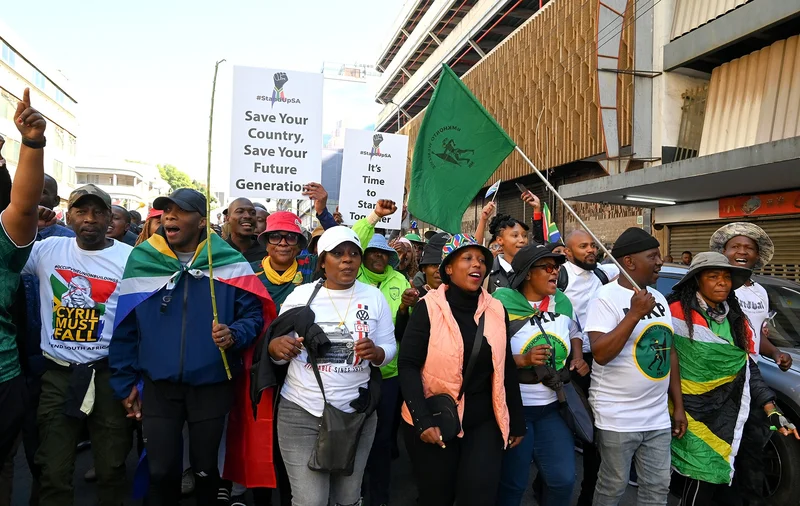
The emergence of the âAbahambeâ movement, spearheaded by groups such as March and March, has intensified the linguistic debate. While many supporters frame the campaign as a response to legitimate concerns about undocumented migration, pressure on public services and weaknesses in border management, there is a real danger when public frustration becomes translated into informal systems of identifying who âbelongsâ, based on how they speak.
When ordinary citizens assume the role of determining nationality through language, the line between civic activism and discrimination becomes increasingly blurred.
Linguistic profiling is particularly dangerous because it relies on assumptions rather than evidence. It reduces complex identities to a single observable characteristic, ignoring the realities of multilingualism, internal migration and regional mobility.
A South African born and raised in Cape Town may speak isiXhosa differently from someone in Mthatha. A Setswana speaker from Mahikeng may sound remarkably similar to someone from Gaborone. An isiZulu speaker from northern KwaZulu-Natal may share linguistic features with communities in Eswatini or southern Mozambique.
None of these differences reveals citizenship; they simply reflect the rich diversity of language communities that have evolved across southern Africa over centuries.
History also reminds us that once societies begin using language or ethnicity as informal tests of belonging, exclusion rarely remains confined to foreign nationals.
Those who speak with unfamiliar accents, belong to minority language communities or simply fail arbitrary linguistic âtestsâ may also become targets. South Africans themselves can be misidentified, questioned or excluded because they do not conform to someone elseâs expectations of what a ârealâ South African should sound like. In this way, linguistic profiling ultimately threatens everyone living in a multilingual society.
Beyond its immediate human rights implications, this trend poses broader risks for South Africaâs regional and continental aspirations.
South Africa is deeply integrated into the Southern African Development Community, where the movement of people, labour, skills and investment has long underpinned regional development.
Families, businesses and communities routinely span the borders of South Africa, Botswana, Namibia, Zimbabwe, Mozambique, Lesotho and Eswatini. Languages such as Setswana, Sesotho, siSwati, isiNdebele, Tshivenda and Xitsonga are spoken across these national boundaries, reflecting shared histories rather than separate identities.
If language increasingly becomes a basis for suspicion, South Africa risks undermining not only social cohesion at home, but also the spirit of regional integration that has been central to post-apartheid foreign policy.
Trust between neighbouring countries can be eroded when their citizens are routinely viewed with suspicion because they speak a familiar language differently. Such perceptions may also weaken cooperation on trade, labour mobility, education, tourism and cross-border development â all priorities embedded in regional integration frameworks and the African Unionâs vision of a more connected continent. DM
Vukani Chris Mhlanga is a technology executive and entrepreneur whose work spans technology, digital systems and cross-border business development in southern Africa and Europe. His perspective on migration, identity and human rights is informed by his lived experience across national and cultural environments.
Dr Simangele Dlamini is a social sciences researcher and academic, and writes in his personal capacity.