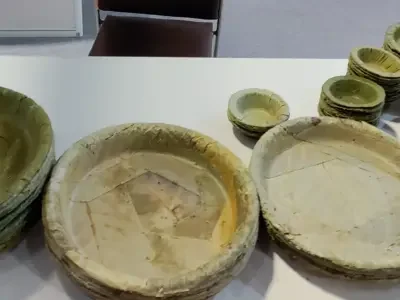
While the paper, plastic and styrofoam plates have replaced the traditional leaf plates in most community feasts throughout Nepal, in the country’s rural areas, people still use leaf plates made from bauhinia (a creeper plant) and banana leaves, not to mention the duna, a bowl and tapari, a plate made from sal (Shorea robusta) leaves and areca palm leaves.
“Nepalese use the fresh leaf plates and bowls for many occasions, including religious rituals, children’s rice feeding ceremonies, many festival feasts, and marriage ceremonies,” writes Nepali food blogger Jyoti Pathak. “The dry sal leaf plates are mostly used for picnics, restaurant use, village parties, and at the street food stalls as disposable plates.”
With the rising demand for sustainable sal plates and bowls, many small enterprises have sprouted, some supported by non-governmental organisations.
“The production of sal leaf plates involves minimal processing and energy use, resulting in a significantly lower carbon footprint compared to plastic or paper plate manufacturing,” writes Baral. “Sal leaf plates are chemical-free and don’t leach harmful substances into food, unlike some plastic and foam alternatives. This makes them a healthier choice for serving food, particularly in eco-conscious regions like Europe and America.”
Likewise, a bio-bowl and plate enterprise, supported by the non-profit People, Energy and Environment Development Association (PEEDA), collects sal leaves as raw materials to produce biodegradable bowls and plates as an eco-friendly alternative to plastic products from the Dhulekhar Community Forest in Pyuthan District of western Nepal.
According to PEEDA, an enterprise managed by 22 women, more than half of whom are Indigenous, combines indigenous practices with improved technology and market-oriented production, transforming traditional skills into a sustainable green enterprise.
The community forest, covering an area of 488.68 hectares and managed by 339 households, has the potential to annually supply more than 250 quintals of sal leaves, which can produce approximately 5.2 million bio-bowls and 1.5 million bio-plates each year.
This is just one of the many community forests, and the women’s group is one of the many groups involved in producing biodegradable bowls and plates. The potential is immense.
Community forests in Nepal, national forests handed over to local user groups for protection, management and utilization according to the Forest Act, 1993, have played a vital role in forest conservation and sustainable resource management.
Simplifying the handover process and recognizing community forest user groups as self-governed, autonomous corporate bodies to manage and use community forest according to a community forest operational plan has led to the broader participation of local people in forest protection and management,
According to the Ministry of Forests and Environment, Government of Nepal’s 2020 estimates, nearly 2.58 million hectares of forestland in Nepal have been handed over as community forests. However, the community forests of Nepal have not been able to increase forest productivity, generate income, and create jobs as expected, write Laudari et al.
Despite Nepal’s relatively low contribution to global carbon emissions, the communities increasingly experience the impacts of climate change, including annual forest fires and the drying up of natural water sources. These challenges have intensified the climate vulnerability of local communities, particularly women.
In this regard, forest-based initiatives like duna tapari-making enterprises, involving local communities, might offer answers to these interconnected social and environmental challenges.
The women from community forest groups, involved in these enterprises, have turned their vulnerability into a means for earning sustainable livelihoods, contributing simultaneously to environmental conservation, climate resilience, and local economic development – one leaf at a time.