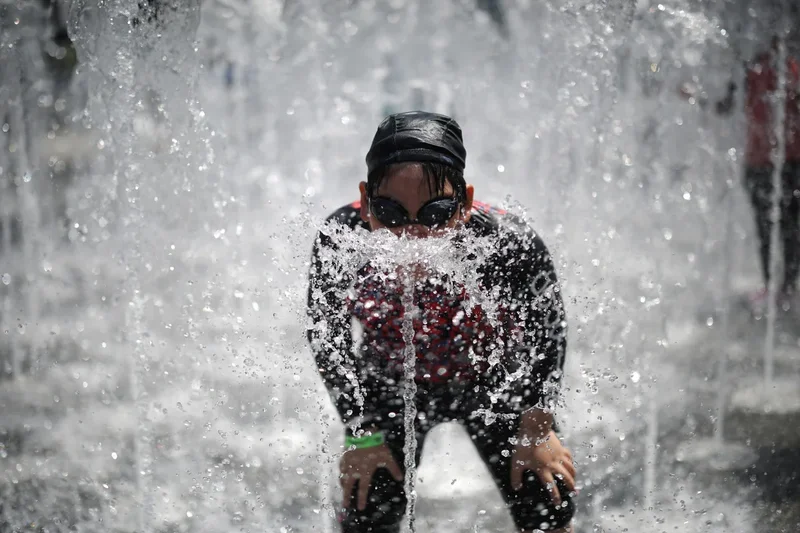
South Korea issued a severe heatwave warning as it recorded its highest ever temperature of 42.5C on Sunday, prompting the government to activate an emergency disaster response and urge people to immediately stop all outdoor activities.
The peak temperature of 42.5C was reached in the southeastern city of Yangsan at 1.26pm on Sunday, the Korea Meteorological Administration said, marking the highest reading since records began in 1904.
Yangsan, about 310km southeast of Seoul, has been at the epicentre of the ongoing heatwave in the country, where temperatures have exceeded 40C for five consecutive days.
The “severe heatwave” alert is in place across southern parts of the country, while most of the rest of the country is under either a heatwave warning or heatwave advisory.
“Each ministry shall use all available channels, including public broadcasters, emergency text messages, electronic information boards and village broadcasts, to swiftly inform the public about heatwave conditions,” prime minister Han Seongsook said in a statement posted on Sunday on a government Facebook page.
South Korea only added heatwave emergencies as a new category of public warnings last year, as it sought to improve the government’s response to rising temperatures.
Issuing the alert, the weather agency urged people to “immediately stop all outdoor activities” and said that “indoor spaces without air conditioning are dangerous.”
“Move immediately to a cool place, such as a designated cooling centre or a shaded area, and stay hydrated while resting,” it advised.
Residents who were caught off guard by the heatwave have been taking refuge in air-conditioned shopping malls or cafes to escape the scorching heat.
Ju Dong-yeol, 27, who sat down in Starbucks in Seoul along with his parents, said he came inside as it became too hot to stay outdoors.
“It is too hot to be outside doing anything,” he told the Japan Times. “I can’t think of anything else to do other than stay in air-conditioned places like home, shopping malls and cafes.”
The Korea Meteorological Administration said the extreme heat across the country was caused by the simultaneous influence of the North Pacific High and the Tibetan High pressure systems, which have covered the Korean Peninsula like a lid, trapping heat and allowing temperatures to build across much of the country while limiting cloud cover.
The interior ministry is preparing to dispatch director general-level officials to oversee arrangements and operations in the Seoul Metropolitan area.
They would be deployed to assess local heatwave responses and identify areas requiring additional support, Yonhap reported.
A total of 1,781 people suffered heat-related incidents between 15-31 July, according to government data. As many as 13 people died from heat-related illness during the period, it said.
Temperatures climbed to 40.3C in Gyeongju by 2.14pm on Saturday, marking the city's first 40C reading of the year. It was also the highest temperature recorded there since August 2018, when the mercury reached 39.8C.
In response to the extreme heat, the government activated level 2 of its disaster response headquarters at 1pm, stepping up nationwide emergency measures.
It is the first time the level 2, on a three-tier emergency response system with level 3 being the highest, has been triggered since August 2023 and only the second time since heatwaves were officially classified as natural disasters.
The average annual number of heatwaves in the country has doubled to 19 over the past five years, from eight in 1970s, according to the Korea Meteorological Administration.
A heatwave day in South Korea is defined as one with a maximum temperature of at least 33 C.
South Korea’s professional baseball league cancelled a game in Changwon after the city’s temperature rose to 39.5C during the day. It was the second consecutive cancellation of the game in the city.
“The decision was made with the safety and health of spectators and players as the top priority, as a severe heat wave warning remains in effect for the Changwon area,” said the Korea Baseball Organisation in a statement.
Neighbouring Japan is also enduring an intense heatwave, with temperatures approaching 40C across parts of the country. The Japan Meteorological Agency warned that the extreme heat would persist through Sunday, including in earthquake-hit Kumamoto Prefecture, where daytime highs reached 37.5C and temperatures are forecast to climb to around 40C in the coming days.