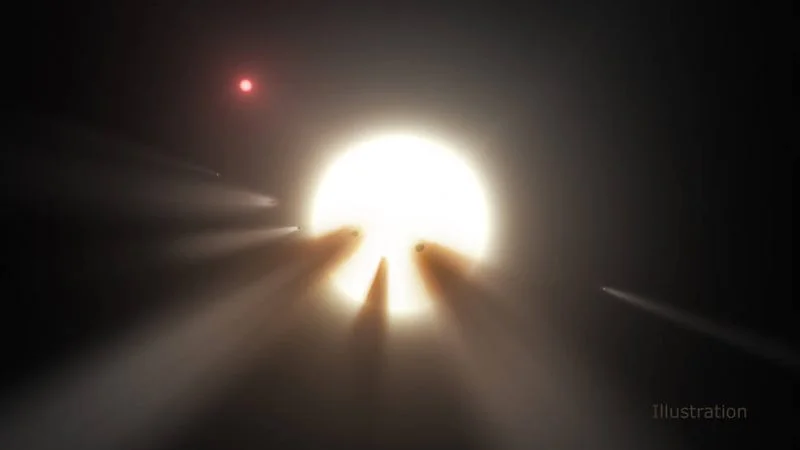
- Tabby’s Star is known for its strange episodes of dimming.Astronomers found the dimmings “weird” and “mysterious.”
- The star made headlines a decade agoas a possible site where an advanced extraterrestrial civilization might be building a massive array of solar collectors, designed to harvest the star’s energy.
- An alternative explanation is a giant companion for Tabby’s Star.Now astronomers say they have evidence for the companion.
A giant planet orbiting Tabby’s Star?
Remember Tabby’s Star? That’s the star that was experiencing weird dips in brightness of up to 20% or more. One idea was that an advanced extraterrestrial civilization might be building a Dyson swarm there: a massive array of solar collectors orbiting the star, designed to harvest its energy. Tabby’s Star been quiet as of late. But there is some new news.
A team of astronomers in the U.K. and France, led by Cristina Madurga-Favieres at the University of Warwick in the U.K., says that it has found evidence for a possible giant planet orbiting the star. The planet – or maybe a brown dwarf – if real, would be about nine times the mass of Jupiter and 1.7 times the radius.
A huge companion like that could help to explain the episodic dimmings of Tabby’s Star. But the companion hasn’t been confirmed yet.
A not-yet-peer-reviewed paper about the possible companion has been published as a preprint on arXiv.
Tabby’s star may have a companion about 9.4 times Jupiter’s mass. The possible object could help explain the star’s irregular dimming, but its orbit and presence still need confirmation. doi.org/hccw2x
— Science X / Phys.org (@sciencex.bsky.social) 2026-07-28T10:00:38-04:00
What TESS and other data revealed
The researchers analyzed data from NASA’s Transiting Exoplanet Survey Satellite (TESS) mission, as well as data from ground-based radial velocity measurements. The researchers used archival radial velocity data from the Nordic Optical Telescope (NOT), the ESO 3.6-m telescope, the Observatoire de Haute-Provence (OHP) and the Leonard Euler telescope. New, additional analysis was also conducted on the SOPHIE spectrograph data from the Observatoire de Haute-Provence.
Launched in 2018, and now in an “extended” mission, TESS explicitly seeks exoplanets orbiting bright stars relatively close to Earth. It has identified thousands of candidate exoplanets and hundreds of confirmed worlds, ranging from small, rocky Earth-sized planets to gas giants and super-Earths.
Tabby’s Star (officially named Boyajian’s Star or KIC 8462852) is located approximately 1,470 light-years from Earth, in the direction of the constellation Cygnus the Swan. It’s too dim to see with the eye (approximately 11th magnitude), but a modest-sized telescope can pick it up.
The new results for Tabby’s Star suggest the existence of a huge round companion object. Size-wise, the companion appears to be in the boundary region between a planet and a brown dwarf. The paper states:
This work presents a symmetric round-shaped transit found in the TESS data of KIC 8462852, suggesting the existence of a companion, either a giant planet or a brown dwarf, around the star.
The companion would be huge and massive
So just how large is the presumed companion? The researchers say it would be 1.7 times the radius of Jupiter and 9.4 times as massive. Jupiter is the largest planet in our solar system, with about 2.5 times the mass of all the other planets in our sun’s family combined. So 9.4 times that is pretty big!
And, if it exists, the companion would also be quite cool, at 268 Kelvin (-5 degrees Celsius or 23 degrees Fahrenheit). Plus, its orbit would be slightly eccentric (oval) with an average distance of 2.35 AU (astronomical unit) from the star. One AU = Earth’s distance from the sun.
Could the companion be flinging exocomets?
One theory about Tabby’s Star has been that groups of comets are causing the dimming. If there was a giant planet, it might be corroborating evidence for this earlier idea. That’s because a giant planet could fling comets around with its gravity.
And we do already know that exocomets exist around other stars. TESS found at least 30 of them around Beta Pictoris in 2022, for example.
The new paper on the possible companion states:
No transiting companion has ever been detected around this well-known star, so the potential evidence of a candidate presented in this work is significant, as its existence could explain the complexity of the system.
The strongest theory is that a group of exocomets or planetesimal fragments are responsible for the irregular and apparently non-periodic dips in the Kepler light curve of Tabby’s Star. The presence of a companion would explain why these bodies are driven to the vicinities of the star, breaking up, as it would orbitally perturb them.
Fingers crossed for more data
As always, the astronomers who wrote the new paper about a companion for Tabby’s Star speak to the need for further observations. These will be essential, they say, to finding out whether there actually is a giant planet or not. These new data could come from the James Webb Space Telescope or Hubble Space Telescope.
There is also the upcoming new data release from ESA’s great Gaia satellite, which completed its final science observations and was decommissioned in 2025. Gaia’s data release #4 (DR4) – currently expected in December 2026 – could shed more light on Tabby’s Star.
And as is normal in scientific inquiry and debate, there is some skepticism that a companion exists. For example, in a thread on the social media platform Bluesky, astronomer Jason Wright said:
Ummm… I've looked at a lot of RV curves over the years and Figure 9 of this paper does not show any evidence of a giant planet/BD companion. At best, I'd say they've done a lot of work and done a good job to rule out giant companions at various periods and the remaining parameter space is small.
— Jason Wright (@astrowright.bsky.social) 2026-07-25T18:52:44.669Z
Tabby’s Star is weird!
Tabby’s Star is well-known for its weird dimmings in brightness. Astronomers have proposed various hypotheses over the years. These include clouds of dust or groups of comets, or a melting exomoon.
A decade ago, astronomer Jason Wright proposed and helped popularize the idea of a Dyson swarm (or alien megastructure) as a hypothesis for Tabby’s Star. A Dyson swarm is a theoretical megastructure consisting of a vast network (or “swarm”) of independent, solar-powered satellites or collectors orbiting a star in a dense formation, with the goal of harvesting a large fraction – or all – of its energy. The data now make the Dyson swarm idea unlikely.
Tabby’s Star, also known as Boyajian’s Star, was named after its discoverer, astronomer Tabetha Boyajian.
Also, in 2021, astronomers found that the star is part of a binary pair of stars. The companion is a red dwarf star, about half the size and mass of the sun.
Bottom line: Astronomers in the U.K. and France say they might have found a giant planet orbiting Tabby’s Star. The star is famous for its weird dimmings in brightness.