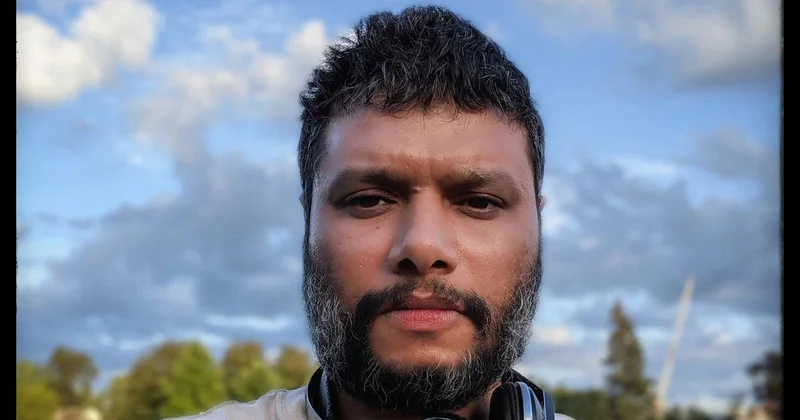
In Lindsay Pereira’s latest work of fiction, Super: A Novel, Sukhwinder, a young man from Chukhiara village in Punjab, goes to Jalandhar to fulfil the dreams and aspirations of many like him, to migrate to Toronto like his cousin Dan/Deepanshu, who works as a gig worker but hopes to build a better life with Sukhwinder by his side.
In Jalandhar, Sukhwinder meets Harneet, who is bogged down by the immigration dream forced upon her. She continues to question this desire throughout the novel while also wanting agency to decide for herself, knowing there’s no way out. Meanwhile, in Brampton, a middle-aged unemployed man spends his time on Reddit spreading hatred against the migrants, setting the stage for hate crimes.
Pereira’s nuanced portrait of the immigrant life evokes sympathy for characters who seem to be stuck in a vicious cycle of debt and dreams of a better life.
In a conversation with Scroll, the author spoke about his new novel and its themes. Excerpts from the interview:
What drew you to the subject of immigration to write a novel about it now?
I read a report, a few years ago, about a funeral home based in Toronto that was responsible for the repatriation of human remains to families of the deceased in India. It mentioned a surge of young people dying under questionable circumstances and documented a rise from eight bodies in 2018 to 33 in 2022. It was a disturbing report that suggested the presence of a story that wasn’t being given the attention it deserved.
That prompted me to take a closer look at why so many young Indians, primarily from some parts of India, were selling everything they owned or mortgaging family land to try and live in a country they knew little or nothing about. That research uncovered some startling statistics, which then became the seed for this novel.
Your earlier novels, Gods and Ends and The Memoirs of Valmiki Rao, describe the lives of people in the margins in Mumbai. In Super, you move to Punjab and Toronto. Were there any challenges in making this geographical shift?
I don’t think of it as a shift because I still place an emphasis on stories rather than settings. There were a few challenges related to pinning down distances and looking for landmarks in cities I had never visited, but that didn’t bother me much because I was clear about where the heart of the story lay and what I needed those characters to do.
I am always drawn to people who survive on the periphery of something larger than themselves, and that hasn’t changed with this novel.
There have been films that portray the lives of Punjabi immigrants abroad, especially in the UK. They often showcase immigrants living in townhouses, the life that your characters, Dan and Sukhwinder, dream about. You subvert the representation and showcase the struggles of working-class people through scams and the gig economy. Tell us about that.
It increasingly feels as if an immigrant’s story is defined as much by what compels them to move as it is by their economic background. Moving as a student is radically different from arriving with a golden parachute, and those buffers shape the nature of any experience in a foreign country.
In 2014, the government of Canada introduced something called the Labour Market Impact Assessment program, which was meant to tie work permits to labour shortages. It was soon abused and ended up giving rise to an underground economy. In recent years, this has led to the exploitation of foreign workers, many of whom happen to be international students who are desperate to stay on, at any cost, because of what they have invested in getting to Canada. I wasn’t dismissing the lives of successful immigrants, but they were not the segment I wanted to examine through these characters. My story is about people who I believe are underrepresented when it comes to how life in Canada is often portrayed.
What were your influences while writing this book?
I wasn’t modelling the story on anything I had read or seen, because that would defeat the purpose of what I was trying to say myself. I struggled with form and structure, so I know there was no mould I could emulate. I wouldn’t be able to identify any specific influences that pushed me into making any of the narrative choices I made here.
You use seemingly insignificant days to tell the story and show the passage of time. What was your thought process in choosing this style of narration? Was there a reason for picking the dates that you did?
I wanted to make this episodic in a way that compelled a reader to fill in the blanks. The idea was to use a series of what felt like snapshots, capturing these characters at random moments in their time, without delving too deeply into everyday occurrences. I felt that was the best approach because I didn’t want to let the story be overwhelmed by the minutiae of what it means to go about one’s daily life. While that could possibly have made for a more immersive novel, I wanted form to serve the story, and this worked best.
Also, while the dates were random, the days were not insignificant because they all served as markers or milestones in how these characters were evolving, for better or worse. It’s also why I didn’t jump within the chapters themselves, documenting events or conversations in constant stretches.
In Super, we get an empathising view of the aspirations of immigrants vis-à-vis the resentment of the locals. You give us Maynard Wilson, a middle-aged unemployed man in Toronto who despises outsiders. What was the process (and/or challenges) of writing such a humanising view of a xenophobe?
The challenge arises when one is attempting neutrality, which is what I always hope for. The aim is to try and take on the role of neutral observer rather than omniscient narrator, because that allows me to step back and avoid taking sides. It is important for me to present all sides and allow a reader to choose one, even if that shifts as the story progresses.
I couldn’t empathise with the character of Maynard Wilson, but I also wanted to be fair and allow him to explain why or how he made his choices. The novel, for me, is an exploration of intent and that becomes tricky when prejudice is involved. I knew it couldn’t be a portrayal in monochrome, because that simply wouldn’t work.
**You were a co-editor with the late Eunice De Souza for Women’s Voices: Selections from Nineteenth- and Early-Twentieth Century Indian Writing in English. Did this impact your creation of Harneet, who seems to be the moral centre of the book? **
I don’t know if what I did back then has had a tangible influence on any fiction I have written over the past few years, but I believe that research certainly helped in other ways. My work with Eunice de Souza focused on the beginnings of Indian writing in English and how writers adopted gender roles that were heavily reliant on the effect of the outside world on their inner lives. An emerging nationalism, waves of imperialism, the impact of colonialism and religion were all part of what compelled these early writers to embrace certain positions, and that may have been on my mind while writing about a female character.
I fell in love with Harneet. Could you talk about shaping her character?
Harneet is, along with the other protagonists, a figure of tragedy. To refer to her as a moral centre implies an immorality in the actions of everyone else, which isn’t the case. They are compelled to do what is in their natures by circumstances beyond their control, because they believe those decisions to be right for them.
Her tragedy is her sex and what that means in India because she is the only one without agency. The others have a right to choose, but she is never given that option. Her future is implied, and her story is written at the time of birth, which is a part of her already appears to understand.
Those were the ideas I kept in mind while shaping her character. What she says and thinks also alludes to how her life moves towards an inevitability of its own.
The structure of the book is ouroboric. Was it intentional?
Yes, it is intentional and critical because the death that occurs early on must weigh heavily on all pages. One is meant to read every chapter armed with the knowledge of what is now inevitable and feel the helplessness with which this horrific event cannot be prevented.
Lastly, you have dabbled in both forms, novels and short stories (Songs Our Bodies Sing). How does the process of writing one differ from the other for you?
I don’t think of it as separate because the intention doesn’t change: I am trying to tell a story in a form that serves it best. If I can do this in a more concentrated manner, the short story works but often, I feel the need to explore an idea in some detail, for which I find the novel form to be most appropriate. The physical and mental exertion that goes into writing both is also the same.
We welcome your comments at letters@scroll.in.