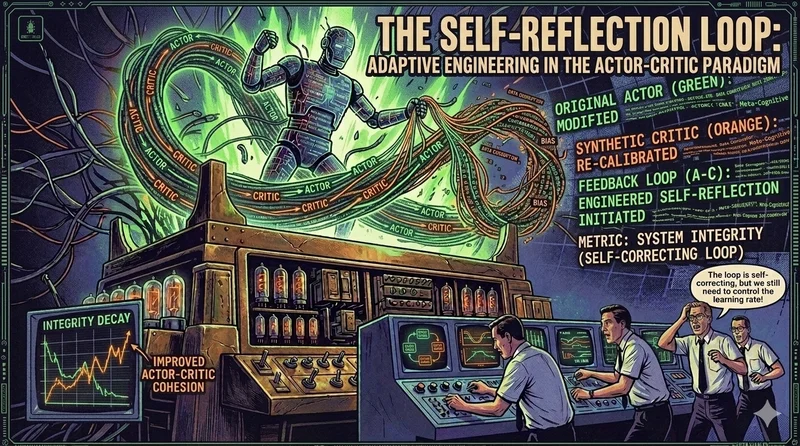
One-shot generation is fast, but fragile. A model produces an answer in one pass, with no enforced verification step, no hard break condition, and no structural defense against its own blind spots. The result is familiar: polished language masking logical drift.
Reliable AI systems are not built by asking for better prompts. They are built by engineering feedback loops directly into execution.
This article walks through three escalating control layers:
- Linear Pass(Self-Reflection)
- Autonomous Loop(Execution-Bound Repair)
- Brain Split(Actor-Critic Architecture)
The Problem with One-Shot AI
One-shot prompting assumes the first output is close enough to truth. In practice, that assumption fails under pressure:
- The model cannot reliably detect its own mistakes without structured critique.
- Subjective confidence is mistaken for objective correctness.
- There is no runtime gate between draft and deployment.
If your application needs stability, you need structured friction: deterministic checks, explicit correction cycles, and role separation
Level 1: Self-Reflection (The Linear Pass)
The Concept: A single model drafts once, then critiques once, then outputs. No infinite recursion and no external test execution.
Visual Anchor:
The Technical Explanation:
- Step 1 (Generator):Model A drafts the initial content.
- Step 2 (Self-Critique):The same model reviews its own draft for spelling, grammar, and logical clarity, updating the output once before submission.
Strengths and Limits
**Pros:** low latency, low compute cost, simple to implement.
** Cons:** high confirmation bias because the same reasoning stack both creates and evaluates the output.
This tier is useful, but it is not a robust correctness system.
Level 2: Loop Engineering (The Autonomous Loop)
The Concept: When moving from prose to production code, subjective review is not enough. A single model enters a bounded correction loop driven by raw sandbox feedback until code satisfies defined test criteria.
Visual Anchor:
The Technical Explanation:
- The Sandbox Environment:Run the generated code directly against compiler and unit test pipelines.
- The Automated Corrective Cycle:Capture raw failures such as-
Expected token match failed, feed that exact log back into the model, and force a targeted rewrite. - The Break Condition:Continue iterating until all required tests are green, then terminate cleanly.
Why It Matters
This replaces confidence-based output with execution-based validation. The model is no longer trusted to self-assess correctness; it must prove correctness against runtime constraints.
Level 3: Actor-Critic Architecture (The Brain Split)
** ** The Concept: To reduce systemic bias, separate synthesis from judgment. Two distinct models collaborate adversarially: one builds,
Visual Anchor:
The Technical Explanation:
- Model A (The Actor):Focuses exclusively on synthesis: code structure, algorithm design, and implementation strategy.
- Model B (The Critic):Applies strict rubric constraints: syntax compliance, policy checks, structural validity, and bias rejection.
- Cross-Agent Dialogue:Actor proposes, Critic rejects or constrains, Actor reframes. This continues until all structural and correctness criteria are satisfied.
Why It Works
Decoupling generation from evaluation reduces single-model blind spots and creates an explicit gatekeeper function before release.
Conclusion & Takeaways
Reliable AI engineering starts where one-shot prompting ends.
- Level 1 (Self-Reflection):introduces a minimal quality pass, but remains vulnerable to model self-bias.
- Level 2 (Autonomous Loop):binds generation to objective compiler and test feedback, creating measurable correction.
- Level 3 (Actor-Critic):separates production and critique into adversarial roles, yielding stronger structural alignment.
As orchestration becomes more deterministic and runtime-monitored, defect rates fall and deployment confidence rises. The path forward is not waiting for larger foundation models to hallucinate less. The path forward is building systems that enforce correctness before output reaches production.