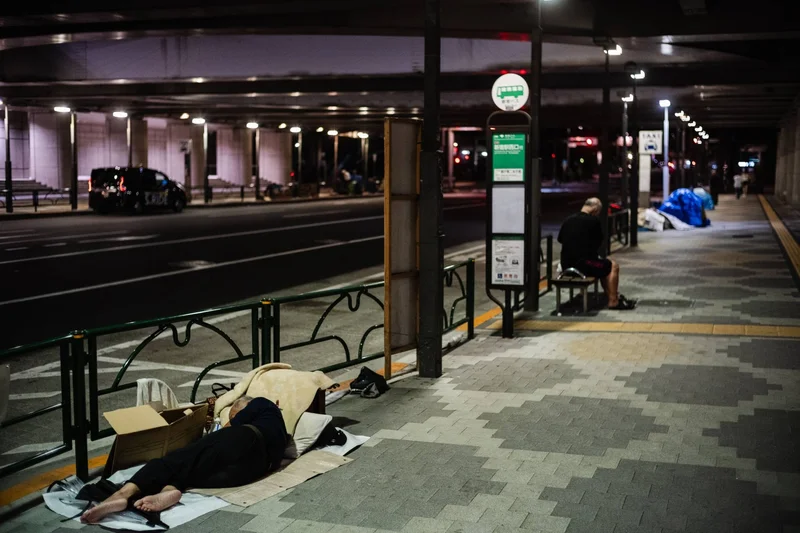
For Ito, an 82-year-old homeless man who lives around Shinjuku Station, Tokyo’s searing summer days require careful planning.
“I take my breakfast around here because the aircon is on, so it’s fresh and cool,” he says on a sweltering, humid Sunday evening.
“And then I have lunch around the Metropolitan Government Building. For dinner, I’ll receive food around here and go eat it with my friend upstairs,” he says. At night he and his girlfriend lay together, falling asleep near a station entrance.
Ito became homeless eight years ago after losing his construction job and the company housing that came with it. Now living on Tokyo’s streets, seasonal changes can bring not only unpleasant temperatures, but also danger.
After three consecutive years of record-hot summers, cities across Japan are seeing fresh highs once again in 2026 as relentless heat made worse by human-induced climate change envelops the nation.
At a time when temperatures are regularly reaching dangerous levels, new terms are needed to describe the weather. Earlier this year the Japan Meteorological Agency introduced the phrase kokushobi, or “cruelly hot day,” to describe temperatures surpassing 40 degrees Celsius. Last month, the term was used for the first time.
Such heat is becoming more deadly and dangerous. Between July 13 to 19, 10,857 people were transported by ambulance to hospitals for heatstroke, and each year more than 1,500 people die as a result of heatstroke, on average, far exceeding the toll of many higher-profile disasters like earthquakes and typhoons. Those age 65 or older make up the majority of heatstroke cases.
For the country’s largely elderly homeless population, the risks are pronounced, explains Junko Yamaguchi, of the Nihon University School of Medicine’s emergency and critical care medicine division, who is busier each year with heatstroke patients, including some who are homeless.
“Tokyo summer is very, very hot. I see many heatstroke patients admitted to the hospital. The temperature increases year by year, and high humidity conditions accelerate the risk,” she says, noting that homeless people face a severe risk of heat-related illness. Some have other underlying health conditions, mental health challenges or alcohol dependency, which can make treatment and prevention more complex, she says.
Japan’s growing ranks of older people are more at risk of heatstroke, and while it’s difficult to paint an accurate picture of the country’s homeless population due to an absence of comprehensive data, research shows this demographic is also aging rapidly. A welfare ministry survey conducted every five years found in its 2021 results that 34.4% of the homeless population was 70 or older, up from 19.7% in 2016. Other research has found that people age 60 and older made up close to 60% of the homeless population.
Authorities have warned the public to avoid unnecessary outings and advised people to stay in air-conditioned spaces, but for people who are homeless, this is often not an option.
Hiroshi Goto, a professor at Rikkyo University and a board member of Tokyo-focused nonprofit Sanyukai, co-authored a 2024 research paper on the issue, surveying homeless people in Japan about their survival methods.
“The effects of extreme heat are not experienced equally by everyone in society,” he wrote. “It is well known that people in socially and economically disadvantaged positions are more strongly affected.”
Goto found that due to stigma and shame, homeless people would actually “self-exclude” themselves from cool spaces.
“They become conscious of their appearance and body odor, and they may imagine that others are watching them,” the report said.
Goto tells The Japan Times that designated cooling shelters that are open 24/7 could help provide immediate help for those facing the elements, noting in his research that “the issue mentioned most frequently concerns sleep,” with his findings indicating that “many respondents were effectively unable to undertake any meaningful coping behavior during the night.”
Nighttime temperatures tend to stay stubbornly high across most of Japan, with overnight lows often remaining well above 25 C.
While there are some daytime cooling shelters available to the general public in the capital and other major cities, rights groups say these are not well publicized. And because many homeless people do not own smartphones, they may not be able to easily find such information. As a result they are underutilized.
In 2022, Neru Kaigi, a nonprofit aid and activist group, requested that Tokyo’s Shibuya Ward keep their shelters open at night in order to cater to the homeless community in the area, but the ward office declined to do so, telling the group that “extreme heat is not defined as a disaster.”
A spokesperson for Shibuya Ward said that its position has not changed.
“There are currently no plans to establish overnight shelters specifically in response to extreme heat,” the spokesperson says, noting that the national government makes decisions about the classification of the risks of extreme heat.
Tetsuo Ogawa of Neru Kaigi says that brutal conditions are unrelenting.
“Homeless people spend much of their day outdoors. Even if they have tents, they do not have air conditioning, and poor sleep and inadequate nutrition further increase their risk of heatstroke,” Ogawa says.
Aside from basic shelter, food is another key concern, and Goto says the dangers of having to travel to source goods during severe heat is another critical issue.
“For people who rely on soup kitchens or other food distribution services, the need to travel between different locations can itself become dangerous during periods of extreme heat,” Goto says.
Yuichi Kanno, a 69-year-old man who is homeless in the Shinjuku area, knows this all too well.
“I try to stay around places that have aircon, that could be libraries, could be trains, buses, those kinds of spaces,” he says as he fans himself while perched on a ledge. Kanno explains that, while he does have some food delivered, allowing him to eat with his friends who reside around Shinjuku Station, he also ventures out to other parts of the city to find meals, braving the weather.
This issue is not lost on grassroots support groups such as Tokyo Spring Homeless Patrol, which delivers food to Ito, Kanno and others in areas where homeless people congregate and reside in cardboard shelters.
Mathilde Dubois, who has been volunteering with the group for several years, wears a neck cooler as she passes out meals in the scorching heat. Most of the organization’s recipients are older men, she says, and the demand for food appears to be increasing.
While officially Japan’s homeless population is declining, economic pressures, such as higher prices for rent and food, have made more people’s lives financially precarious. Lower-income households, including those with young children, have been cutting back on their grocery bills wherever possible and limiting their use of air conditioning, according to a recent survey by nonprofit Kidsdoor.
Goto says while there are at times other factors, economic drivers are an underlying cause for homelessness in Japan, citing unemployment as “the main factor.”
“The number of people experiencing homelessness in Japan began to rise sharply around 1992. At that time, many people who had been working as day laborers in the construction industry lost their jobs and subsequently became homeless,” Goto says.
He noted that a more recent rise in the number of homeless people was due to people struggling to find jobs after the end of temporary employment, with some becoming homeless because of an unexpected injury, illness or inability to find work quickly.
The half a dozen homeless people interviewed by The Japan Times for this story all cited a mixture of job losses, loss of company housing, forced evictions, poor health or family issues as the reasons they ended up on the streets.
While Japan does have support systems in place, once someone becomes homeless — particularly when they are older — the pathway back to housing is difficult.
Goto says that age-related declines in cognitive ability and comprehension make it more challenging for older people experiencing homelessness to access and navigate support services.
“In Japan, landlords and real estate agencies are often reluctant to rent to older people because of concerns about issues such as people dying alone in their homes,” Goto says, noting that “older people experiencing homelessness may face even greater difficulty securing stable housing.”
A lack of sleep may also create a vicious cycle in which people do not have the energy to navigate or seek out supportive options.
Some, however, simply do not wish to seek support.
In contrast with Europe and North America, Goto says, “In Japan, many people experiencing homelessness try to avoid public attention, possibly because of the strong stigma and sense of shame associated with homelessness and asking others for help.” This may be a reason homelessness is less visible in Japan compared with other countries, he adds.
Ito expresses ambivalence about the notion of being housed once more, saying he is accustomed to his life on the streets. Others feel similarly, he says.
Those who seek help “receive welfare and they have a room, but then they’re in a different environment. They don’t know anyone. They’re lost, so they go back to what they’re used to,” he explains.
Misako Ichimura of Neru Kaigi says that there will always be people who fall through the gaps in the social security and welfare systems.
“Providing places where homeless people can feel safe is an essential condition for creating a city that leaves no one behind,” Ichimura says.
And while summer is frightening, equally worrying is extreme winter weather, Ito says.
“Because I’m thin, I’m very affected by the cold,” he says. “Even if I wear a lot of clothes in the winter, I’m still always cold.”