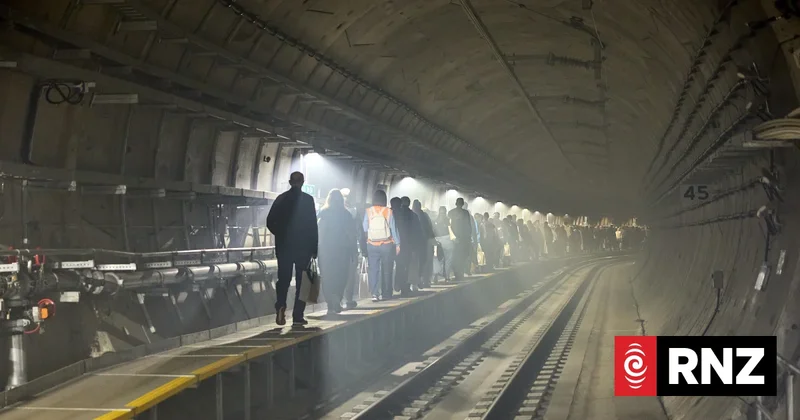
Explainer: There's never been anything quite like it in Auckland. But is it safe?
The $5.5 billion Auckland City Rail Link is New Zealand's largest transportation infrastructure project, and construction has been going on for the past 10 years. A confirmed opening date is finally expected to be announced soon.
Part of the reason for the long gestation of the CRL is its sheer complexity.
New Zealand's first urban underground rail system, it's a massive project that adds two 3.45km tunnels deep underground that will link Auckland's existing rail lines into one network and allow the rail system to almost quadruple its capacity.
It also includes two huge new underground train stations downtown and renovations to others.
Multiple entities are involved: Auckland One Rail runs the trains including the drivers, station staff and contracted security, Auckland Transport (AT) owns the trains and KiwiRail owns the infrastructure such as the tracks and signalling.
Once final approvals from NZ Transport Agency are given, commuters will have about six weeks' notice before CRL service begins.
About 16,000 tests have been run on the system, Auckland Transport says. These include everything from testing everyday operations like ticket gates and CCTV cameras to planning out complex emergency scenarios.
What could go wrong?
What happens if a train derails - or crashes into another train? What if there's an explosion deep underground? What if there's some kind of attack?
Given the nature of public transport, CRL organisers have had to prepare for everything. Imagine the worst, then work out how that might play in reality.
"When they designed everything, they thought through the worst-case scenarios for disaster preparedness," said Lisa D'Oliveira, Auckland One Rail's general manager for health, safety, quality, environmental, sustainability and security (or HSQES&S for short).
Simulations included station fires, train failures in tunnels, derailments, onboard medical incidents, multi-threat scenarios and complex evacuations across multiple stations.
Watch some of the live safety drills right here:
"The City Rail Link's underground environment, with tunnels more than 40 metres below ground in some parts, presents unique challenges around access, evacuation and communication, requiring specialist planning and coordination," said Glenn Gowthorpe, City Rail Link operational testing director.
Drill participants were often given little or no advance detail about what might happen, AT said, which allowed for more realistic responses to things like smoke-filled carriages or simulated injuries.
"We had over 300 people in one of the tests," D'Oliveira said.
"A number of them had real people come in and volunteer to be passengers and show us what passengers can do if they don't know what's going on. (People are) always a bit unpredictable, aren't they?"
D'Oliveira is confident that the tests have shown all the planning has paid off.
"With the testing, it reiterated that the design is robust."
Fire and Emergency New Zealand, NZ Police and Hato Hone St John ambulance services have also been deeply involved in the training.
"The priority for us has been making sure our crews are well prepared to respond safely and effectively when the City Rail Link becomes operational," a FENZ spokesperson said.
Where will the CRL be controlled from?
The Auckland Rail Operations Centre or AROC opened in Ellerslie in 2024 - it's the sister facility of the Auckland Transport Operations Centre on the North Shore that controls road traffic.
Befitting a place that makes the trains run on time, gigantic clocks are the first thing you see when entering the room, organised around a series of pods that control and monitor different aspects of the rail network.
Between 30 to 40 staff are typically on the floor at AROC, which operates 24-7.
"This site's function is to run the Auckland metropolitan train network," said Tim Waetford, KiwiRail's national network performance manager.
Have a look at how it all works:
The centre is set up to facilitate cross-agency coordination with the multiple groups involved in the CRL.
"If we get into disruption, if we have service failures in the network, they can get together and share all the information quickly and come up with the best recovery response possible," Waetford said.
Five control desks, each devoted to a different section of the rail network, are set up with dozens of screens filled with a dizzying amount of data that takes in rail schedules, deals with any reported issues, and keeps the whole system running.
Separate AROC sections keep an eye on the stations themselves, while hundreds of cameras monitor the tracks, platforms and around the stations.
An incident room for planning and response is also ready and waiting if any major problems affect the rail network.
Prior to AROC's opening, all rail traffic was controlled from Wellington. The Ellerslie facility is built to withstand extreme weather and a one-in-a-thousand-year earthquake resilience, with its own backup generators and the capacity to take up Wellington's work if that facility is compromised.
"If there was an event, both the operations centres have got huge resilience and redundancy to keep operating," Waetford said.
Are the new stations safe if something happens?
The new downtown stations are impressive mixes of design and utility.
The Te Waihorotiu station on Albert Street is expected to be the country's busiest station, with an estimated 19,000 people per hour at peak times. The underground location of Te Waihorotiu and the nearby station on Karangahape Road adds to their complexity.
"It's worth remembering that Karanga-a-Hape Station is 33m below ground - roughly the height of a 10-story building, and that creates real challenges in an emergency," City Rail Link chief executive Pat Brockie has said.
There have also been an additional 900 CCTV cameras added to the nearly 5000 existing AT cameras around the city.
Each station includes several "hidden" systems that can help in case of emergency such as alarms, cameras and fire or gas suppression.
A sump pit can collect water in case of flooding, while uninterruptible power supply rooms have back-up batteries in case of any power outages. Huge fans can clear smoke quickly if there's a fire.
Behind closed doors, there are emergency stairs and a secure evacuation holding area that can hold people temporarily if needed, even including spaces for wheelchair users and communication boxes back to AROC facilities.
There are also bright orange "safety points" boxes spread throughout the CRL. The help button on them connects people to AROC. It won't connect directly to emergency services, so if people are in immediate danger they should contact 111.
There are also plenty of signs reminding people of other rules. You can bring your dog into the CRL, but it must be leashed and muzzled, and don't try to ride the escalators barefoot, mate.
There are safety rules that might seem a bit odd at first - for instance, don't bring helium-filled balloons into the stations. This is because they can hit high-voltage power lines.
Keeping safe on the tracks
The most common kind of incident the trains deal with is people trespassing on the tracks.
There's no one way to prevent people from taking chances, but a combination of education, tech-based alerts and increased security aim to deal with the problem.
At Auckland's level crossings in the decade between 2013 and 2023, Auckland saw almost 70 crashes, plus over 250 pedestrian near-misses and 100 vehicle near misses.
With the increased traffic the CRL will bring, there's a long-term plan to remove level pedestrian crossings around Auckland and replace them with rail overbridges or underpasses.
People often radically misjudge how fast trains can approach and sometimes take dangerous chances trying to get to their train, D'Oliveira said.
"They look and they say, I can't see anything so I'll just jump across to the other one, rather than climbing up the stairs."
In the new CRL underground stations multiple measures are in place. An alert goes off if passengers cross the yellow safety line on platforms before trains come to a full stop.
"If anyone pushes open a platform end gate or gets onto the track, then instantly they get an alert to say that someone was there, and there's some purple beacons that start rotating in the tunnel so the drivers can see and they can slow right down to a walking speed," D'Oliveira said.
What about the possibility of violence?
Earlier this year, RNZ reported that in 2025 there were 2161 reported incidents of "aggression, violence, racism, discrimination, and inappropriate behaviour" on Auckland public transport including buses, trains and ferries.
Some of those 900 new CCTV cameras will be monitoring antisocial or dangerous behaviour. Artificial intelligence will also soon be a tool.
"There's a lot of work going into AI as well, because obviously you can't keep an eye on every camera when you've got that many cameras, so it's the sort of stuff that's going to alert these CCTV operators as to what they should be looking at," D'Oliveira said.
Security staff and transport officers will be visible on platforms, in stations and on trains. They don't have arrest powers but are trained in de-escalation techniques and incident management and escalating to police when necessary.
NZ Police's Auckland Central area prevention manager Inspector Mark Clayton said police are also well prepared and will be monitoring the areas around stations.
"For police, our deployment in the CBD is focused on being highly visible in busy public spaces, and this includes public transport hubs. We regularly have our staff patrolling through busy high profile areas in the central city area."
He said police would work closely with station security guards and transport officers.
"Police will continue to respond and deploy to demand prioritising criminal and unlawful antisocial behaviour including on public transport in support of our partner agencies."
Billions of dollars have been put into this - will it improve rail's reliability?
A frequent complaint heard about Auckland's current rail network is its frequent shutdowns. The system has been closed repeatedly during the CRL build, including for an entire month over Christmas.
But day one of the CRL will "open a new chapter for rail in Auckland," said Rachel Cara, AT's group manager of public transport operations.
"I think it's important that we acknowledge the disruption that Auckland train commuters have had over recent years with a number of closures and some extended closures throughout the calendar year, not just the typical Christmas/New Year block," she said.
AT "absolutely acknowledge that customers may have lost confidence in the train network, but all of that work is being done to provide a reliable train service once CRL opens."
CRL organisers told RNZ the whole network would not be closed again anytime soon.
"What we can say for sure is that there's no full network closures for the foreseeable future," KiwiRail communication manager Jo Reeves said.
There are still partial closures planned for later this year that will be well publicised. Auckland Councillor Mike Lee called more closures "unacceptable" at a committee meeting last week.
"If this sort of disruption is going to carry on there's going to be a real problem... from the people of Auckland," Lee said. "That is just not acceptable."
KiwiRail chief metro officer Bevan Assink said partial closures would be planned with as few disruptions as possible.
"We have consistently said that short partial network closures will still be needed on the Auckland network from time-to-time post-CRL opening," Assink said in response to Lee's criticisms.
"Routine maintenance can generally be carried out at night or while trains run on a single line, but more intensive work or upgrades will require short partial network closures, planned well in advance - in line with other busy networks across the globe.
"Following an intensive period of upgrades and associated closures to prepare the network for CRL, the metro is in much better shape to support increased services without the need for full network closures in the foreseeable future - bar major weather events or other circumstances outside our control."
Okay, but we're all waiting for an opening date. Are they nearly ready?
"We've tested, we've tested on desktops, we've tested in real life, we've got people working collaboratively," D'Oliveira said. "We've got good numbers of people established in the stations to support our passengers."
"We're as prepared as we can be."