- READ MORE: Burnham MUST scrap 'disastrous' pro-union strike laws
- See more Daily Mail on Google - save us as a Preferred Source
Labour's policy uncertainty and 'constant speculation' about tax is damaging business confidence, a report warns.
The Institute of Directors (IoD) said cost pressures and political upheaval had led to forecasts sagging among business leaders.
A poll of more than 500 bosses found confidence remained subdued, with a 'modest deterioration' in July compared to the previous month.
IoD chief economist Anna Leach said: 'Looking towards the autumn, there's a risk that cost pressures rise further in light of renewed conflict in the Middle East, reinforcing the squeeze on households and businesses.
'Businesses also note that policy uncertainty has worsened as the UK undergoes a further change in political leadership.'
Leach said businesses wanted an end to 'constant speculation' about taxes - especially those that could hit Britain's investment climate - and engagement with the Government over its workers' rights laws to try to avert damage to growth.
It comes as a separate report from accountancy giant EY warned that a prolonged closure of the Strait of Hormuz could tip the UK economy into recession and send inflation soaring above 6 per cent.
EY said that growth had been more resilient than expected so far this year and under a central forecast the UK will grow by 0.9 per cent this year and 1.2 per cent next year.
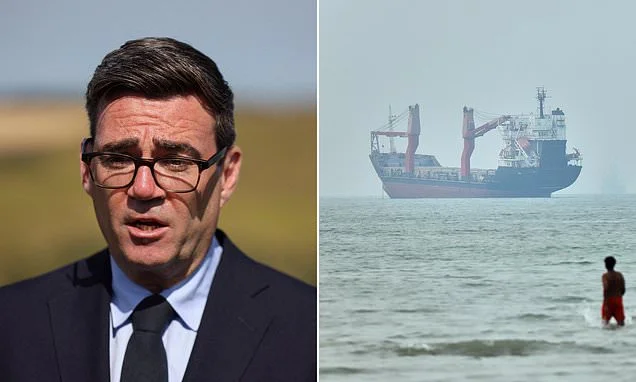
A report by the Institute of Directors (IoD) warns that policy uncertainty, constant tax speculation, and rising cost pressures under the Labour government are damaging UK business confidence, which deteriorated slightly in July. Pictured: Prime Minister Andy Burnham
Ongoing conflict in the Middle East and the closure of the Strait of Hormuz threaten to worsen cost pressures, squeeze households, and undermine Britain's investment climate
That is based on the Strait of Hormuz, through which a fifth of the world's oil and gas passed before the war, reopening by the end of September.
But the report outlines a separate scenario - which looks increasingly likely after the collapse of the fragile ceasefire between the US and Iran - where the strait remains closed into next year.
In that case, GDP is expected to grow by 0.5 per cent this year and shrink by 0.2 per cent next year.
EY's forecast for inflation is also dependent on the war - with a prediction that it will climb to only 3.5 per cent if peace breaks out but spiral to 6.4 per cent should the strait remain closed.
Brent crude surged from $72 (£53) a barrel before the war to $126 (£93) in April. More recently the resumption of hostilities has seen it hit $100 (£74), before easing back to around $90 (£67).
EY's UK chief economist Peter Arnold said: 'If the Strait of Hormuz reopens in the coming months, we expect the UK to avoid a more pronounced downturn, but an extended closure into 2027 would raise inflation and could push the economy into contraction next year.'