In his Instagram reel posted on July 23, Prime Minister Narendra Modi declared that the government had acted with great speed to reconduct the 2026 National Eligibility cum Entrance Test. “Just five-six days ago, the results were announced,” Modi said. “And there is good news from across the country of students who have passed.”
The prime minister’s post was aimed at assuaging the anger of protestors across the country, who were targeting the government for failing to prevent the leak of the paper of the first exam, held in May.
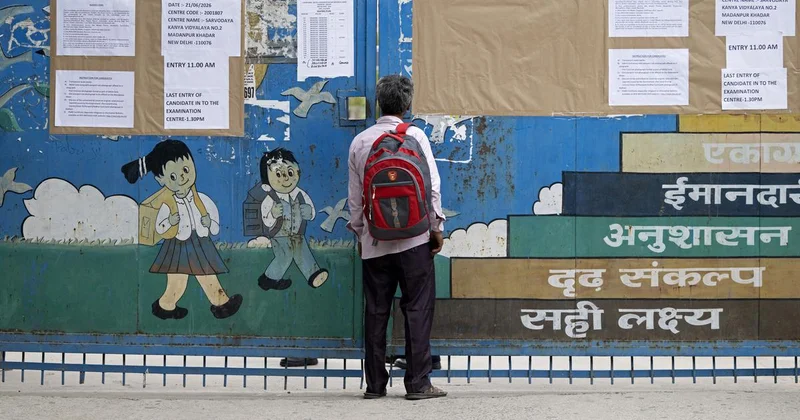
In his note on X two days later announcing his resignation as education minister, Dharmendra Pradhan, too, emphasized the reconduct of the exam. He stated that “with the cooperation of students, guardians, and parents, this examination was successfully completed on 21 June 2026”.
But despite these self-congratulatory statements, for many students, the process has been nerve-wracking, and has compounded a year already marked with immense stress.
Within a few hours of the results being announced, students, and those speaking up for them, took to social media to point out various errors and discrepancies they had encountered. Some said optical mark recognition answer sheets that the NEET portal was displaying did not match their answer sheets. Others said they were unable to__ download their marksheets. Still others said they were finding that the __score displayed on the portal was changing each time they logged in.
Among them was a student from Haryana. The student noticed that the OMR response sheet on the NEET portal did not match his original answer sheet. Further, as the student later noted in a petition before the Delhi High Court, he found that his results changed three times in a matter of 24 hours.
The student said that after the exam, he had checked his answers with the provisional answer key published by the National Testing Agency, and estimated that he would get 620 marks. A few days later, the agency gave students access online to scanned copies of their answer sheet too – again, when he checked his responses against the provisional answer key, he arrived at a similar estimate for his final score.
But to his surprise, on the day of the result, he found out that he had scored 650 marks. His petition notes that soon after, he was “automatically logged out by the system” On logging in again, he “found that his score had changed to 500 marks”, the petition stated.
More shocks awaited him the next day, the petition stated, when he found “that his score had drastically reduced to 135 marks”.
The student immediately wrote to the National Testing Agency, but, he noted in his petition, he did not receive any satisfactory response to his emails.
He visited the agency’s office in Delhi, where, he said, he was shown an answer sheet that did not belong to him. “Instead of investigating the grievance, officials allegedly informed the petitioner that the displayed OMR sheet was the only one available in their records and that even if he approached the court, the same OMR sheet would be produced,” the petition stated.
Aggrieved, the student filed the petition in the Delhi High Court, asking that it direct the National Testing Agency to produce his original answer sheets before it. The court ordered the agency to do so, and it complied on July 3.
The student’s advocate Vineet Jindal told Scroll that when these documents were examined, they were found to be different from those that had displayed online earlier. “This raises serious questions about the authenticity and consistency of the records,” he told Scroll.
On July 31, the court granted the student the liberty to legally challenge the National Testing Agency over his results in the exam.
Scroll spoke to other students who took the re-exam and encountered similar glitches and errors. Their accounts suggest that the government’s claims of successfully conducting the re-exam are likely misplaced, and that many aspirants remain wracked with anxiety about their future. We emailed the National Testing Agency, seeking its responses to these reports of errors – this story will be updated if it it responds.
Many problems, no responses
One student from a North Indian state, who asked not to be named, recounted that he had marked three dots on the top of his answer, so that he would be able to identify the scanned copy online later. Those dots were missing from the scanned copy that displayed on the portal, he said. “The very reason I made those dots is because I wanted to be able to be sure that the answer sheet was mine,” he said.
Indeed, the student said, the answers marked and evaluated in the scanned sheet did not match the answers he remembered marking in his answer sheet. “I had checked the answer key and calculated my marks and estimated that I would get 679 but then my OMR is showing only 179 marks,” he said.
He also noticed what appeared to be another inconsistency. “We were told clearly that we are not supposed to overwrite any details but in my OMR sheet, it looks like someone tried to write on top of my name,” the student said. “It also looks like somebody tried to copy my handwriting.”
He, too, has written to the National Testing Agency about these errors, but has not heard back from them yet.
Another student, from Delhi, who also asked not to be identified, said that when the results were announced, he was unable to access his results because there was a technical problem with the website. His friend logged in on his behalf and was confused by what he noticed: it displayed two scorecards with two different scores. “One of the scorecards mentioned my category as general and my marks were 343, and the second scorecard mentioned the EWS category under which I got 133 marks,” the student said, referring to the economically weaker section category. “So I was left feeling very confused.”
The next day, when the student logged in again, one of the scorecards was missing. “The one with the lower marks was what was still appearing,” he said. The student immediately wrote to the National Testing Agency seeking a clarification, but has not received a response yet.
Apart from being stressed about these glitches, the student is also discouraged because he feels he performed far better in the first round of the exam, after which he estimated he would score around 525. “After the leaks happened and the retest was announced, I was very disheartened and didn’t do as well in the second round,” he said “But thought I may get around 460.”
The student has enrolled in a BSc course because he feels waiting for the National Testing Agency to respond and address his concerns is going to be fruitless.
Even in instances when the agency did respond, some __students __have not had their problems resolved.
One X user posted a screenshot of an email from a student from Maharashtra. She recounted that she found that her score of 190 on the portal was lower than expected, and so wrote to the agency, asking for a copy of her answer sheet. In its first response, the student said, the agency sent her the wrong sheet, corresponding to the one on the portal. When she emailed them a second time, she was sent the original one – according to this sheet, her score was 434. But, she noted, the website still reflected the marks that were initially assigned to her, and she had not received any response from the agency about rectifying the error.
The agency’s response online
Even as some students await resolutions to their problems, online the National Testing Agency has taken a fairly aggressive tone in responding to students’ posts. Among the claims it repeated were that some students were raising complaints using scoresheets that had been doctored using artificial intelligence.
“The NTA announced on X that some of the students had sent AI manipulated scorecards to them and claimed to have been given wrong marks,” the student from the North Indian state said. “After that, the NTA issued strict warning about sending AI generated scorecards. But there are also people like me with genuine problems, but it hasn’t addressed it yet.”
In one series of posts on X, the agency addressed the claims of five students who had posted on the platform about their concerns. In its posts, the agency cited the name and application number of the students, and stated that the OMR sheets that the students had shared was a “digitally altered version of the genuine OMR sheet”.
It stated in one post, “In the wake of many OMR sheets submitted for scrutiny turning out to be fake/AI generated, students and parents are advised to submit only original OMRs for scrutiny. Any fake/AI generated OMR may invite legal action against the complainant.” Some X users responded to these posts with threatening, abusive posts.
Jindal said that around 40 students had approached him with concerns about their marks. However, only three students had considered legal action, he noted. The advocate said most students feared being harassed on social media and were therefore scared to go public with their concerns. He added that they are worried that taking legal action will harm their career prospects.
“After the NTA’s warning and seeing the reaction of people on social media, students are scared to come out or even pursue legal action,” the advocate said.
We welcome your comments at letters@scroll.in.