- See more Daily Mail on Google - save us as a Preferred Source
A Cambridge professor embroiled in a plagiarism row seemingly claimed he was in TV series Seven Up – then backtracked when told it was broadcast decades before he was born.
Jason Arday became a poster boy for diversity as the university's youngest black professor, but is now facing questions about his academic record and bizarre claims.
Critics have accused the 41-year-old of taking chunks of his PhD thesis from research by another student, leading him to last week admit a series of errors in his work.
But he insisted he was not a 'liar' after doubts were raised about his sensational list of personal achievements, which include running 600 miles in six days and raising millions of pounds for charity.
Now footage has emerged from a talk he gave in 2022 in which he claimed to have appeared in the TV series Seven Up.
The landmark show has followed the lives of the same group of people every seven years from the age of seven since 1964.
Professor Arday told the University of Bath's Race Equality Taskforce: 'I was part of a programme which doesn't really exist any more, but was called Seven Up at the time.
'Seven Up is basically when they follow you over the duration of your life, so they follow you at seven, 14, 21. I was pulled out of the project when I was 14.'
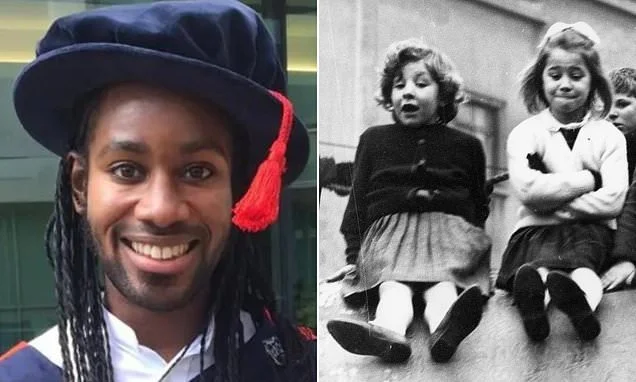
Jason Arday became a poster boy for diversity as the university's youngest black professor, but is now facing questions about his academic record and bizarre claims
Footage has emerged from a talk the professor gave in 2022 in which he claimed to have appeared in the TV series Seven Up (Pictured: The original Seven Up show which aired in 1964)
Seven Up was first broadcast two decades before Professor Arday was born in 1985.
The original 14 participants would have been born in 1956 or 1957. The Seven Up project is scheduled to end this year.
He also would have been too old to have featured in a series launched in 2000 by the BBC – Up Millennium Generation – which followed individuals who were seven years old at the turn of the millennium.
Last night Professor Arday said that when he talked of 'Seven Up', he didn't mean 'Seven Up' the famous TV series, which followed children at seven-year intervals in the format he described. He says he in fact he was referring to 'a local community and parent-led initiative developed around the Ubuntu principle that 'it takes a village to raise a child'. It was organised by Black women to support Black mothers raising children with complex learning needs.'
He asked that we attribute the quote to 'a source close to Professor Arday'.
'The reference to "Seven Up" was used informally as a shorthand illustration of the concept. It was not intended as a literal comparison and should be understood in the context in which it was made. Attempts to present the phrase in isolation risk creating a misleading impression of both the initiative and Professor Arday's comments,' Professor Arday said.
A BBC spokesman on Sunday confirmed Professor Arday had 'nothing to do with our films'.
Appointed to Cambridge aged 37, the professor of sociology of education has had a remarkable life that, according to talks he has given, has seen him overcome a raft of challenges.
Critics have accused Professor Arday, pictured on This Morning in 2023, of taking chunks of his PhD thesis from research by another student, leading him to admit errors in his work
Raised in south London by working-class immigrants from Ghana, he was diagnosed with autism, dyslexia and 'global development delay' at a young age, and was non-verbal until the age of 11.
He has described only learning to read and write at 18, but went on to enrol in a BTech course before studying for a degree in PE and teaching, followed by two Master's and, ultimately, a PhD from Liverpool John Moores University.
He taught at four universities prior to Cambridge but his elevation to such a high-profile institution sparked scrutiny, which led to allegations of plagiarism in his 2015 PhD thesis last year.
Liverpool John Moores University cleared him of academic misconduct, but there have been calls for a fresh inquiry after critics uncovered scores of 'plagiarised' passages in his work.
An investigation by The Guardian at the weekend cast doubt on a claim he made that a pig's head was sent to his home in a campaign of racist intimidation.
Professor Arday said police investigated the matter but this was denied by the Metropolitan Police.